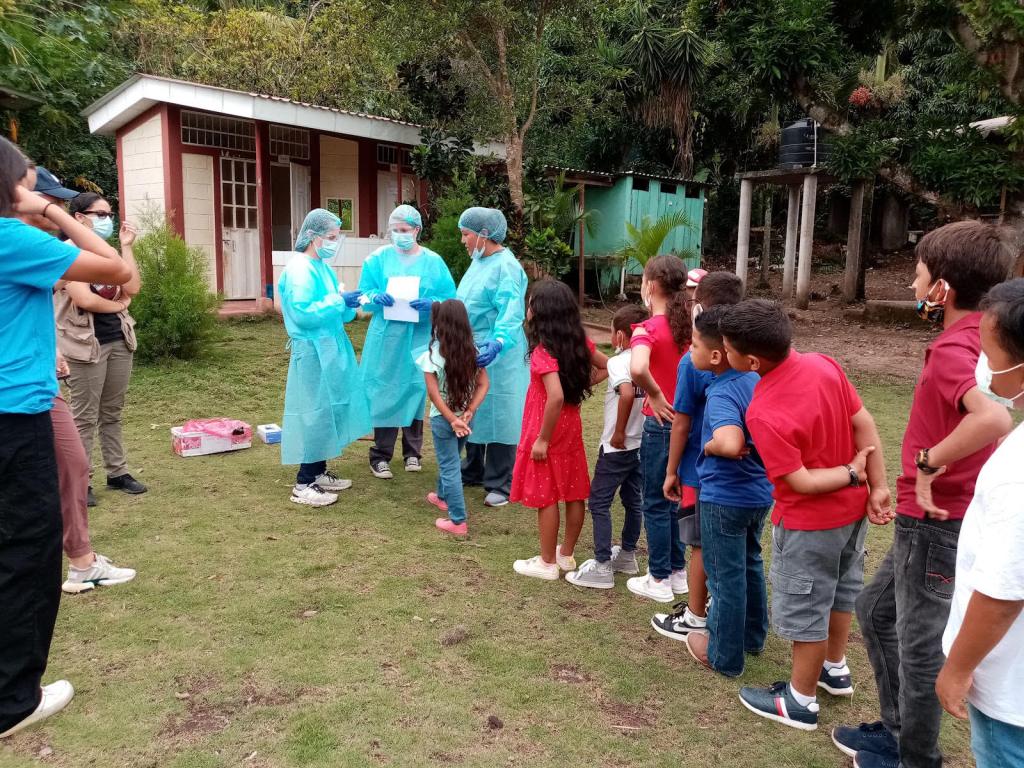
Students create connections and provide health care in Honduras
LILI KIM / ASST. NEWS EDITOR
For many students, summer is a time to kick back, relax and prepare for the upcoming school year. For the USD Medical Brigades chapter, however, summer served as a way to support communities in need. In August, 10 students from the USD club traveled to Honduras for a week-long “brigade,” or service trip, to holistically support a small, rural community.

Photo courtesy of Allison Marquis
USD Medical Brigades acts as a chapter within the nationally recognized Medical Brigades, a subdivision of the nonprofit organization Global Brigades. While the organization originally began its work in Honduras, efforts have now expanded to other countries such as Panama, Greece, Guatemala and Ghana.

Photo courtesy of Allison Marquis
Within these countries, Global Brigades workers, volunteers and student groups partner with local community health workers to provide care that citizens may not be able to access, including medical and dental care, fresh water, proper engineering and infrastructure. The intentions, passion and commitment to the Honduran healthcare model are what set this group apart from other organizations and missions, according to USD senior Allison Marquis, who serves as Co-Presidentof the USD Medical Brigades. “It’s all community led,” Marquis explained. “If anything, we are learning more from [the community] than they are from us. We’re there to support their community in whatever way their community leaders think is necessary.” Due to COVID-19, the USD Medical Brigades branch has not been able to travel abroad since 2019. In the meantime, they engaged in “tele-brigades,” allowing students to work virtually with patients and shadow healthcare workers from afar. Transitioning back from telehealth to traveling across the world entailed a great deal ofeffort, according to USD senior and Medical Brigades Education Chair, Paulina Castellanos. Casetellanos recounted her work toward making this trip happen. “Coming from COVID, we had to work hard to discover our ‘why’ and ‘how’ and make sure our intentions were aligned with the global organization.” To do so, Castellanos led sessions for the club to help dismantle “white savior complex” ideologies, such as beliefs of superiority or providing support without consideration of cultural differences. She also taught members introductory medical Spanish, in order for the group to better connect with patients and work together with the Honduran doctors. “Learning the language, culture and the public health model they’re operating under [in Honduras] all help you care for these communities the way they deserve,” Castellanos said. Medical Brigade members also chose to invite USD adjunct professor Dr. Víctor Zambrano, who has taught Spanish at USD since the late 1980s. While some professors may have chosen to takecontrolasanauthorityfigure, Dr. Zambrano emphasized his involvement as a part of the team.
“My role is to anticipate and give students tips on how to address different issues, rather than tell them what to do. I let them lead the brigade, and become leaders.”
During their one week brigade, the club traveled to two small Honduran communities. First, they visited Los Hatillos, where the team worked with the community to construct eco- stoves for six local families, as a way to decrease the chances of respiratory illnesses and housefirescausedbyopenflamestoves. They then transitioned to their main focus of the trip: working for three days in Escobas Amarillas, a rural village in the Honduran rainforest with a population of around 300 people. There, the team worked with Honduran healthcare professionals to set up various medical stations, including triage, dental, medical consultation and pharmacy. Also available for community members was a “charla” station (Spanish for chat), which educated on hygiene, anxiety and nutrition.
For many Honduran civilians, this brigade was the first chance to receive medical care all year. Since many students in the club are on the pre-med track, it was also their first opportunity to perform medical treatments in real-life scenarios. For example, Allison Marquis described her ability to stitch a patient’s hand with sutures with guidance from a local Honduran doctor.
“It was the coolest thing I’ve ever done,” Marquis stated. Beside aiding in medical efforts, students also had a chance to connect with community members by practicing their Spanish or engaging in casual games of soccer with kids.
When the time came for students to return to the U.S. for the fall semester, they reported gaining a fresh perspective of how cultures around the world approach healthcare and how it relates to healthcare in the U.S., as well as different lifestyles on the whole.
“We can learn a lot from other countries’ health care systems,” Marquis said. “You can’t assume that all patients have access to clean water or other resources, so when you’re prescribing something, you have to think about what’s attainable for the patient. And that’s applicable for our health care system, too.”
Now that the team is back on campus, they plan to continue their work by fundraising for the next brigade planned for the summer of 2024, which students of all majors are eligible to join. They will also continue to engage in team building and community outreach in San Diego. These outreach efforts include working with the homeless population in the city, as well as with the Juvenile Diabetes Research Foundation (JDRF), a nonprofitsupporting childhood diabetes.
“You don’t have to travel eight hours on a plane to realize there are disparities in our healthcare system, too,” Castellanos also noted.
Even though the Honduras trip is complete, the long- term, sustainable effects of the students’ work, and the connections they made with the community of Escobas Amarillas will continue on indefinitely.

 The USD Vista
Leave a comment