
KATIE FOREMAN / FEATURE EDITOR
Correction:
Last week, The USD Vista (9/14/23) incorrectly printed Lili Kim as the Assistant Feature Editor. She is the Assistant News Editor. We regret this error.
Dr. Antonieta Mercado holds many identities — being from Ciudad Nezahualcóyotl, Mexico, an immigrant to the United States, a first generationcollege student with a doctorate, a professor at USD, an artist and many more. Navigating these varying identities has come with struggles, but through analyzing and questioning these different facets of who she is, she has found her passion in life: learning.
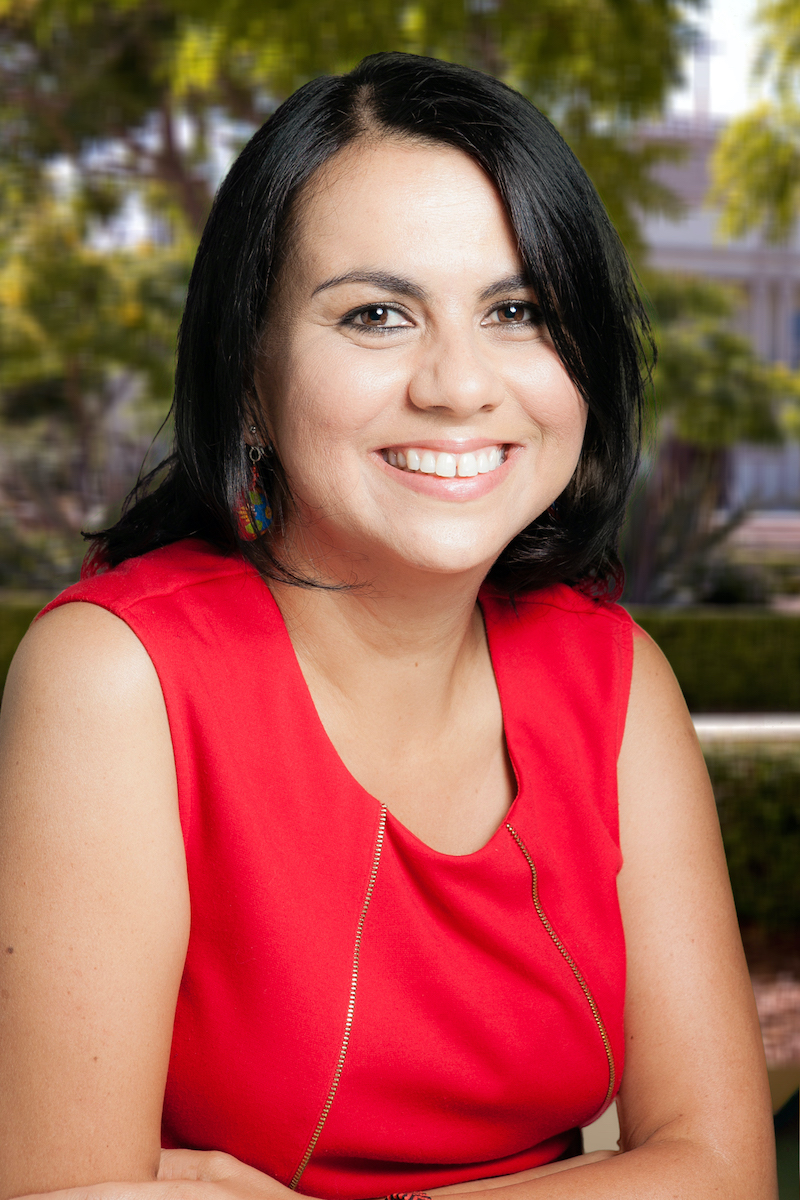
Photo courtesy of www.sandiego.edu
Mercado spent the first 23 years of her life in her hometown in Mexico and then moved to San Diego. Her father attended school until fourth grade, and her mother did not learn to read or write until she was an adult, but her mother especially wanted her daughters to complete school. Although nobody in her family had gone to college before, Mercado said that the teachers she had in her childhood inspired her to further pursue her education.
“Because of my teachers in elementary school and in secondary school, I could envision myself going to college,” Mercado said. “Because of that, I was like, ‘this is so cool. This is liberation, right?’”
After getting her bachelor’s degree in political and social sciences at the National Autonomous University of Mexico, she moved to San Diego, but it wasn’t until a few years later when she decided to continue on with her education. Mercado received her master’s degree in Communication at San Diego State University and her doctorate degree in Communication at University of California, San Diego.
“A lot of what I learned in school was liberating in a way. It gave me the world, basically. It gave me a lot of tools to get to know the world. But for a long time, I was not being reflected,” Mercado said. “My particular history and the struggle even in my own family — I come from a mixed family — even those histories were not reflected in my education.” Mercado also noted that — throughout her schooling — there was a very Eurocentric approach to the world and she questioned if that was really what resonated with her life and her history. A Eurocentric approach is one that centers around the idea that Europe is the dominant leader of the world/center of the world and whiteness is valued.
“I have invested a good chunk of my adult life unlearning a lot of what I learned,” Mercado said. “Unlearning can be painful sometimes. I mean, hopefully not always. But there is some discomfort along the way…I was learning all these things that were hegemonic, and I was so well versed. I did very well on this hegemonic knowledge. But this knowledge doesn’t represent me. So I had to really find which knowledge represents my experience.”
Hegemonic knowledge was defined by Mercado as a dominant viewpoint in society being spread as the only valuable perspective and she wanted to challenge that idea. Mercado began to work with different humanitarian organizations in San Diego and would investigate the narratives of immigrants from Mexico and the U.S. to see if there were any commonalities between them. This passion for learning more about people’s stories and identities and how they were also represented in the media led Mercado to co- create “Comparative Race/Class and Gender Formations and Popular Culture” with Dr. David González-Hernández, Professor of Communication at Instituto Tecnológico y de Estudios Superiores de Occidente (ITESO) Guadalajara. This binational project was made to exhibit the ways that colonialism has constructed race, gender and class around the world and how this is shown in the media. She also is a founding member of USD’s Decolonization Working Group, which started in 2015 as a discussion of Columbus Day and its implications for indigenous people.
“We [the Decolonization Group] get together periodically, in the semester a couple of times and we discuss these issues,” Mercado said. “How do we frame our research and what do we do? As you know, many of us who are persons of color who have been put at a disadvantage by colonialism, talk about it. How have we been living?”
Mercado has continued on this anti-colonial work through scholarly pursuits with her most recent project “Comparative Intersectionalities,” a collaboration between her and her colleague Dr. Gonzalez-Hernández.
Mercado said her goal in this new project is “to talk about colonialism, to talk about the effects of colonialism in different places, but also to highlight the differences in how those things are different.”
Mercado finds significance in calling out the impacts of colonialism to challenge the hegemonic knowledge that is often taught. “Doing these comparisons of what colonialism looks like and how discrimination due to colonialism looks like in different parts of the world and how people who have been colonized have received this colonialism. Or what does it look like? That’s the sentiment, right?” Mercado said. She values shedding light on these topics for others to discover what their identities are and how colonialism has shaped their story.
“Inclusion is not the only thing that we are aiming for, but also representation that is dignified,” Mercado said, in regards to the media. Her scholarly work, as well as her activism in the community and intersectional approach to teaching, have been noticed by USD senior Sarah Siegel, who has taken two of Mercado’s courses.
“I admire her teaching — she brings a really unique perspective to all the discussions and she always incorporates her culture and experience with indigenous people,” Siegel stated. “She always integrates other cultures into her discussions and goes outside the Eurocentric view.” Siegel said that Mercado is never one to judge and is always open to hear everyone’s experience.
“My first impression was that she was super into hearing our personal opinions and experiences and she cared a lot about how we’re feeling,” Siegel said. “She made sure that we all had the resources to be involved in the class for the day. And she was really friendly and inclusive to everyone.”
Siegel appreciated the work Mercado does in and out of the classroom and has valued having a professor who truly wants to get to know you for you.
What motivates Mercado the most are the relationships she has built along the way.
“My favorite thing is the relationship with the students,” Mercado said. “There’s so much value in that and showing the students the world and seeing how they take it…I have developed so many relationships along this road. And that’s the thing that drives me, both with the students and with people in the communities that I study with. I don’t see them as subjects of research.”
Mercado shared a phrase that her father would tell her when she was growing up: “richness is your people; that’s your wealth.” She has lived by these words and they have molded her into the person she is today — someone who has deep love and empathy for the world and those around her. She defined herself as rich in life, for she is surrounded by people whom she truly cares about and wants to inspire.
Mercado is a woman of many talents who managed to turn her struggles into her life’s work. By taking an intersectional approach to the world and colonialism, she is exhibiting new ways of thinking and experiencing life to others.


 The USD Vista
Leave a comment