Toreros don’t know what Associated Student Government does
At the end of spring semester 2023, USD’s Associated Student Government (ASG) held elections for the following year. However, this most-recent election season was missing an aspect that usually comes with elections: campaigning. Last spring there was only one person running for president of student government, and one running for vice president. Most of the other positions had the same number of people running as positions available, if not less, with the exception of at-large senators, which had seven open positions and 12 candidates.

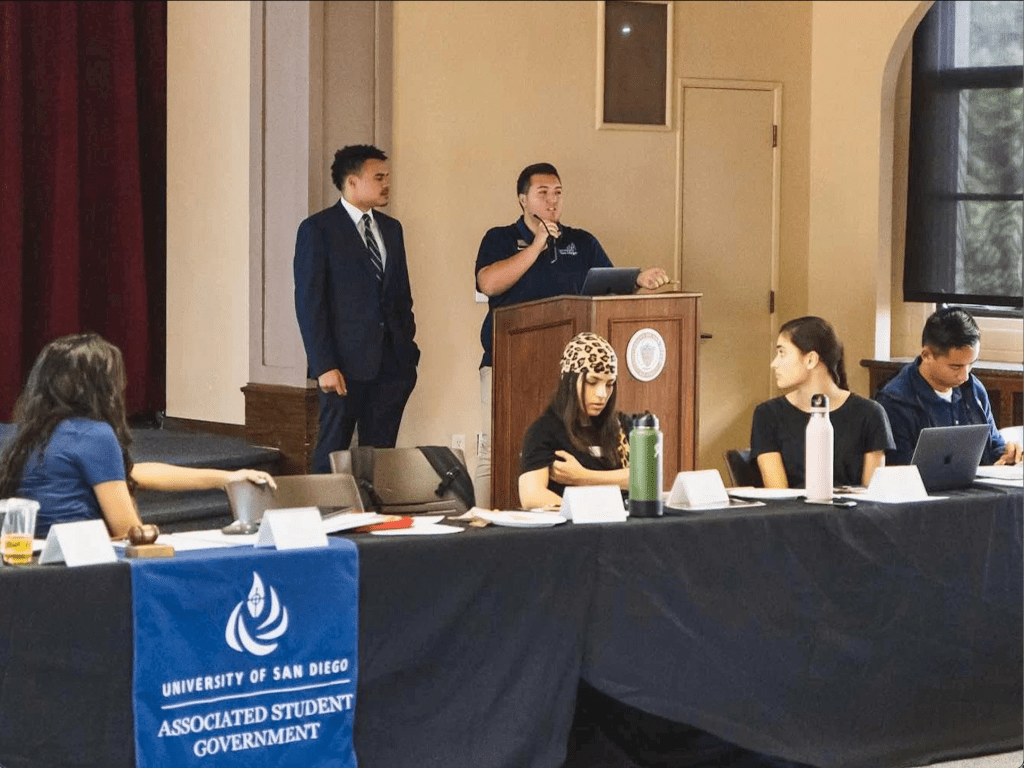
ASG has four equal branches. The Executive Branch is led by the President, Andres Fernandez Perez. The Legislative Branch includes academic, residential and at-large representatives. The Judicial Branch manages disputes with ASG. The fourth branch is the Torero Programming Board, which organizes events for students.
This fall, ASG elections continued with 18 senate positions to fill, both for first-year representatives and remaining spaces that hadn’t been filled from the spring. ASG moved the voting registration time to after the Alcalá Bazaar, to encourage more students to register to run in the elections. This election, some students running for representative spots created posters which were posted around campus and on social media.
ASG held a two-day voting period and had two events to incentivise voting: giving away doughnuts on Sept. 20 and dole whip on Sept. 21 to students who voted in the election.
According to ASG, this fall the total number of votes in the ASG elections was 755. Last spring semester the ASG president race recieved 323 votes, and the vice president race received 295 votes although the races were uncontested.
USD senior Andres Fernandez Perez is the president of ASG; he explained that the majority of USD students are not involved or aware of ASG, but he would like to change this perception.
“I think that the student body doesn’t know much about ASG and isn’t aware about a lot of the things that we do,” Fernandez Perez said.“There is a perception of ASG that we’re just kind of a money-authorizing organization. And myself and the rest of the team on all four branches really want ASG to be a not seen as just a money-authorizing group, but we are ones that can really help students on all issues.”
USD sophomore Gabbie Arellano confirmed this perception of ASG’s role as solely for money authorization.
“I don’t think about it [ASG] until I need to go to request funds for clubs,” Arelleno said. She added that she rarely sees information or posters for ASG.
However, USD first-year Jordan Romo disagreed with Arellano’s statement.
“For promoting [events] they are very consistent. I always see their stuff on social media,” Romo said.
Arellano voted in the elections this semester because her friend was running; however she didn’t vote on any of the positions her friend wasn’t running in. She explained the reason for this.
“I feel like I didn’t get information on any other races, but my friend’s,” Arellano said.
USD senior Olivia Mummery did not vote at all in ASG elections this fall or last semester.
“I didn’t know any of the people. I guess if I knew or recognized any of the people, maybe I would have,” Mummery said. “It’s not advertised super well. Maybe if there were more posters or signs, more people would know about it.”
Despite not seeing information on voting, Mummery expressed that she thinks ASG is very present on campus.
“They do a really good job planning events. I’m always walking around campus and whenever they have stuff set up it’s so fun to just go and see what’s going on. They do a really good job engaging and planning things.”
Fernandez Perez explained the reason he thinks student participation in ASG is low. He said that athletics and student government face similar challenges with low student buy-in. He attributes this issue to the wealth of things to do in San Diego.
“In San Diego, we have a lot of amazing things to do: there’s the beach, the city, so many different neighborhoods and so with that comes a cost at our particular attachment to campus.”
Fernandez Perez said that he believes this is also the reason school spirit is often low in USD athletics.
USD sophomore Tatum Mosley was an at-large Senator in ASG last year. She said that most students are not involved with ASG, because they don’t know that opportunities exist like office hours, which are a chance for students to address issues with ASG.
“It’s more about [students] not knowing that we’re here and also the fact that they don’t know how much power that students really have toward faculty members and actually seeing things done on campus,” Mosley said. Mosley expressed that before joining ASG, she had no idea what they did.
According to the Associated Student Government website, the main purpose of the executive, legislative and judicial branches of ASG are to “work together to solve student issues, financially support several campus services, facilitate communication between student organizations, and serve as the official student voice to the administration.”
Examples of issues Mosley said students could advocate for in office hours include air conditioning in dorms or requesting a water fountain in a certain location.
As well as office hours, ASG holds senate meetings every Thursday from 12:00 p.m. -2:30 p.m. in Salomon Hall in Maher. These meetings are open for all members of the USD community to voice their concerns and talk to members of ASG.
The USD Vista conducted an anonymous poll on the social media app Fizz which can only be accessed by users with a USD email account. The poll asked “Does Associated Student Government (ASG) allow students to have a meaningful voice on campus about important issues?”
The poll gained 932 responses. Only 3% of users voted “yes” while the rest said “no,” “don’t know” or “don’t care.”
USD students have a variety of opinions on their student government, ASG’s level of involvement on campus, and the impact that student participation in elections can have on real issues.
This year ASG said they hope to increase their presence on campus while responding to student’s concerns.



 The USD Vista
Leave a comment