
Distinguished lecture series invites activist, academic, author and icon
NYLA HARRIS / ASST. A&C EDITOR
Distinguished activist and academia leader Angela Davis was invited by the Peace Studies department to host a lecture series at the USD Kroc Institute for Peace and Justice (KIPJ) theater last Thursday. This free admission event sold out within hours of announcement, as access to the occasion was highly sought by those knowledgeable of the stature of Davis. This caused some widespread disappointment throughout the student body, due to the lack of availability to attend the event. However, KIPJ offered a watch party livestream for those that could not acquire tickets to the actual event, and further posted it on Youtube for the students unable to watch the Q & A lecture series during the time it occurred.
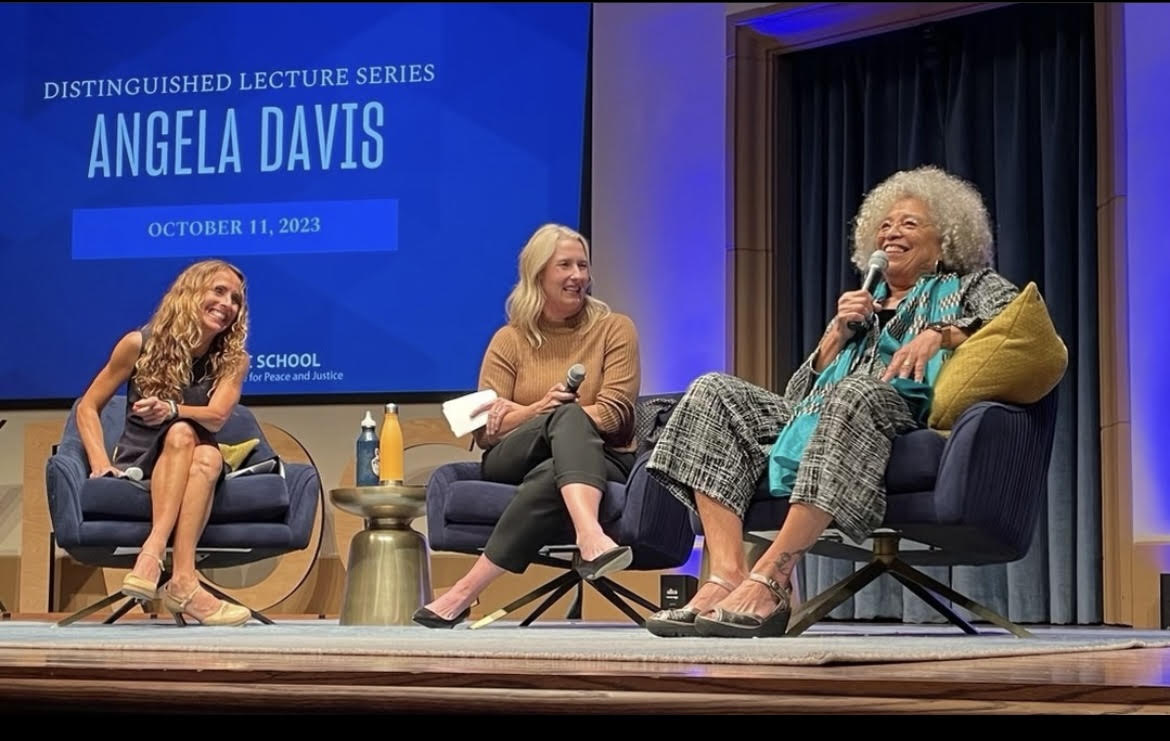
Photo courtesy of krocschool/Instagram
Angela Yvonne Davis is an African American woman born in Birmingham, Alabama, on Jan. 26, 1944. She is considered to be an American revolutionary, feminist, political activist, philosopher, academic and author who has written many books, including “Women, Culture, and Politics.”, which is a collection of speeches and writings that addresses the political social changes of the 1980s to 1990s, as they are concerned with struggles for racial, sexual and economic equality.
Davis began her studies at Brandeis University, and later a graduate student at the University of California San Diego (UCSD) in the late sixties. Her time in college is when she became increasingly interested in human rights and politics. As Davis attended UCSD, she became associated with several activist groups including the iconic Black Panthers, a revolutionary organization with an ideology of Black nationalism, socialism and armed self-defense, particularly against police brutality.
She was also involved in the Black Student Union on the UCSD campus through which she pushed for a movement that demanded Black studies on campus and education that catered to the needs of Black students, as well as Latine and white working-class students.
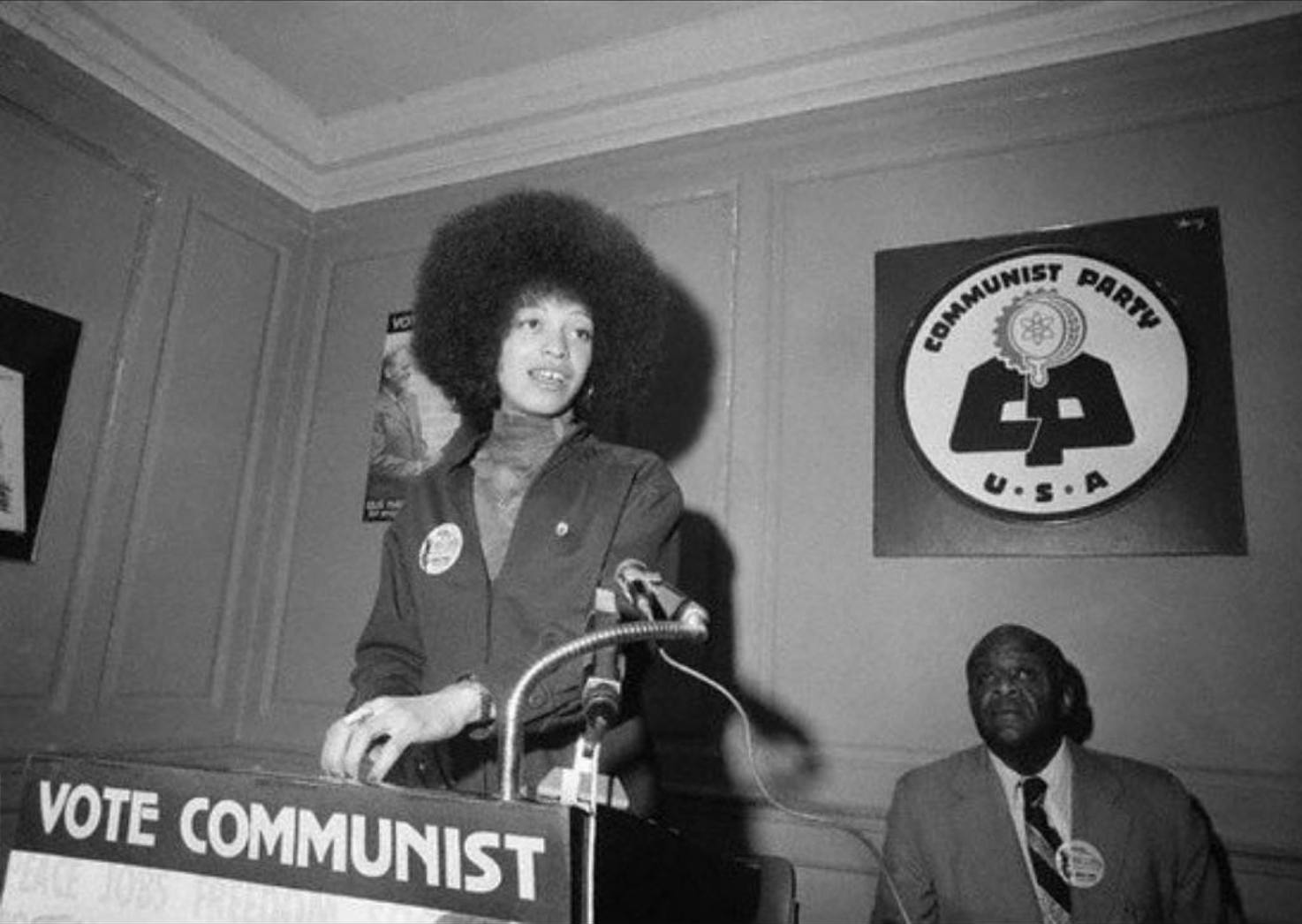
Photo courtesy of @_angeladavis1944/Instagram
Davis’ activism centered on how different forms of oppression overlap and intersect between different groups of people. She spent most of her time in college working with the Che-Lumumba Club, which was an all-Black branch of the Communist Party. Many believed Davis to be a respected academic leader, therefore, UCLA recruited her as an acting assistant professor within the philosophy department. There, Davis contributed to the philosophical thought relating to topics highlighted within her leisure. However, through association with such groups such as the communist party, she became a controversial individual, with many disagreeing with the ways in which she advocated for the oppressed. However, she continued to be a vocal activist leader, attending speech events and writing novels in regards to feminism, civil rights and prison abolition.
Davis has received a wide variety of awards, has been inducted into the National Women’s Hall of Fame and was included in Time magazine’s 2020 list of the 100 most influential people in the world.
During the event held at USD, the topic of discussion was U.S. history and prisons. Davis spoke about her experiences as a Civil Rights activist, her insight on prison abolition, naturalizing gender, activism burnout and more. She starts the conversation by stating how she had relations to prisons virtually all her life. She narrated the time period in which she did activist work around prisons, to the period of time in which she spent time in jail as a result of the work she was doing with political prisoners. In response to the question posed around her views on prisons in the U.S. she stated, “I never expected that there would be a widespread public discourse over prison abolition.”
Further, she spoke on the summer of 2020, in which George Floyd was publicly lynched. Saying, “history doesn’t ever unfold in a linear fashion, sometimes it’s two steps backward, before you take one step forward,” Davis said. “In the summer of 2020, a new collective consciousness was created. This new collective consciousness around carceral issues and around slavery was an awareness that our forebears did not do the work that would have been required to fully abolish slavery.”
The crowd silently focused on Davis’ responses to the questions posed to her, and ended the event with a standing ovation over Davis’ words and impact on history.
USD alum Moumita Roy recently graduated with a degree in Ethnic Studies, and expressed passion regarding Davis’ topics. Roy spoke on why she decided to return to the university to attend the event.
“I’ve been a fan of Angela Davis and her work since high school. She is an icon in the field of social justice, especially when it comes to prison abolishment,” Roy said. “I had the opportunity to attend one of her lectures in Harlem, New York, and it was so inspiring to hear her talk, I couldn’t miss the opportunity to see her again.”
USD senior Gabrielle Hall attended the event, and spoke of why she admires Davis, and how Davis’ words inspired her.
“I aspire to replicate what she has done and created for society; I wanted to hear her insight on leadership qualities and mobilization to become a better leader and implement her ideas into USD’s social justice club,” Hall said. “I was moved when she said ‘do what you love’ because I recently decided to change career paths, and I struggled with knowing if it was too hard or not. It resonated with me, when she said to create your art and follow your passion; it let me know I can’t be wrong in any path if I ensure to express what differences I want to make in the world.”
USD first-year Shukriya Osman also attended the event, and spoke of her enthusiasm for Davis.
“I absolutely loved being able to hear from her, she’s always been someone whose work I enjoyed reading, so seeing her speak in real life was unreal,” Osman said. “What inspired me mostly from what she said was that we have to keep moving no matter if we’re tired or if we’re exhausted, whether it’s music, poetry or anything enjoyable to you, let that passion be the anchor for your activism.”
The 1960s was a turbulent time for the African American community across the country. Davis is attributed as the activist she is known as today, because she was driven by the lack of civil rights and unequal employment opportunities for African Americans. She brought that aspect to light at the event saying, “what divides us must become what unites us.” Her impact on the Black community and push for the importance of education to shift the divide within our country, is directly visible on USD’s campus. Her words and work are still coming into fruition through the inspired students demanding change within the present days.

 The USD Vista
Leave a comment