COLIN MULLANEY / EDITOR-IN-CHIEF
Recently, Senior Prevention Specialist William Perno presented to USD students about the over-the-counter medication Naloxone — used during an opiate overdose incident to reverse symptoms and potentially save a life. Perno, a retired San Diego County Deputy Sheriff, taught students about the signs and symptoms of an opiate overdose, how to potentially reverse an overdose with Naloxone and the current state of opioid abuse in American society today.
Approximately 20 USD students attended the seminar in the University Center on Wednesday, Feb. 7, to learn about Naloxone — recognized by the brand name Narcan. Further, students received their own, free dose(s) of Narcan to carry and use, if they come across an individual experiencing an overdose.
The Narcan was distributed by the San Diego County Naloxone distribution program and SAY San Diego, free of charge, as part of its initiative to minimize overdose incidents and deaths in the region.
According to Perno’s presentation, the opioid crisis in America began with prescription drug abuse in the 1990s, when doctors overprescribed opioid pills and downplayed the potential for addiction. After a crackdown on prescription drug abuse, those who had become addicted to their prescription pills later sought out heroin and other illegal street drugs in the 2000s and 2010s. In recent years, the advent of more powerful drugs like fentanyl took center stage, because of how easy it was to produce, transport/smuggle and lace fentanyl into all sorts of illicit substances.
“When I was working as a deputy, we didn’t have all the street drugs we do today,” Perno said during his presentation. Fentanyl is “100 times stronger than morphine, and 30 to 50 times stronger than heroin,” Perno shared.
Even though it has existed as a pain killer since the 1960s, fentanyl is a relatively new threat to Americans, because it is increasingly prevalent in batches of illegal substances sold in the U.S. The rise in fentanyl-related overdoses and deaths has made it “the deadliest drug this nation has ever seen,” Perno said, and fentanyl overdose is now the leading cause of death between persons aged 18-45, according to the federal government.
Perno also focused on the rise of carfentanil, which is a large-animal tranquilizer, meant to sedate animals like a rhinoceros or hippopotamus. His presentation stated that carfentanil is “100 times stronger than fentanyl, and 10,000 times stronger than morphine,” and the first death attributed to a carfentanil overdose in San Diego County occurred in 2017.
Illicit drug manufacturers are predominantly based in Mexico and use chemicals from China. Dealers located in the U.S. have also become increasingly savvy at marketing their product to unsuspecting populations, especially vulnerable children, with the creation of rainbow fentanyl that looks like candy. More and more, dealers are selling drugs to young adults and teenagers over anonymous apps, or chat-deleting apps, Perno imparted.
“Unless you know exactly where a pill is coming from, you should not be taking that pill… Only take prescription pills that you get directly from a pharmacy. Fentanyl can be found in any street drug — anything sold on the street,” Perno said.
Illegal drug manufacturers now utilize equipment to produce laced pills indistinguishable from name-brand, prescription opioid drugs.
Even pills that appear like “legitimate” pharmaceuticals, stamped with common names like “Xanax” and “Codeine,” can be laced with fentanyl, Perno explained. Not even pharmacists can tell the difference between the real prescription drugs and the fakes. Because you can’t see, smell or taste fentanyl, anyone who takes a drug that they buy off the street is taking their life into their own hands — and running the serious risk of a fentanyl overdose.
“One pill can kill,” Perno emphasized.
The route of administration of a drug also matters — and it’s not just pills that are deadly. Real pills made by pharmacists have a coating for a delayed release that lasts between 4-12 hours. The liver naturally filters the drug out of the bloodstream in a timely fashion. However, any pill or substance that is crushed up, snorted, smoked or injected all at once greatly increases the overdose risk.
Regarding the signs of an opiate overdose, Perno pointed to pale skin tones, blue or ashen lips and fingertips, constricted pupils and being unable to rouse or wake somebody — even with a hard tap or nudge to the sternum. Opiates kill by slowing down respiration to the point of stopping it. An overdose can have the appearance of a deep sleep — but with added noise like gasping, or a rough snore — which is the body struggling to get oxygen as it shuts down.
If students find someone in this state, they should “call 911 immediately. They’re not going to just ‘sleep it off,’” Perno explained. If available, the helper should then administer Naloxone/Narcan.
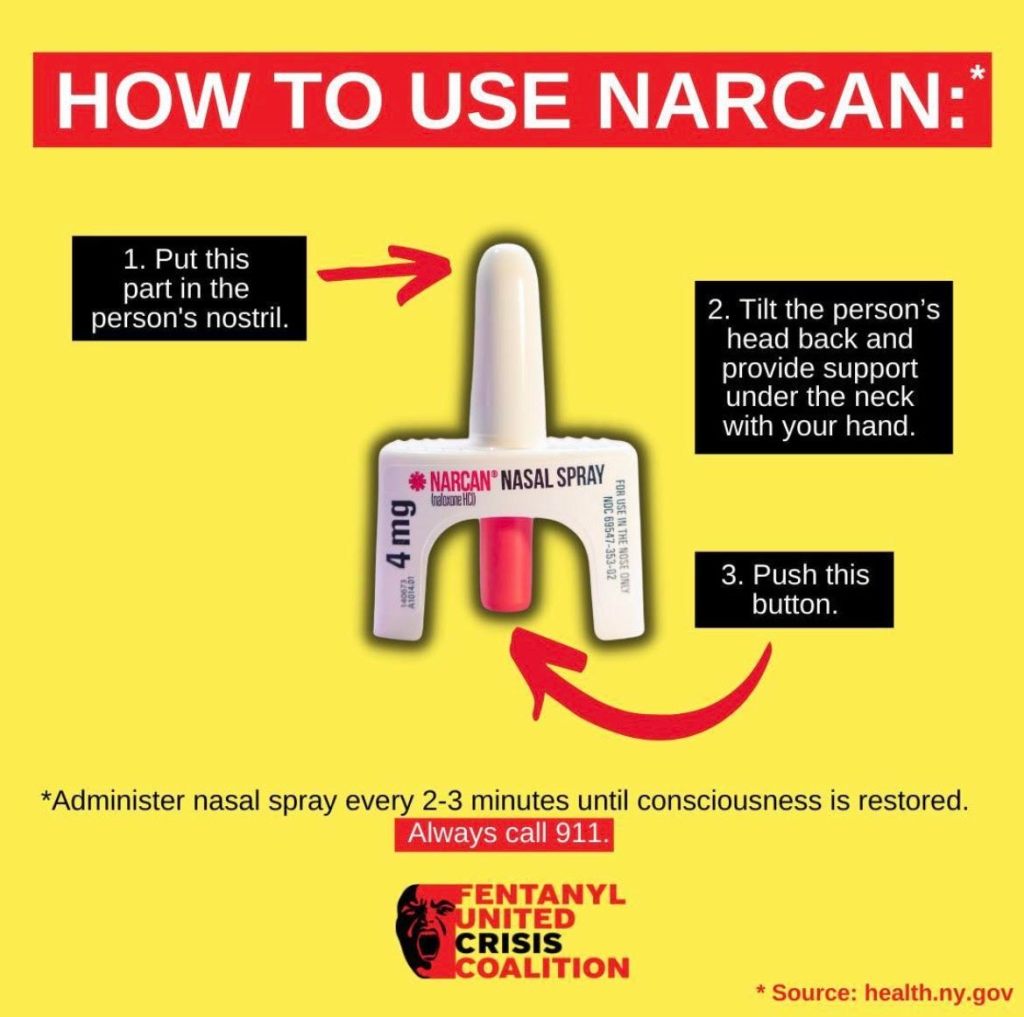
Perno’s presentation instructed to first remove the cartridge from its packaging, tilt the unconscious person’s head back, hold the nasal spray with thumb on plunger, insert into either nostril, empty the plunger into the nose, roll a victim onto their side and rest their head on their arm in “recovery position.”
If the overdose victim doesn’t wake up within 2-3 minutes, administer more Naloxone, switching nostrils with each administered dose. It is impossible to overdose on Naloxone, or give someone too much.
Naloxone simply “kicks the opioid drug off of its receptor,” and it does not neutralize the opioid drug in the bloodstream. A person who overdoses must still go to the hospital to get an IV drip of Naloxone, which is why it is imperative to call 911 in a suspected overdose event.
The CA health and safety code protects those who report a suspected overdose to authorities and/or paramedics, known as a “Good Samaritan Law.” Perno explains that the idea behind the law is that it is more important to protect lives than to punish people. Many youth fear legal trouble, deportation, loss of housing, or being fired from their job, but the law states that it is illegal to punish those who render medical assistance to somebody in need, in good faith.
However, having Narcan on-hand — as many USD students and Public Safety officers now do — is a first-step intervention that could save a life.
Naloxone commonly known by the brand name Narcan can be administered to overdose victims. Photo courtesy of @fuccfentanyl/Instagram

 The USD Vista
Leave a comment