AUDREY DAY / CONTRIBUTOR
Students may know Ms. Womack — Mandy Womack — if they have ever opened their USD email to find a message from her with the subject line “Correspondence for Case” in a big, bold font. Students could be initially intimidated by Womack, generally apprehensive when receiving emails from USD’s Office of Ethical Development and Restorative Practices. Little do they know that Womack’s past experiences of navigating tragedy and loss and personal obstacles have all shaped her into the woman she is today.
Now in her sixth year as the Assistant Dean of Students, Womack works in USD’s Office of Ethical Development and Restorative Practices which isresponsible for implementing USD’s Student Code of Rights and Responsibilities. Womack guides students to reflect on their choices and behaviors in order to move forward from their mistakes.
She shared that her empathy for others was developed at a very young age due to growing up with her brother, Nick, who had special health needs.
“Nick was about five and a half years younger than me, and he was born with hemophilia, a blood disorder that stops blood from clotting. Even the smallest bruise can be life threatening.”
Womack went on to explain the severity of Nick’s disorder. “Something as little as getting hit by a wild pitch in baseball could make it so that he couldn’t walk without pain. Watching him navigate that reality his entire life really is where I first developed empathy for others that are often battling something,” Womack said.
In her current role, Womack communicated that she approaches the student conduct process in a unique way, with a focus on understanding and compassion.
“Our office philosophy for the Office of Ethical Development and Restorative Practices is that students are generally bright, creative, energetic andtrustworthy individuals who may have made a bad decision. I think that’s a different approach when we look restoratively, versus saying, ‘you’re a bad person and how do we punish you,’” Womack said. “Our hope is that our restorative justice process allows for a lot of reflection.”
Womack explained that her involvement in the Kappa Alpha Theta Sorority as an undergraduate at San Diego State University (SDSU) impacted her life in a large way.
“My time serving on Panhellenic (one year as treasurer and one year as president) sparked my passion for leadership,” Womack said. “Learning to see the needs of an entire community, rather than just my one chapter, solidified my interest in working in higher education.”
While Womack remarked that her sorority experience was filled with happy moments, she recalled a devastating event that occurred while she wasserving as SDSU’s Panhellenic President her senior year.
“During my senior year, the Vice President of Panhellenic took her own life on campus. [We] were good friends and had worked on the Panhellenic Executive Board for about seven months together. My initial emotion was shock. This transitioned into sadness and confusion. I would describe her as someone who ‘had it all together.’ She was beautiful, strong academically and kind. The most shocking thing for folks was, if she’s feeling desperate and has it all together, what does that mean for other people? Being able to open this conversation was so important,”Womacksaid.
Womack elaborated on how she handled the situation. “Myself and another Panhellenic leader visited all the sorority houses and told them what had happened. We talked about how to support them and their members. That experience of navigating a crisis, that is what cemented for me that this is what I like to be doing,”Womacksaid. While Womack shared about supporting others through their obstacles and crises growing up, it was not until about 20 years ago that Womack was faced with her own obstacle. “[I had] a life-threatening illness called Guillain-Barré Syndrome… it was my most powerful reminder that I am in control of absolutely nothing, except how I react to things,” Womack said. “It really shifted my perspective on what matters most to me.” In addition to this illness changing her outlook on life, Womack shared that raising her two kids, Megan and Zoe, has helped her recognize the importance of showing up for herself and others authentically.
“Having my two kids has really helped me show up to work in a vulnerable way. One can only pretend to have so much together when you are raising two children.”
Although Womack described the feeling of not having control in her life, she said she has learned how to take these experiences and use them to apply kindness to the students she meets with. She expressed that she is given new chances to help others on a daily basis.
“I have opportunities to do this every day at work… noticing when policies or practices are no longer serving us, noticing when underrepresented voices are not being noticed, speaking up when values do not align with actions,” Womack said.
Womack said she spends her free time volunteering in local and national organizations for Kappa Alpha Theta Sorority.
“Fraternity and sorority life was my passion that brought me into higher education,”Womack said.“The sorority experience,and Theta specifically, can provide a strong sense of belonging to our members of these organizations. Considering ways that we can continue to do this — expand our support for members, create a more welcoming and inclusive environment — these are all reasons I continue to volunteer almost 30 years after my college graduation,” Womack said.
Womack shared that her work in USD’s Restorative Justices and her volunteer work for Kappa Alpha Theta sorority are largely intertwined.
“The work I’m doing now in Restorative Justice has really impacted how I’m doing my sorority work. I really think about how I can help people move forward — both USD students and people I work with in Theta chapters across the country,” Womack said.
Womack expanded on how she views her own position here at USD.
“I see my role here in the Office of Ethical Development and Restorative Practices as someone who accompanies students as they are on this path to who they are becoming. As they are on this path, sometimes little and sometimes big things happen. I’ve accompanied students through loss of parents, unexpected pregnancy, the death of a best friend and also through joyous times such as finding their partners in life,”Womacksaid.“So this idea, that particularly for the four years students are here we get to walk on a journey with them, is such a blessing. That is my greatest joy of work.”
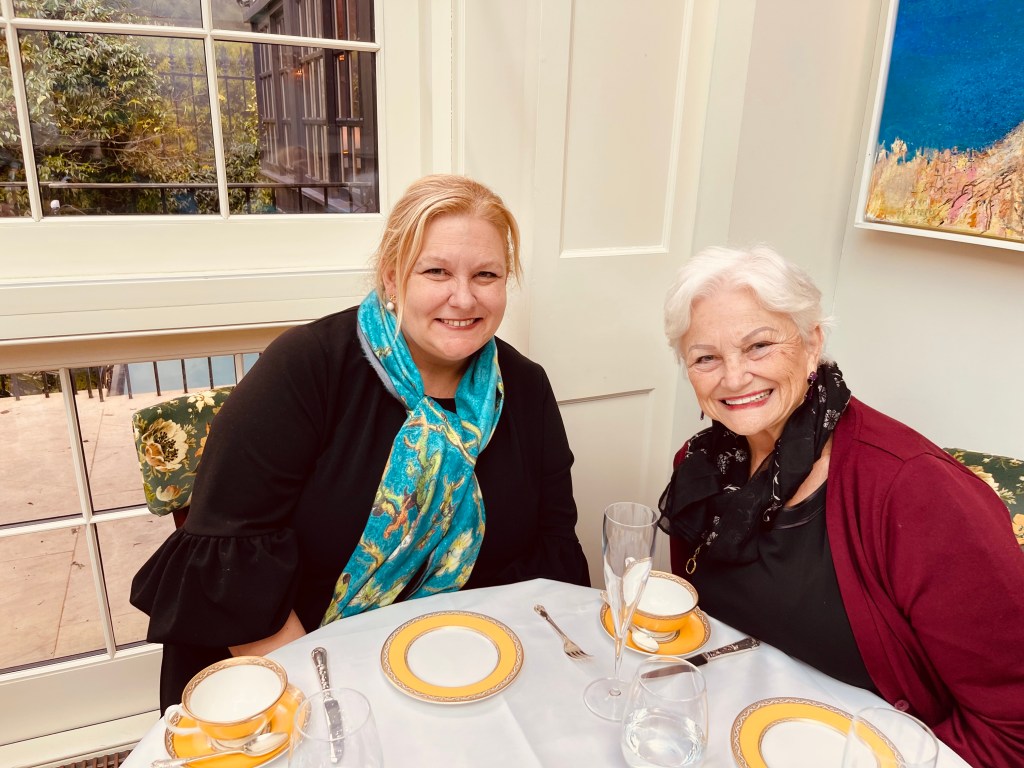
Womack enjoying tea with her mother. Photo courtesy of Mandy Womack

 The USD Vista
Leave a comment