EMMA-KATE SQUIRES / PHOTO EDITOR
The world is at war — and USD knows it. The Department of Political Science and International Relations hosted over five hours of presentations and discussion panels during their annual Pearson-Chambers Symposium on Feb. 22. The symposium brought students, faculty and community members together to learn about the conflicts breaking out all over the world. The symposium featured guest speakers who are experts in their field — from Vice Admiral Robert Thomas, to professors from all over San Diego — the panels highlighted the variety of perspectives the San Diego community brings to the table.
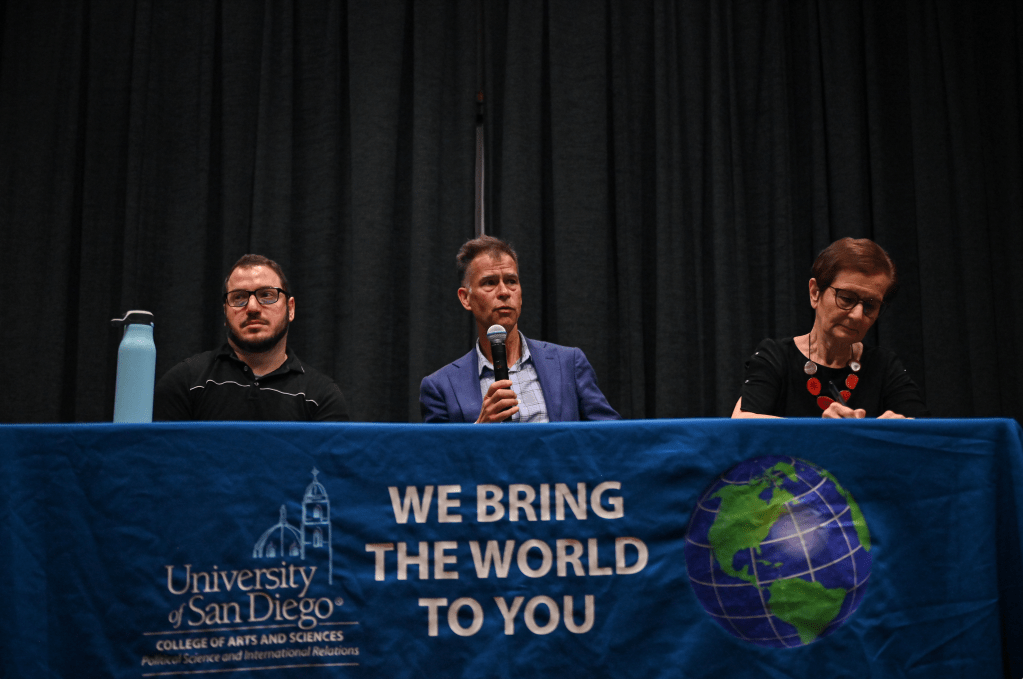
Three panels, broken up throughout the day, began with Israel, Palestine and the Middle East. Panelists included USD professor Dr. Ted Falk, UCSD professor Dr. Michael Provence and USD professor Dr. Necla Tschirgi. Panelists universally criticized the distinctive approach the U.S. has taken by insisting that it is always involved — but never constrained — in international politics, particularly in the U.S.’ decision to block ceasefire initiatives. Provence pointed out that “a ceasefire would be a false promise, if it leads us back to the status quo.”
The panelists concluded that the U.S. should de-center itself from the conflict resolution process, and instead focus on the dynamics within the Middle East, such as the role of non-state actors in the conflict. Falk talked in particular about the influence of Hezbollah in the area, a Lebanese group with social, political and terrorist components.
The next panel was about China, Taiwan and Asia, with keynote speaker Admiral Thomas to provide his military insight from the Taiwan Strait. The panelists also included USD professors Dr. Yi Sun and Dr. Kacie Miura. Dr. Sun specialized in the view from Beijing, which allowed attendees to understand the strategy behind China’s geopolitical decision making.
“The hands that tied the knot must also untie it,” Dr. Sun said referencing U.S. military bases surrounding China. She emphasized that the tension between the U.S. and China is not one-sided and it will require action from the U.S. to convince China to slow expansion efforts.
Miura added that the recent Taiwanese election of Democratic Progressive Party (DPP) candidate William Lai could be a reflection of a Taiwanese desire to distance itself from China. The DPP has been clear on their support of Taiwanese independence, an idea which Miura says is making China uneasy.
Miura has studied China extensively, working as a Peace Corps volunteer in Fuling, China. Miura was one of four female panelists for the day and when USD senior Angela Miller attended this panel, she said that having diversity among the speakers helped her connect more to its message.
“You see [someone] that looks like you and there’s trust building in how they deliver the information – that it is for me,” Miller said.
Among the diverse perspectives represented was SDSU professor Dr. Mikhail Alexseev who weighed in on the final panel about Russia, Ukraine and Europe, contributing his unique perspective as a Ukrainian. He shared polling data from Ukrainians about personal loss and trauma caused by the warfare.
“We will win, because we have to, because there is no other option,” he said.
Alexseev was joined by USD professor Dr. Casey Dominguez — who explained that republican voters have soured on the issue of sending aid to Ukraine — and USD graduate student Jack Kamps, who brought in his unique experience from attending a NATO conference.
“It’s an incredible honor. This feels like the right way to wrap up that time in Copenhagen… it’s so my bread and butter,” Kamps said. The three experts reflected on the war, almost exactly two years after Russia invaded Ukraine in 2021.
The field of international politics is constantly changing and evolving, which can make global events hard to keep up with, but USD graduate student Nicky Perez said attending was beneficial.
“Just hearing what our professors have to say helps clarify a lot of ambiguity,” Perez emphasized.
Perez attributed the large turnout to the quality of USD’s Political Science department.
“We have a really talented [political science] department, so I love just getting any chance to hear more from them.”
Kamps agreed with this and reflected on his experience with guest speakers in the department.
“I think one of the biggest impacts [the political science department] can have on the university is the speakers we bring in.”
Over 150 people attended the symposium throughout the day, choosing presentations that coincided with areas they were most interested in. Miller chose the afternoon panel about China with the intention to learn more about a conflict she felt unfamiliar with. She talked about the empowering nature of political involvement as a first generation student.
“My family doesn’t engage in politics, so I grew up isolated from it. I wanted to understand my government… to better understand my place in it,” Miller said.
The panelists served as a reminder that the USD community has the opportunity to be a part of something bigger, even the global stage, and that starts with knowledge. Through education, USD students can become more involved in the world around them, and far away. While the world may be at war, there are plenty of opportunities like this symposium to understand these complex situations.
Dr. Ted Falk, Dr. Michael Provence and Dr. Necla Tschirgi presented on a panel about the Middle East. Emma-Kate Squires/The USD Vista

 The USD Vista
Leave a comment