ANJALI DALAL-WHELAN / NEWS EDITOR
Over 6,000 miles away from her hometown, Dr. Yi Sun is living out her dream in a way she never would have imagined. Her journey spans oceans, indoctrinations, culture shocks and mishaps, but it has brought her exactly to where she believes she should be.
Born in Tianjin, China, in 1963, Sun grew up in a multi-generational home with her parents, grandparents and two younger siblings. During her childhood, due to the Communist Party of China’s rule, most housing was government-owned and practically free.
Sun’s childhood home was a three-room apartment for seven people that lacked modern luxuries such as indoor plumbing, refrigeration and air conditioning. The apartment was part of a compound that shared a courtyard with other families. Sun reflected on communal living.
“It was really a community, so people looked after each other’s children, they babysat… it was sort of a reciprocal arrangement…but it was really kind of a nice, communal warm kind of setting.”
Sun reminisced on the cultural differences during her childhood being different from the traditional American experience, with separate houses and modern conveniences.
“In the summertime, back then there was no AC, there was no refrigeration, so you basically had to cook your food every single day, but on the plus side, it was all fresh,” Sun said. “You could say, ‘oh you toughed it out.’ But at the moment, we didn’t feel there was unnecessary hardship. It was just the way it was, and people went about their daily lives pretty cheerfully.”
A large part of Sun’s childhood was during the Cultural Revolution in China, a movement launched by Mao Zedong to rid capitalist influence from the country of China — often remembered for its violence and propagandizing of youth. The Cultural Revolution lasted from 1966, when Sun was three years old, to 1976 when she was in middle school. Sun explained how her personal experience with the period differ from her view as a historian.
“As a child, I didn’t know enough to feel it was traumatizing,” Sun said. “As a historian, you look back and go ‘oh, my goodness, that was a decade of chaos.’ But interestingly, the way it affected… personally would have been the fact that during that era, there was serious promotion of gender equality.”
With slogans such as “women hold up half the sky,” the idea that women were equal to men was enforced during the Cultural Revolution, which gave girls both a sense of empowerment and responsibility. In school, she was required to memorize and repeat Marxist sayings, which emphasized the importance of gender equality and financial independence. Sun explained that these messages continue to have a profound influence on her.
“To an extent, maybe you could call it indoctrination,” Sun described. “Ever since you were little, we are told day in and day out that you’re just as good, you’re just as equal [as men], but to prove that — you have to work… to this day, that may be a lingering influence. I can’t imagine myself not working.”
Since childhood, Sun always knew what profession she preferred.
“I always wanted to be a teacher, for some reason, I still can’t explain it, I think I just knew I wanted to be a teacher.”
However, Sun never expected to become a professor in the U.S. As a young adult, she attended Nankai University in Tianjin, where she studied literature and planned on teaching American history in China.
Sun explained that she decided to come to the U.S. on a chance encounter. A conversation with another student led her to decide that she wanted to see the world outside of China.
“It was kind of almost a random thing, but I’m glad I made that decision,” Sun said.
Deciding to attend graduate school and study diplomatic history, Sun thought Washington State University would be the perfect place for just that. It was not until she arrived in “Washington” that she learned of the difference between Washington state and the U.S. capital, Washington D.C. Sun describes being driven through the woods, after getting off the plane in utter confusion of where she had ended up. She didn’t have the courage then to ask anyone where the monuments were, for a few days after her arrival.
“Later on I learned, oh, there’s so many places, including schools that are named after Washington. What did I know?” Sun recalled, with a laugh.
Despite the initial mix-up, Sun still enjoyed her time at Washington State University, where she earned an MA and Ph.D. in American history.
In graduate school, Sun’s doctoral dissertation was in China-U.S. relations during the Taiwan Straits Crisis, a part of the Cold War. After finishing her Ph.D., she moved to Michigan to teach at Albion College for three years. Although Sun enjoyed her time at Albion, she was attracted to the University of San Diego, where she has now taught for 26 years, because of the warm weather and opportunities for career growth.
Her plan for her next research project is personal, because she wants to write about women in her hometown of Tianjin.
“I actually want to write about Tianjin because I have this emotional attachment there… The women in Tianjin [I’ve selected] are all women who [have been] very active in the areas of education, medicine, journalism and political activism from the very beginning of the 20th century,” Sun said. “I am really fascinated by their stories and I want to dig more into it and read their diaries, newspaper reports and also archival materials.”
Dr. Sun brings a personal approach when teaching history. In her classes she incorporates personal stories and experiences, making history more interesting and relatable to her students.
She hopes that students will remember the big picture of what they learn, not just specific details.
“The human and personal ties that I have established with students, I consider that my biggest accomplishment. I think people will forget about the Treaty of Nanjing a few weeks after the test, but if they still retain the bigger picture, I think that’s amazing,” Sun said.
She is most proud when she talks to former students and they discuss the impact that her classes have had on them. Sun discussed how some of her proudest moments entail introducing students to Asian Studies in high school curriculums and having her students travel to East Asia because of her classes.
Sun’s positive outlook has followed her through the many twists and turns she has been through in her life, continuing to inspire students and make a difference at USD.
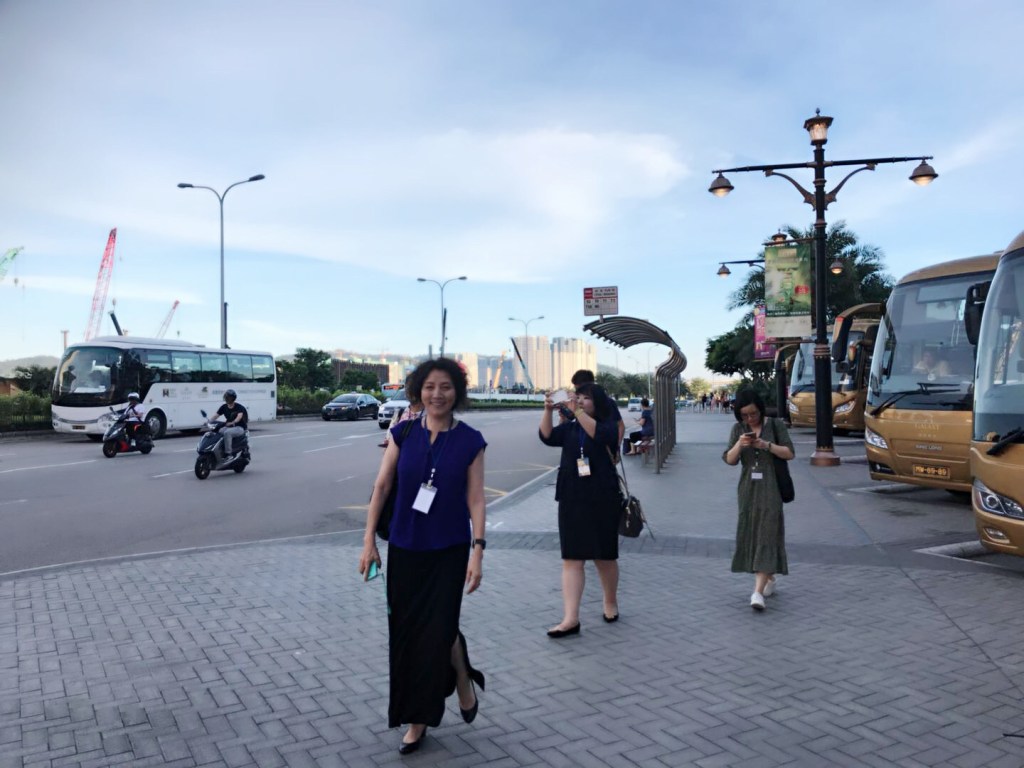
Dr. Sun exploring Monaco on foot in 2018. Photo courtesy of Yi Sun

 The USD Vista
Leave a comment