KRISTI PHILLIPS / CONTRIBUTOR
There is so much weight in a name. A name is a culmination of a person’s past and present, a signifier of a rich personal history. On Jan. 18, 2015, Chanel Miller lost the privilege of her name. This was the day she was sexually assaulted while unconscious behind a dumpster at a Stanford party, the day her name was forcefully replaced with the label of an anonymous victim, “Emily Doe.”
The University of San Diego was the presenting sponsor for KPBS’s 2024 One Book, One San Diego adult selection on Sept. 18, which featured Miller’s book, “Know My Name: A Memoir.”
One Book, One San Diego is a literary program that aims to create community through shared reading experiences. Every year, people in the community nominate titles that they believe should be featured by KPBS. After the committee chooses four special books, a community partner hosts an author event for the public to attend. This year’s event commenced at Shiley Theater at 7:00 p.m. and consisted of an author talk with Chanel Miller, a book signing session and a post-event reception. Audience members listened intently as Miller described the journey she took to liberate herself from the pain that she endured while under the disguise of anonymity.
Chanel is often referenced in the media as the victim of the People v. Turner case, where Stanford student Brock Turner was convicted of three accounts of felony sexual assault. But the physicality of the assault is not the story she chose to tell. Instead, she took her healing process and magnified it, educating the masses about the importance of using proper rhetoric and sharing hope through lived experiences.
“Your lived experience and the way only you can take things in and what you’re observing has its own really potent value,” Miller said. “Even though the primary action is happening in the courtroom, I’m going to take you into the bathroom with me, and you’re going to watch me wipe off my make-up.”
For Miller, storytelling also provides a place to fall apart when there are no answers about what the future holds. Though traveling into the past can be dangerous, she spoke about the opportunity for catharsis that a fresh, blank page can offer.
“That feeling of expansion and liberation — that no one was going to come in and interrupt me or object — was really necessary,” Miller said.
Dr. Jillian Tullis, a Communication Professor and the Program Director of the Biomedical Ethics minor at USD, moderated the event. Tullis added that rhetoric, either intentionally or unintentionally, can be harmful if it’s used in a way that supports the perpetrator. She also spoke about how Miller had to deal with negative responses from people she didn’t even know.

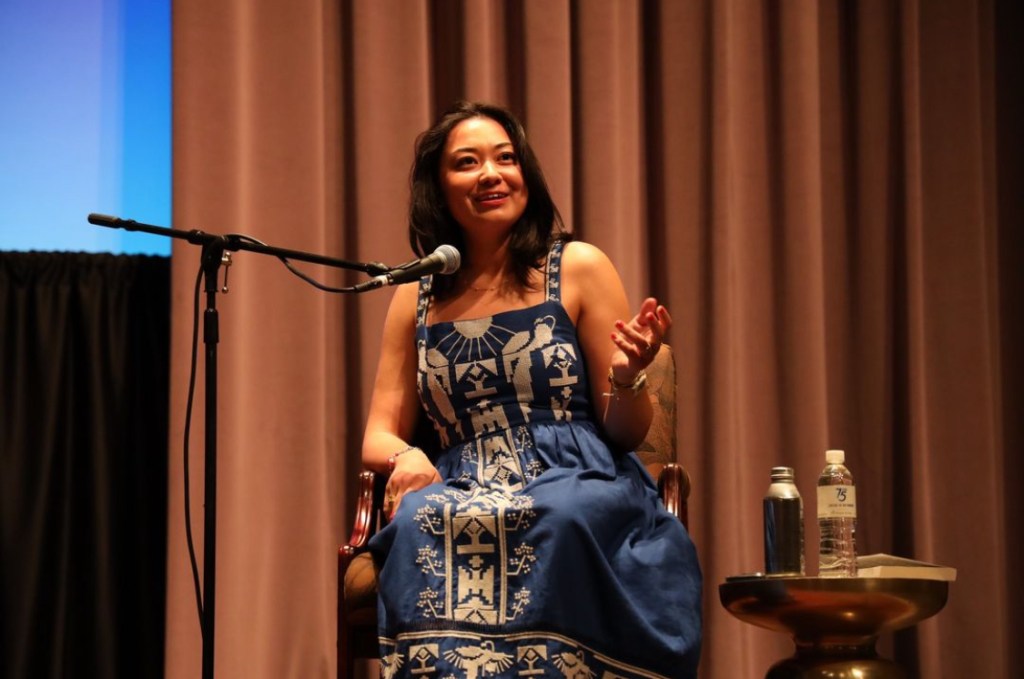
Miller sitting with Dr. Jillian Tullis, who moderated the event. Photo courtesy of Kristi Phillips
“I think we should really be guarding against a kind of language that promotes any kind of rape culture,” Tullis said. “I think it just further contributes to this culture where men and boys are not held accountable and held to low and pathetic standards.”
USD students who attended the panel praised Miller’s message. Many students lined the sides of the theater at the end of the panel to ask questions, share their experiences reading the book or convey their personal traumas.

Audience members were able to participate in a Q & A after the event. Photo courtesy of @usdcas/Instagram
“Chanel shows that healing is not linear, there’s good days and there’s bad days,” USD sophomore Ella Cromer said. “I felt like even in the event itself she shared bits and pieces where we got to see more of her character.”
Miller inspires students to embrace their personal histories, but it’s also up to educators to teach them how to convey their stories in an effective and powerful way. USD’s liberal arts education enables students to do just that. The University offers classes in disciplines such as communication, gender studies and peace and justice studies, along with a variety of others that emphasize skills such as narrative construction and empathetic listening.
“Certainly in my class I try to teach about the power of storytelling and narrative,” Tullis said. “When I’m teaching a gender communication class, I really want my students to be critical consumers of information about things like sexual assault, domestic partner violence and rape.”
USD offers the services of the Campus Assault Resources and Education (CARE) team whose focus is to provide confidential support and resources to victims of sexual assault and relationship violence. They also promote bystander intervention through the efforts of student peer educators and informative workshops.
“Our CARE Advocate team aims to create a space that encourages open and respectful dialogues where survivors feel safe sharing their experiences,” Confidential Care Advocate Megan Martin said. “We aim to validate their feelings and perspectives without judgment.”
Thanks to courageous individuals such as Chanel Miller, survivors are on a journey toward reclamation — not only of their stories but of their names. But there are still those who are waiting in silence. According to statistics provided by the #MeToo movement, fewer than one in ten women who experience rape while in college report it to the police. But as Chanel notes, the effects of sexual assault are communal, and therefore there must be a collective effort to amplify survivors’ voices too.
“The assault happens to one physical body. Emotionally it happens to everybody who loves that person,” Miller said. “That care needs to be distributed.”
Chanel has finally reclaimed her name, and her work is helping others to do the same.
Miller speaking about her experiences and her new book “Know My Name: A Memoir.” Photo courtesy of @usdcas/Instagram


 The USD Vista
Leave a comment