
HAILEY HOWELL / FEATURE EDITOR
With the growing success of platforms such as Spotify and Apple Music, podcasts have become even more popular. Whether it’s about news, pop culture or true crime, the medium gives students access to other stories and perspectives. Students may not know, but USD has a student-led podcast that focuses on giving voices to students and other members in the San Diego community.
Through a collaboration with the Humanities Center, the Changemaker Hub and the USD College of Arts and Sciences, the podcast first began as a way to combine both storytelling and changemaking. Dr. Brian Clack, Director of the Humanities Center; Mike Williams, Director of the Changemaker Hub and Dr. Noelle Norton, Dean of the College of Arts and Sciences officially started to conceptualize what this would look like in 2016 and approached Dr. Diane Keeling, a USD professor who focuses on rhetoric studies.
“They approached me because my expertise is rhetoric…storytelling is one of the most influential forms of rhetoric,” Keeling said. “They sat down with me and really allowed me to conceptualize from the ground up what storytelling might look like on campus and for it to be an interdisciplinary space. A space where we’re thinking about change and how stories can work better than arguments at helping people to empathize and understand difference or relate to someone who has an experience that’s similar to theirs and that they’re not alone.”
Keeling explained that she had experience working with radio in college but quickly realized that there were differences between radio and podcasting.
“I had to teach myself how to do podcasting,” Keeling said. “It’s really popular now in rhetoric programs, particularly on the composition side of rhetoric…So I attended a few workshops. I taught a few really bad classes, but now they are, of course, classes where people get jobs, and they’re the highest student evaluations I’ve ever received.”
Most of the time, the podcast collaborates with an organization on campus such as the Black Student Resource Center or the Office of the Tribal Liaison. Typically the campus partner identifies what the stories should be about, which is usually in relationship to what their program is working on. Then, they find people, either students, faculty or people in the community, who they think would be great storytellers. Typically three people share at each live event.
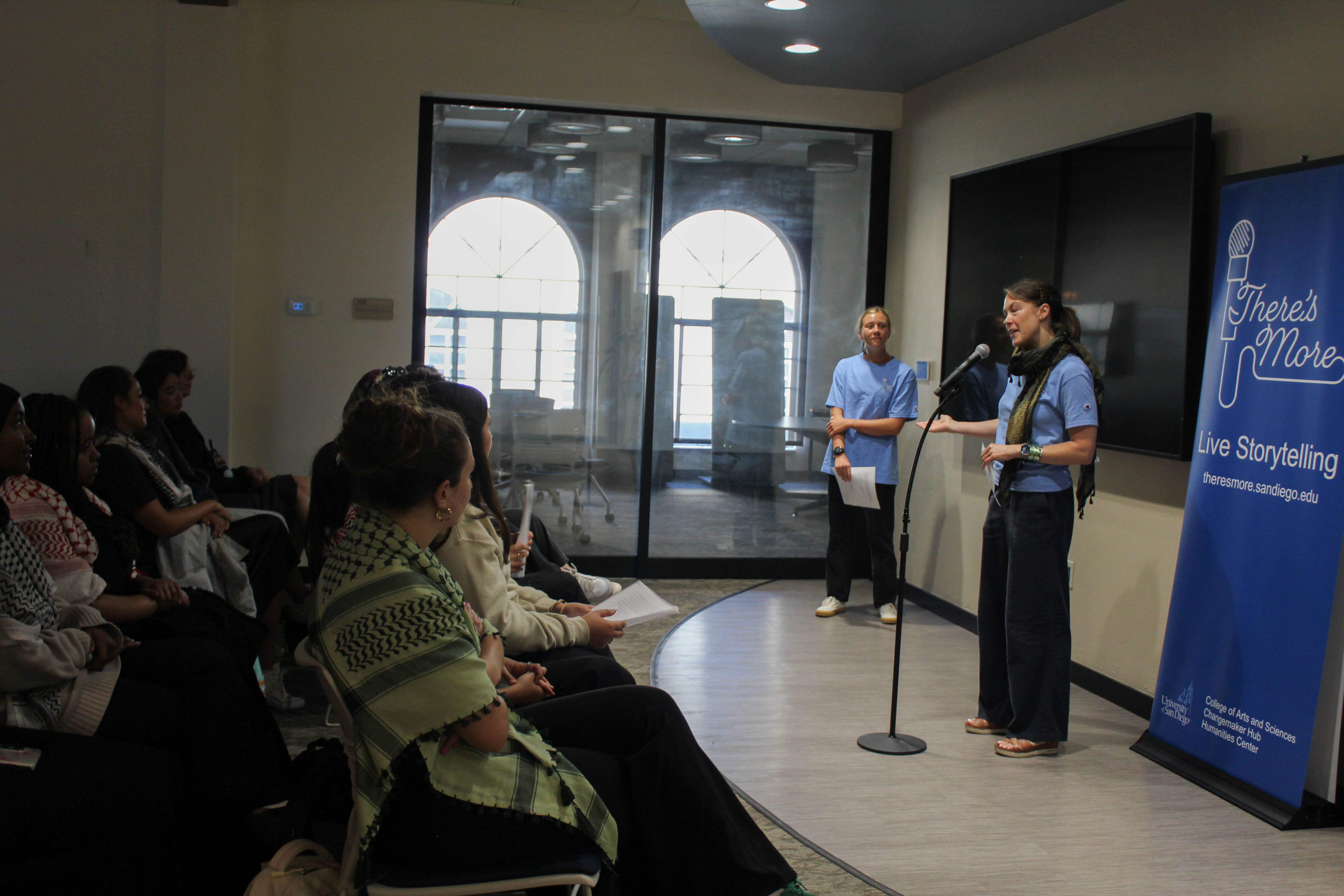
Producer Dr. Diane Keeling speaking to audience at live event in the Humanities Center. Photo courtesy of Magdalene McRae
“Anyone can be a storyteller,” Keeling said. “Anyone can collaborate with us. We have information on the website of how to get involved if they want to be a campus partner.”
Keeling also recognized that she wanted the podcast to be similar to “The Moth,” a nonprofit storytelling group that records live events, allowing them to be shared with an international audience. Her other main goal was that the podcast should be student-led. She explained that the first student producers were hired in 2017. That’s when they conceptualized the name of the podcast, “There’s More,” and how the podcast website would go on to be designed.
One of the student producers for the podcast, USD senior Ashley Larson, described her role and involvement with the podcast.
“We do hosting, we do producing, editing, scripting, emails, contact, like the whole nine yards,” Larson said. “Basically we do everything that you see and that you don’t see. So, we do work with producing on Spotify, we work with stuff in Adobe editing softwares. We host events. We contact storytellers and work with them too, one on one.”
Larson explained that taking Dr. Keeling’s podcast storytelling class sparked her interest after already having a love for podcasting, which is why she decided to join.
“I took the podcasting class,” Larson said. “I’ve always been interested in podcasting. I ran a small one a couple years ago just on my own, and I was thinking, ‘I really want to get into the nitty gritty of all of it.’ I signed up for the class all last semester. I loved it, and then I just connected with Dr. Keeling. I was like ‘Hey, I’d love to be on the team, if you’ll have me,’ and then it just ended up working out that we had spots open this year.”
Kate Buehrig, a USD junior, is the other student co-producer of the podcast. She shared about the significance of the podcast and the impact it creates on those listening to these stories.

Kate Buehrig, a USD student producer, recording in a studio. Photo courtesy of Magdalene McRae
“My favorite aspect of the podcast is listening to the student stories,” Buehrig said. “Every month we have a different theme of the live event, and it is so great to hear from so many different students on campus. I love learning more about different activities students are involved with and how they have impacted their community and how their community has impacted them. It is great to see how vulnerable all of the speakers are when sharing their stories.”
Buehrig also described why students should listen to the podcast or hear the stories live.
“Students should listen to the ‘There’s More’ [podcast] because there are so many awesome stories from their peers, as well as faculty and Linda Vista community members,” Buehrig said. “Each episode is usually less than 10 minutes which is perfect for walking between classes! And if students do not find podcasting to be their favorite medium, students are always encouraged to go to the live events in person!”
USD senior Zeina Battikha was one of the three storytellers who spoke at the previous podcast live event, which focused on Palestine. She described the reason why she chose to share with the “There’s More” podcast and the impact she hopes it makes on students.
“I think it’s essential for people to hear from others who have a personal stake in humanitarian crises to fully understand the impact they have on individuals, despite distance from the region,” Battikha said. “It’s difficult to share these stories because of how deeply personal and emotional they may be, but that’s the point – speaking freely about my culture should not have to be so difficult. But vulnerability is also a source of strength, and the power of oral tradition should not be underestimated…”
The podcast has worked with a variety of campus partners and plans to continue to focus on hearing important voices within the San Diego community. The “There’s More” will facilitate their next event with the Black Student Resource Center and USD Votes on Oct. 3, 2024 at 4 p.m. in the Humanities Center, Saints Hall 200. It will be held in partnership with “The Stoop,” a podcast which has been featured on NPR. The focus will be on amplifying Black voices and the upcoming 2024 election.
Student co-producer Ashley Larson editing audio for the podcast. Photo courtesy of Magdalene McRae
 The USD Vista
Leave a comment