
JULIE FROMM / ASST. OPINION EDITOR
The views expressed in the editorial and op-ed sections are not necessarily those of The USD Vista staff, the University of San Diego, or its student body.
In my four years as a student at USD, I have never had to show my student I.D. in order to get on campus or to prove why I was on campus. USD is an open campus, and therefore allows students, campus employees, faculty and visitors to enter and exit the premises as they please. With gun control as a heated and common topic of discussion — in the news, in the presidential and vice-presidential debates and on social media — my safety has been at the forefront of my mind. And knowing that I have never had to prove why I was entering USD I realized that if an individual with ill-intentions enters campus, there is very little anyone could do about it. Our open campus restricts us from being completely safe, and the lack of identity verification exacerbates this fact.
According to Everytown for Gun Safety, a non-profit organization advocating for gun control, there have been at least 160 incidents of gunfire on school grounds in 2024. Of these incidents, 46 deaths and 106 injuries have been recorded nationally.
Gun safety has been on my mind since I was a child after 26 people at Sandy Hook Elementary School were shot and killed. When this happened, I was ten-years-old, eating breakfast in the kitchen while my mom watched the news on mute.
After that day, active shooter drills were incorporated into my everyday school life. Twice a year, my teachers would barricade the doors, turn off the lights and my classmates and I would remain silent until we were given the all clear and the drill would end.
When I arrived at USD, after spending four years at a public high school with police officers on every floor and an awareness of every possible exit at all times, I was shocked to realize how easily someone could enter the campus and that accessing classrooms would be just as simple.
The unveiling of the new Knauss School of Business left me with more fears. As I walked through the building, I realized almost every room was fashioned with a clear glass door and glass walls surrounding them. A crucial aspect of the active shooter drills from my childhood was the ability to stay hidden. If a shooter were to enter the building, there would be very little time for students and staff to sufficiently react and hide.
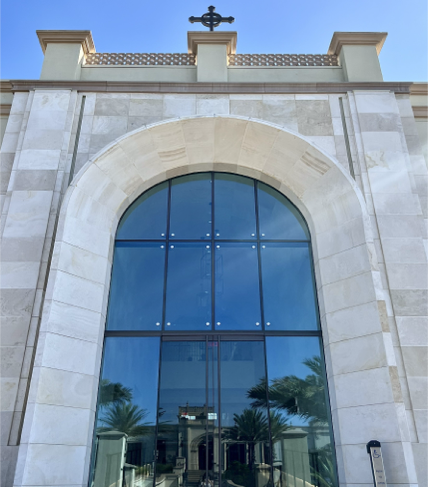
Knauss’ tall glass doors pose as a safety threat to students and faculty. Photo courtesy of Shannon Swars/The USD Vista
California has not experienced any deadly university shootings in 2024, according to Everytown for Gun Safety, which abates my fears somewhat. Though the idea that our campus community could be unprepared for an emergency situation, such as an active shooter, is still incredibly worrisome.
Captain Quentin “Q” Kawahara, the Department of Public Safety Captain, provided information on USD’s safety precautions in the case of an emergency. There are several safety measures in place to give students, faculty and staff peace of mind in the face of an emergency situation. These include license plate cameras at the campus entrances and well trained officers on duty at all times. However, these precautions do not guarantee the campus’s safety.
“Obviously it’s not 100%, but it generally does a great job of capturing those license plates that we can be looking out for,” Captain Kawahara said. “If there’s a greeter, or one of our kiosk officers on scene, they would be on the lookout.”
When I first moved onto campus four years ago, I was surprised to learn that there were no mandatory emergency-preparedness training sessions, especially for incoming first-year students. As someone who was unfamiliar with the campus, I would have been completely lost in the instance of an emergency. Captain Kawahara discussed a new online training course that went into effect this year. The training focuses on gun safety and is included in the mandatory online courses that students are required to take at the beginning of each semester.
“All incoming students and, I believe incoming transfer students, have to take this required online training,” Captain Kawahara said. “Within that training is an aspect of public safety that consists of the run, hide, fight training video, as well as the emergency procedures that are on our website, as well.”
Additionally, there will be in-person active shooter training sessions available to the USD community later this October. These presentations will be open to the entire USD community, and participants must RSVP to Captain Kawahara via email before the presentations. The Campus Emergency Procedures Review and Guidance for Surviving an Active Shooter/Assailant Situation presentations will be held on Tuesday, Oct. 15 and Thursday, Oct. 24 from 12:30pm-1:30 pm in KIPJ 215 and Saints Tekakwitha & Serra 104B, respectively. According to Captain Kawahara, attending these sessions and being well-prepared in the face of an emergency can be the difference between life and death.
“A lot of the time, the reaction to facing a critical incident is that you freeze, and seconds are critical in a reaction to that type of incident,” Captain Kawahara said. “If you’re mentally prepared…You’re able to prepare yourself and do what you need to do to survive the incident.”
Adding new mandatory online training and offering more emergency preparedness presentations is a step in the right direction, but my safety while on campus is still a major concern of mine. Because of the open campus policy, there is no way to guarantee the safety of the USD community, but ensuring that the in-case-of-emergency conversations are happening openly and often is critical to keeping ourselves safe. If the campus is to remain open to the public, it is up to us to be aware and prepared to handle an emergency situation.
The majority of Knauss’ classes have glass walls. Photo courtesy of Lauren Ceballos/The USD Vista


 The USD Vista
Leave a comment