EMMA PIRHALA / NEWS EDITOR
As USD’s campus transitions into fall, classes begin to fill with the noise of coughing and sneezing students. October marks the official start of flu season in San Diego with a slew of reported respiratory illnesses of patients of all ages. Sick students are a common sight on campus, and some students find issues with the presence of symptomatic students in lectures.
USD junior Elena Williams shared how sickness in class impacts her learning experience.
“Usually people being sick in class doesn’t bother me, but when people are coughing non-stop and aren’t wearing a mask it disrupts my learning,” Williams explained. “And it concerns me because I have family members who are immunocompromised and even though I don’t see them often, I don’t want to risk anything happening to them.”
Influenza, also known as the flu, is known for causing respiratory distress such as shortness of breath and coughing. Additional symptoms include fever, sore throat, fatigue and body/headaches. According to the Center for Disease Control and Prevention (CDC), the flu is spread by close person-to-person contact, making students living in college dormitories highly susceptible to contracting the virus. To prevent falling ill, the CDC recommends that everyone above the age of six should get the flu vaccination yearly.
The vaccine is available at most pharmacies and doctor’s offices, but this semester the USD Student Health Center (SHC) brought the in demand shots to campus, for free.
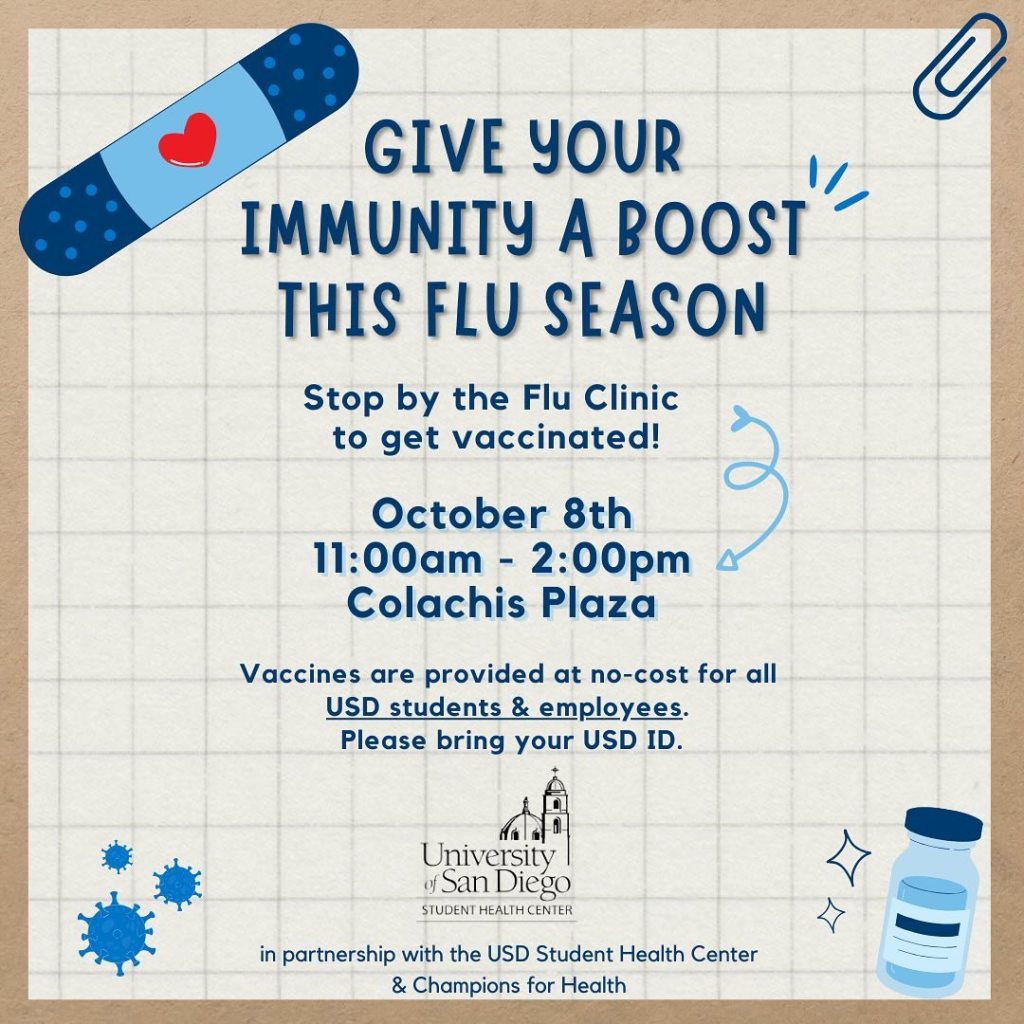
On Oct. 8, SHC partnered with Champions for Health, a local nonprofit, to provide flu vaccines to students and employees at no-cost on the Colachis Plaza. The initiative aims to ensure all USD community members have access to vaccinations. SHC is offering another free flu vaccine clinic scheduled for Oct. 22 at Plaza de San Diego open to all USD students. Daily appointments at SHC are also available for Toreros who cannot make it to the clinics. USD junior Caley Tamondong decided to get vaccinated against the flu at the clinic.
“I chose to get my flu shot this year because I get one every year to ensure that I do not get the flu,” Tamondong explained. “I didn’t even know about USD’s free clinic, but my friend asked me to go with her, so I thought why not get my own flu shot too. It was perfect because I had been meaning to get my shot but have been insanely busy, so the convenience of it was awesome. Also the fact that it was free was a huge factor in me getting it too. I didn’t even have to wait in a line, I just did the basic paperwork and got my shot in the span of like 5 minutes.”
As students attempt to protect themselves from the flu, other viruses are spreading amongst campus. COVID-19 is making a comeback at USD and throughout the County of San Diego. In August, San Diego’s COVID-19 positivity rate hit 20.5%, the second highest rate since the pandemic began. In a statement to USDTV, the SHC reported that student cases have also been on the rise. As of Oct. 5, positivity rates are continuing to decrease– returning to 6.9%.
However, COVID-19 and the flu aren’t the only viruses circulating; the bird flu is also flying around. The California Department of Public Health (CDPH) reported six confirmed human cases of the avian, or bird, flu in the state, as of Oct. 11. All six individuals were employed on a farm with infected dairy cattle.
According to the CDC, prior to 2024 only two human cases of the bird flu have been reported in the United States. The bird flu differs from the common strain as it is contracted via close contact with poultry and other birds. Although the symptoms are relatively similar, the bird flu is far more fatal. The Cleveland Clinic explained that the avian strain has a mortality rate of 50%. Nevertheless, the CDC stated that the risk to the general public is low, as no human to human transmission has been reported.
In September, WastewaterSCAN, a private testing service hosted by Stanford University, discovered bird flu in San Diego’s wastewater in Point Loma. The County of San Diego reported that follow-up testing did not indicate any presence of the virus in samples. Although there have not been any human cases of the bird flu in San Diego, incidents in cattle and poultry have been reported.
With increases in several viruses throughout the state of California, students stay vigilant with measures such as getting vaccines and wearing masks. Those experiencing symptoms of the flu are encouraged to schedule an appointment with SHC to test for the common illnesses. If positive, students should not return to class or normal activities until 24 hours after fevers or symptoms subside.
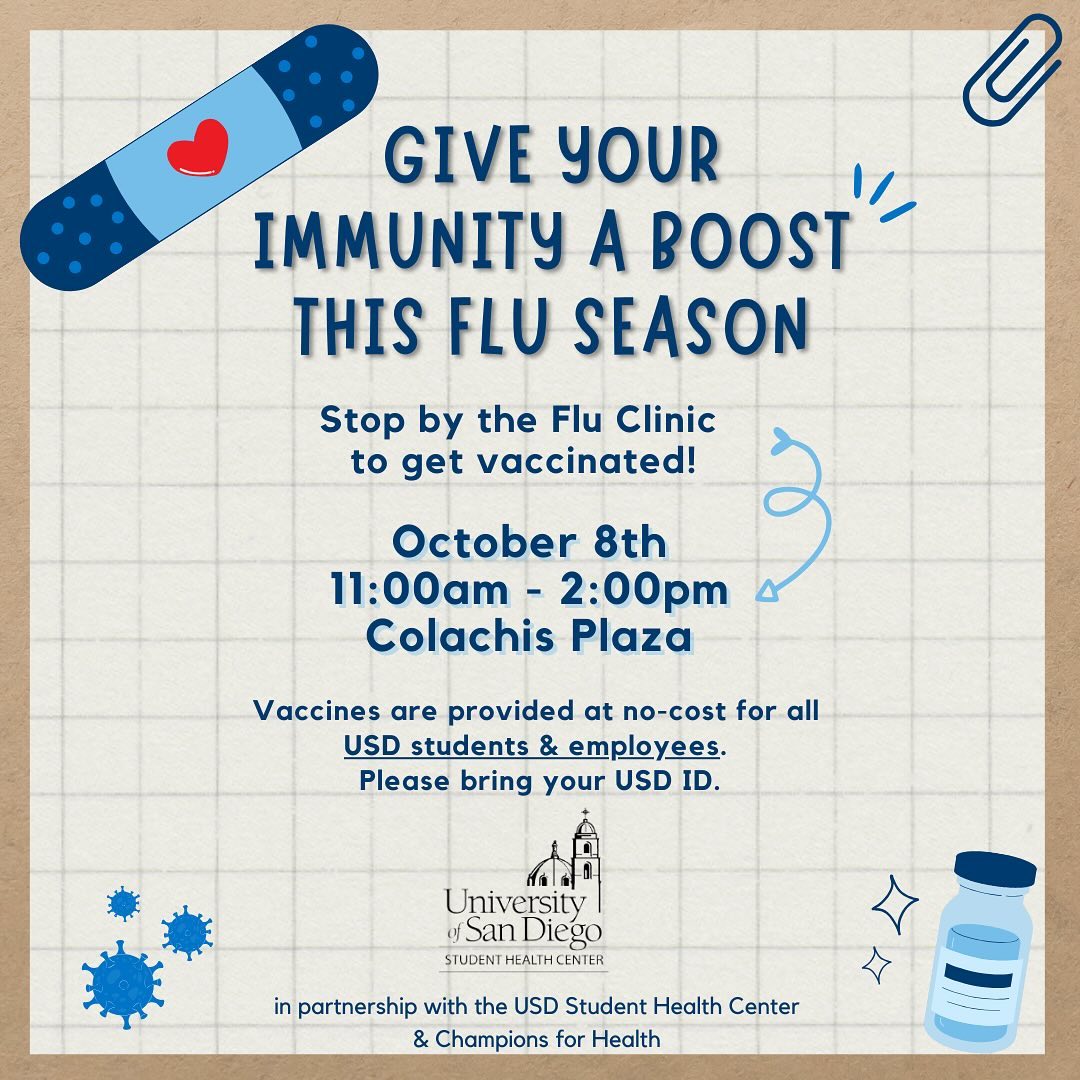
The USD Student Health Center partnered with Champions for Health to provide free flu shots on Oct. 8. Photo courtesy of @bewellusd/Instagram




 The USD Vista
Leave a comment