ELLIE SKJERSAA / ARTS & CULTURE EDITOR
The views expressed in this review are not necessarily those of The USD Vista staff, the University of San Diego or its student body.
During the Super Bowl LIX halftime show, in just a 13-minute performance, Grammy-winning rapper Kendrick Lamar was able to tell a story of racial inequality and the facade of the American dream. Through his complex lyricism, intricate choreography and many other subliminal messages, this performance has became a symbol for revolution. Lamar showed the world that art is capable of inspiring change.
As the performance began, a spotlight illuminated the center of the stage. Here, each portion of the stage took the shape of a button that would typically be seen on a video game controller. In the middle of the stage stood Samuel L. Jackson, who wore a star-spangled suit and introduced himself as Uncle Sam.
“It’s your uncle, Sam. And this is the great American game,” Jackson said as the performance began.
Between the physical video game controller on the stage and allusions to the game in which American life takes place, Kendrick told the world that to survive in America, you must play into the American dream. However, the game is controlled by those in power and has been built with the intention to exclude some while promising success and glory to others. In other words, the American dream is a game that some can’t win because they are not white enough to be granted access to it. Lamar does not want to play that game.
Historically, Uncle Sam has been a fictional character and symbol of the United States of America. Typically depicted as a white man, Kendrick’s choice to have Jackson play Uncle Sam illuminated how deeply embedded racism is in this country. Jackson is well-known for his role in Quentin Tarantino’s film, “Django Unchained” in which his character is eerily similar to his portrayal of Uncle Sam.
In the film, he played a slave who swore his allegiance to his slave owner and even expressed his acceptance of society’s ideals of white superiority which places Black communities in a position of inferiority and oppression.
Similarly, on the halftime show stage, Jackson paints Uncle Sam as a proponent of a system that openly harms and exploits people of color — a system that values capital over the well-being and equality of its people. Jackson’s portrayal embodied the spectacle and sentiment of nationalism that one may have expected to see in a Super Bowl halftime show, and he demonstrated this after Lamar performed his track “squabble up.”
“Too loud, too reckless, too ghetto,” Jackson said as the song concluded.

Samuel L. Jackson portrayed fictional character, Uncle Sam. Photo courtesy of @complexmusic/Instagram
This commentary suggests that Kendrick’s music does not belong in the mainstream status quo of a white America. It becomes clear that while Jackson is playing the American game, Kendrick is opposing it.
Lamar’s choice to have Jackson portray Uncle Sam is particularly worth noting because of his history within civil rights movements since the 60’s. After Martin Luther King Jr.’s assassination, Jackson attended his funeral as an usher and then flew to Memphis to attend a protest advocating for equal rights. He has consistently used his platform as an actor to shine light on the persistence of racism in the United States and has continuously fought for civil rights. All this to say, Lamar definitely chose Jackson to play Uncle Sam for a reason.
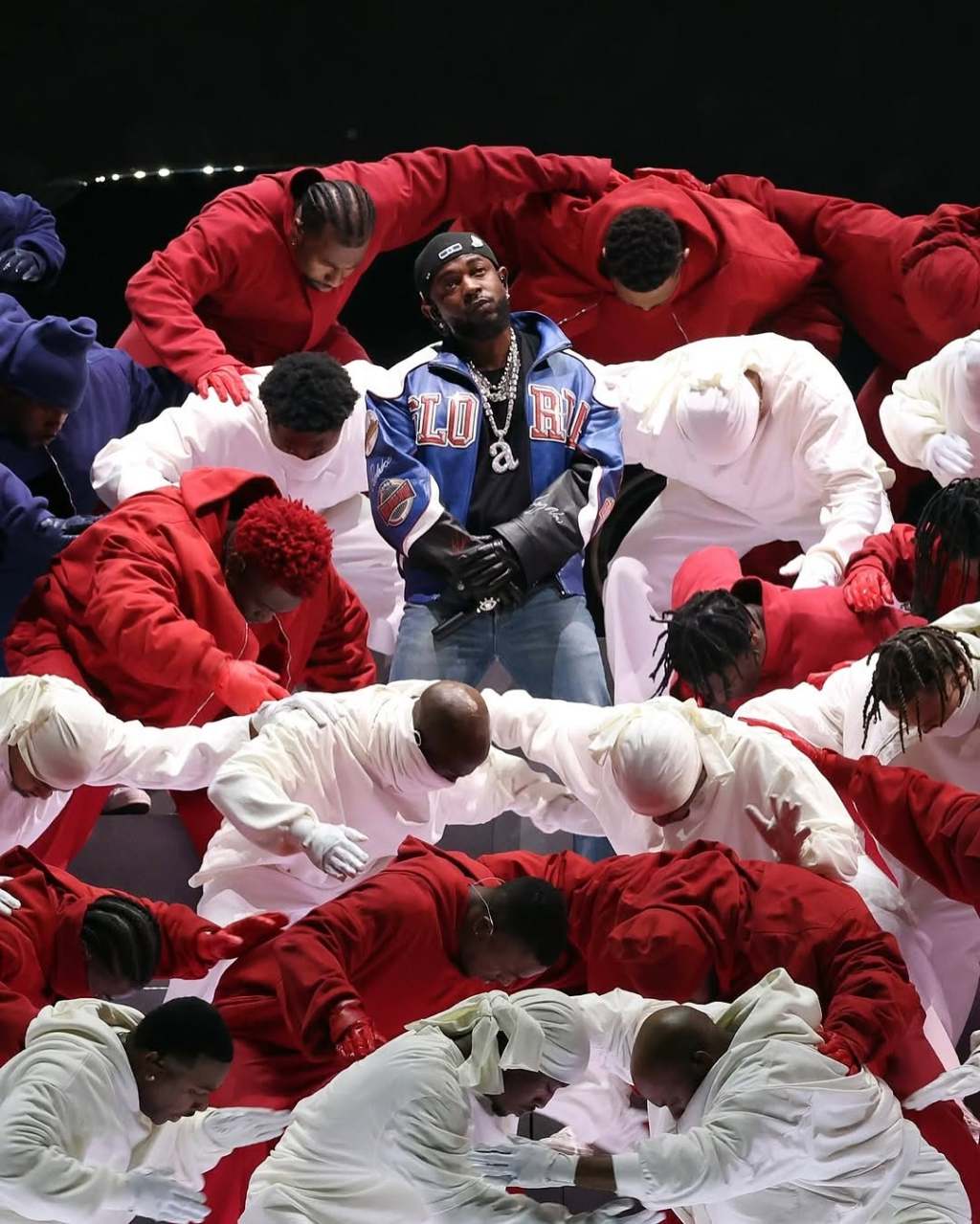
After Jackson’s opening, the camera pans to Lamar standing on the hood of a GNX, the namesake of his most recent album. He opened with a teaser of his song called “Bodies” as the audience watched a staggering and seemingly impossible number of backup dancers jump out of the car. The dancers were covered from head to toe in either red, white or blue. This can be interpreted as a double entendre. Not only are these the patriotic colors of America, but they are also the colors of the Crips and Bloods, popular gangs present in California and more specifically, Compton, where Lamar grew up.
The Black dancers in Lamar’s performance were also integral to the message he wove across the stage. Throughout the show, they physically formed the American flag during the song “HUMBLE” and then pulled away from one another. This could be symbolic of the lack of unity in American politics and culture or a representation of the Black blood, sweat and tears that went into the formation of the U.S..
With very important leaders attending this year’s Super Bowl, Lamar’s message was intentional and with consideration of those who would be watching. This year, President Donald Trump attended, making him the first ever president to go to a Super Bowl. Lamar took the opportunity to use his art not only as a form of resistance against the recent transfer of power, but also to shed light on America’s racist roots. With an all Black cast of performers and backup dancers, Lamar painted a picture of the Black experience across the stage, highlighting the flaws of a country shaped and founded on racism. He emphasized this point when clarifying that this was a performance with a message, not just an theatrical spectacle as seen in previous Super Bowl halftime performances.
“The revolution is about to be televised,” Lamar said. “You picked the right time, but the wrong guy.”
Here, Lamar referenced Gil Scott-Heron’s poem and song, “The Revolution Will Not Be Televised,” a phrase which has been used in protests across the world. Scott-Heron’s song critiqued the way in which television advertisements pushed people toward passive consumerism rather than tangible activism and could be seen as deliberate considering the advertising aspect of the Super Bowl. With millions of people watching the halftime show, he used the stage to wake people up and to send the message that the revolution is taking place right now on their television screen.
Even what Lamar was wearing could have deeper implications than what meets the eye. Although it appears Lamar was just wearing jeans, there may be more to the story. In mainstream media, denim is associated with the whitewashed stories of cowboys or rock stars. However, denim has undisputable links to the African slave trade.
Both cotton and indigo, which are used to make denim, were profitable commodities that were part of the crop-rotation in slavery. In addition, slaves were forced to wear denim which was then referred to as “negro cloth” for its ability to endure the inhumane working conditions. During the civil rights movement, activists often wore denim to symbolize unity and to demonstrate how little progress had been made since the Reconstruction era.
Lamar could have been alluding to the history of slavery in which the United States was built upon. Although messages like these are not directly said by Lamar during his performance, there is an assumption that everything can be interrogated with a sense of curiosity.
Lamar’s artistic creativity throughout the halftime show reflected the music he has released throughout the years. With songs like “squabble up,” “DNA,” Euphoria” and “TV off,” he transitioned the stage from a place of excessive spectacles and instead to a place of thought, poetry and systemic exposure. Onstage, SZA joined Lamar for the songs “gloria” and “All the Stars,” along with surprise appearances from tennis player, Serena Williams and record producer, Mustard.

The words ‘GAME OVER’ illuminated the stands. Photo courtesy of @complexmusic/Instagram
He concluded the show with his track, “tv off” while the people in the stands’ wristbands illuminated to show the phrase “Game Over.” Here, Lamar may be insinuating that it’s time to step away from the distractions of consumerism and to take action, or in other words, to start the revolution.
Every single moment in the show could have an extensive deep dive dedicated to a single dance move, a single phrase, a single flicker of emotion. That being said, there were certainly more messages Lamar snuck into his performance that highlight his work as an artist and a musician. Although there have been complaints and criticisms about Lamar’s halftime show, that may have been his intention from the start. People were not supposed to be comfortable because confronting the harsh reality of struggle and oppression some have the privilege to ignore is certainly not an easy process but is one that can begin.
Backup dancers formed the American flag around Kendrick Lamar. Photo courtesy of @complexmusic/Instagram
 The USD Vista
Leave a comment