
EMMA PIRHALA / NEWS EDITOR
The U.S. Conference of Catholic Bishops (USCCB) filed a lawsuit against the Department of State and the Department of Health and Human Services (HHS) following the freezing of funds for their refugee resettlement program. The program, which receives nearly $65 million from the Bureau of Population, Refugees and Migration (PRM), supports government-vetted refugees entering the country legally. The USCCB provides temporary financial assistance, employment referrals and other forms of assistance to incoming refugees. However, following a recent federal funding freeze, the fate of the services are in danger.
The bishops filed the suit on Feb. 18 against the State Department and HHS, who both played a role in the distribution of funds. The lawsuit came nearly a month after the organization received a letter from the Department of State announcing the Refugee Funding Suspension — an order freezing grants for programs supporting refugees moving to the country.
The Catholic Church in the U.S. has been involved in refugee resettlement for over a hundred years. In 1980, the USCCB partnered with the federal government to enhance and increase their operations. Dr. Mary Doak, a professor in USD’s Theology and Religious Studies Department, explained the partnership between the bishops’ programs and the government.
“It makes for a very nice partnership if the government has a government interest, [and] they’ve approved that these are all legal immigrants,” Doak explained. “They have a government interest in building up society and helping people get settled and become productive tax-paying citizens. That’s a government interest, and there’s a Catholic, and other Christian and other religious, interest in caring for our poor and vulnerable neighbors and helping them get on their feet and become flourishing members of the community in our circle of love. So, it works really well from both perspectives in general for them to have set this up, that they granted the money and the Catholic Church also raises more money.”
Rooted in the teachings of human dignity, Doak explained that the refugee assistance programs are intertwined with Catholic values.
“From [the Catholic] perspective, [assisting those in need] is also something that we need to be doing,” Doak stated. “We need to be caring for people in our midst and the vulnerable, especially. And we need money from all sorts of sources, including from the government, which can just raise a lot more money than [USCCB] can.”
USD Vice President for Mission Integration, Dr. Michael Lovette-Colyer, affirmed that the Catholic Church is uniquely committed to helping those who are most in need.
“A core value of the Catholic Church, and of USD as a Catholic institution, is compassionate service, especially toward the most vulnerable among us,” Lovette-Colyer stated. “As an anchor institution, University of San Diego has a long history of supporting immigrants and refugees, and we continue to support our university’s mission and values by giving back to our community, leading with love and upholding the dignity of all.”
The complaint explained that the State Department’s justification for the freeze was Trump’s executive order, which called for the revaluation of all foreign aid funding. Since the freeze was enacted, the USCCB has taken on millions of dollars in backpay to employees and refugees.
“As a direct result of the suspension, USCCB has millions of dollars in pending, unpaid reimbursements for services already rendered to refugees and is accruing millions more each week — with no indication that any future reimbursements will be paid or that the program will ever resume,” the lawsuit stated. “USCCB has already been forced to initiate layoffs for fifty employees. It faces irreparable damage to its longstanding refugee resettlement programs and its reputation and relationship with its subrecipients and the refugee populations it serves.”
The complaint stated that the State Department’s halt to USCCB’s funding is an overstep of power. Traditionally, Congress is responsible for allocating funds and creating budgets. However, Trump’s recent executive orders have overridden traditional regulations.
The Catholic Church and the Trump administration have had a tense relationship, dating back to Trump’s first term in office, when Pope Francis openly condemned the construction of the border walls. Since then, tensions have heightened. The pope recently issued a letter detailing the severity of the immigration crisis in the U.S..
“I have followed closely the major crisis that is taking place in the United States with the initiation of a program of mass deportations,” Francis wrote. “The act of deporting people who in many cases have left their own land for reasons of extreme poverty, insecurity, exploitation, persecution or serious deterioration of the environment, damages the dignity of many men and women, and of entire families, and places them in a state of particular vulnerability and defenselessness.”
in general for them to have set this up, that they granted the money and the Catholic Church also raises more money.”
Rooted in the teachings of human dignity, Doak explained that the refugee assistance programs are intertwined with Catholic values.
“From [the Catholic] perspective, [assisting those in need] is also something that we need to be doing,” Doak stated. “We need to be caring for people in our midst and the vulnerable, especially. And we need money from all sorts of sources, including from the government, which can just raise a lot more money than [USCCB] can.”
USD Vice President for Mission Integration, Dr. Michael Lovette-Colyer, affirmed that the Catholic Church is uniquely committed to helping those who are most in need.
“A core value of the Catholic Church, and of USD as a Catholic institution, is compassionate service, especially toward the most vulnerable among us,” Lovette-Colyer stated. “As an anchor institution, University of San Diego has a long history of supporting immigrants and refugees, and we continue to support our university’s mission and values by giving back to our community, leading with love and upholding the dignity of all.”
The complaint explained that the State Department’s justification for the freeze was Trump’s executive order, which called for the revaluation of all foreign aid funding. Since the freeze was enacted, the USCCB has taken on millions of dollars in backpay to employees and refugees.
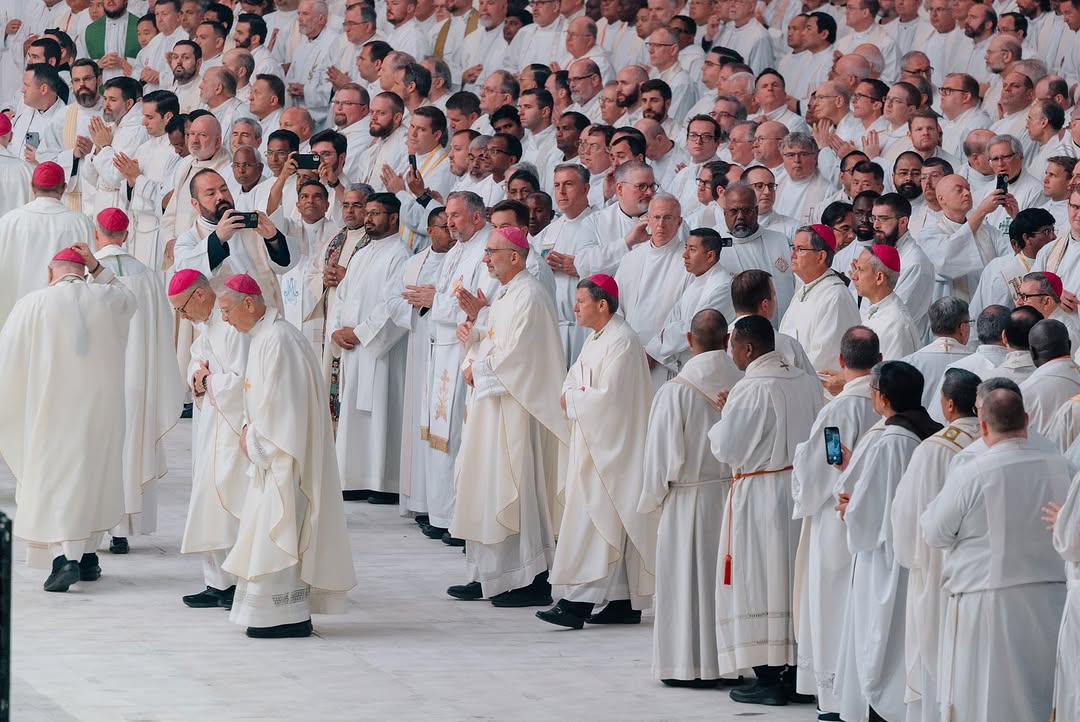
Bishops assembled at the National Eucharistic Congress, an event sponsored by the USCCB. Photo courtesy of @bpspalding/Instagram
“As a direct result of the suspension, USCCB has millions of dollars in pending, unpaid reimbursements for services already rendered to refugees and is accruing millions more each week — with no indication that any future reimbursements will be paid or that the program will ever resume,” the lawsuit stated. “USCCB has already been forced to initiate layoffs for fifty employees. It faces irreparable damage to its longstanding refugee resettlement programs and its reputation and relationship with its subrecipients and the refugee populations it serves.”
The complaint stated that the State Department’s halt to USCCB’s funding is an overstep of power. Traditionally, Congress is responsible for allocating funds and creating budgets. However, Trump’s recent executive orders have overridden traditional regulations.
The Catholic Church and the Trump administration have had a tense relationship, dating back to Trump’s first term in office, when Pope Francis openly condemned the construction of the border walls. Since then, tensions have heightened. The pope recently issued a letter detailing the severity of the immigration crisis in the U.S..
“I have followed closely the major crisis that is taking place in the United States with the initiation of a program of mass deportations,” Francis wrote. “The act of deporting people who in many cases have left their own land for reasons of extreme poverty, insecurity, exploitation, persecution or serious deterioration of the environment, damages the dignity of many men and women, and of entire families, and places them in a state of particular vulnerability and defenselessness.”
Following the filing of the case, U.S. District Judge Trevor McFadden denied the bishops’ request for a temporary restraining order. However, the case of the temporary injunction is still up in the air. McFadden requested further briefings from both parties. The case will continue and in the mean time the USCCB will have to re-evaluate the status of their refugee aid.
The U.S. bishops gathered in November for the Plenary Assembly held in Baltimore. Photo courtesy of @usccb/Instagram

 The USD Vista
Leave a comment