LILY ANDERSON / MANAGING EDITOR
Trigger warning: This article discusses topics of disordered eating, anxiety and depression.
The views expressed in the editorial and op-ed sections are not necessarily those of The USD Vista staff, the University of San Diego, or its student body.
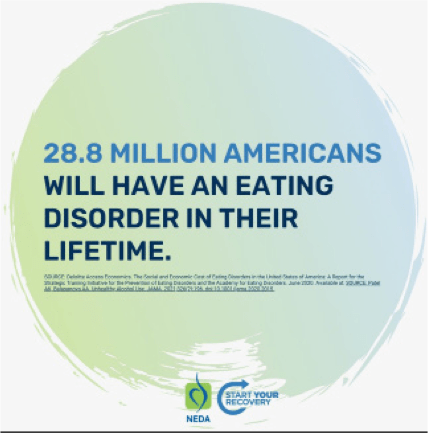
Feb. 20 through March 2 is National Eating Disorder Awareness Week. According to the National Eating Disorders Association (NEDA), 28.8 million Americans deal with an eating disorder at some point in their lifetime. The theme of this year’s awareness week is “The Time is Now,” aiming to emphasize the importance of sharing stories, finding resources and encouraging treatment. So, here is my story.
Throughout my time in high school, I struggled with anxiety and depression, and I developed an eating disorder as a way to cope. I reveled in the false sense of control that this gave me, and I did everything I could to deny there was a problem. On the outside, I tried to appear confident, happy and indestructible. On the inside, I was constantly and desperately trying to glue myself back together.
I wanted to be someone who loved themself, but I wasn’t. I was my own worst enemy. I transformed into a person I didn’t recognize, both in the mirror and in my mind. I stopped eating, talking to my friends and leaving my house because I was too cold to step outside in the dead of winter. Afraid to feel the emotions I knew were inside of me, I starved my brain of the nutrients it needed.
COVID-19 and the isolation that ensued only made things worse. The World Health Organization found that, in general, anxiety and depression increased by 25% during the pandemic. I continued to spiral, and I hit my breaking point when I was left to sit, think and come to hate the things I was doing to myself even more. Eventually, my family, my treatment team and I decided that a change desperately needed to happen before I dug myself into a hole I couldn’t get out of.
I realized that the change needed to come from within. If I wanted things to be different, I was going to have to honestly want to get better. I packed my bags and left for a residential program to help me sort out my eating and my mental health.
I was scared out of my mind and only told a handful of friends the day before I left. Besides a few weekly Zoom calls with my family, I had no phone or contact with the outside world. I was there for six weeks with six other girls, and it changed my life. I found a community who understood me. I devoted all my time and energy to shifting my mindset and habits, which eventually started working. I learned grounding techniques, coping skills and the perspective that I was simply selling myself short. I realized I was my own roadblock. Sick of setting myself up for failure, I decided I’d had enough.
While the experience was far from easy, I left with a glimmer of hope. I knew that I had the power to change with the tools and resources I had been given. No longer was I concerned with gaining weight. Instead, I wanted to gain back happiness. I wanted to regain a smile, warmth, love and the ability to become the person I wanted to be.
Since then, I have still struggled. I occasionally battle with thoughts surrounding food and my body. Recovery doesn’t just stop one day. Like fighting an addiction, it is something you commit to for the rest of your life. I now know that when the voice telling me not to take care of myself gets too loud, I can shut it down. I know that I never want to return to where I was during high school; I want to grow and learn and continue to help myself and the people around me.
I do this by being vulnerable and knowing when I need an extra hand to help hold me up during particularly stressful times, by reminding myself that I am worth so much more than any number or measurement and by focusing on intuitive eating and listening to the signals that my body is giving me. There are many tools out there that professionals can help you identify, and something different will work for everyone.
A couple of years back, I wondered if there was a point in stories like these. I’ve always been told that openness and shared experiences are important, but transparency can be terrifying. I wasn’t sure if opening up would actually have a positive impact.
The first time I posted online about eating disorder awareness, I was met with over 100 messages from friends and acquaintances thanking me for starting a conversation about the topic. One particular comment from a friend of mine validated everything I was hoping for.
“Lily, you are my inspiration, and you helped me find support,” she wrote. “You are so beyond strong, loved, and cared for! Proud of you.”
I realized in that moment that if I could help one person find hope, everything was worth it. I want you to know that you are never alone. If you are struggling with food, exercise, mental health, weight or intrusive thoughts surrounding your body, I have been there. 28.8 million Americans have been there. I hear you, and I see you.
There are resources here on campus that can offer support, such as the USD Counseling Center, located in Saints Tekakwitha and Serra Hall 300 or reachable at (619) 260-4655, and the health center, located in Maher Hall 140, which can be contacted at (619) 260-4595. Speaking to a trusted adult or close friends is another great way to begin the process of finding help.
If you know someone struggling with disordered eating, it can be challenging to understand how to best offer help. I recommend approaching the situation with grace. Avoid making any accusations or diagnosing their behavior. While good-natured, interventions can often result in increased secrecy and defensiveness.
Instead, check in regularly, show them you are always there to listen and be honest about your concerns. Encourage the involvement of a professional and emphasize that additional support is needed. Everyone’s journey will be different, and finding the right path can take a while. It may take multiple conversations until they feel comfortable being candid about what they’re going through, so be patient and show love.
Disordered eating occurs in many different ways — it is not “one size fits all.” No matter your experience, your struggles are valid and you are worthy of support. You are not broken, and this is not permanent. You deserve to love yourself and feel loved no matter what you look like. You deserve to experience excitement and build community around food, not sit with fear. Choosing to change my mindset and actions has led to so much more joy than I ever thought possible. Asking for help is much easier said than done, but it is so worth it.
I believe in you. Break the silence. Stop the cycle. The time is now.
With love and gratitude,
Lily Anderson.
Eating disorders heavily impact Americans and are more common than many may think. Photo courtesy of @neda/ Instagram




 The USD Vista
Leave a comment