EMMA PIRHALA / NEWS EDITOR
The University was recently hit with two lawsuits related to employment at USD. The lawsuits claim that the University failed to provide meal and rest periods, keep accurate records of shifts and breaks, failed to reimburse employees for job-related spending and failed to compensate employees after termination. The first case was filed in August 2024 by an estimated class of 40 unnamed current and former hourly-paid employees. The lawsuit also includes a named employee, Maria Gabriela Verdugo, who worked for USD from June 2021 to October 2023, as a plaintiff. The lawsuit did not specify which departments the current and former employees worked in.
In October 2024, Verdugo filed another lawsuit accusing the University of the same offenses. Both lawsuits named the University and 10 anonymous “Does” as defendants. USD’s attorneys filed a response to the first lawsuit on Oct. 24, 2024 denying any wrongdoing. Shortly after, the University’s attorneys asked the court to consolidate the two cases for efficiency.
The USD Vista obtained a copy of the lawsuit through a public records request. The suit claimed that USD violated several labor laws.
“Defendants failed to pay for all hours worked … failed to provide Plaintiff with legally compliant meal periods, failed to authorize and permit Plaintiff to take rest periods, failed to timely pay all wages to Plaintiff when Defendants terminated her employment, failed to furnish accurate wage statements to Plaintiff, and failed to indemnify Plaintiff for expenditures,” the class action complaint stated.
The lawsuit is centered around the claim that the University failed to provide meal and rest periods, keep accurate records of shifts and breaks and failed to compensate employees after termination.
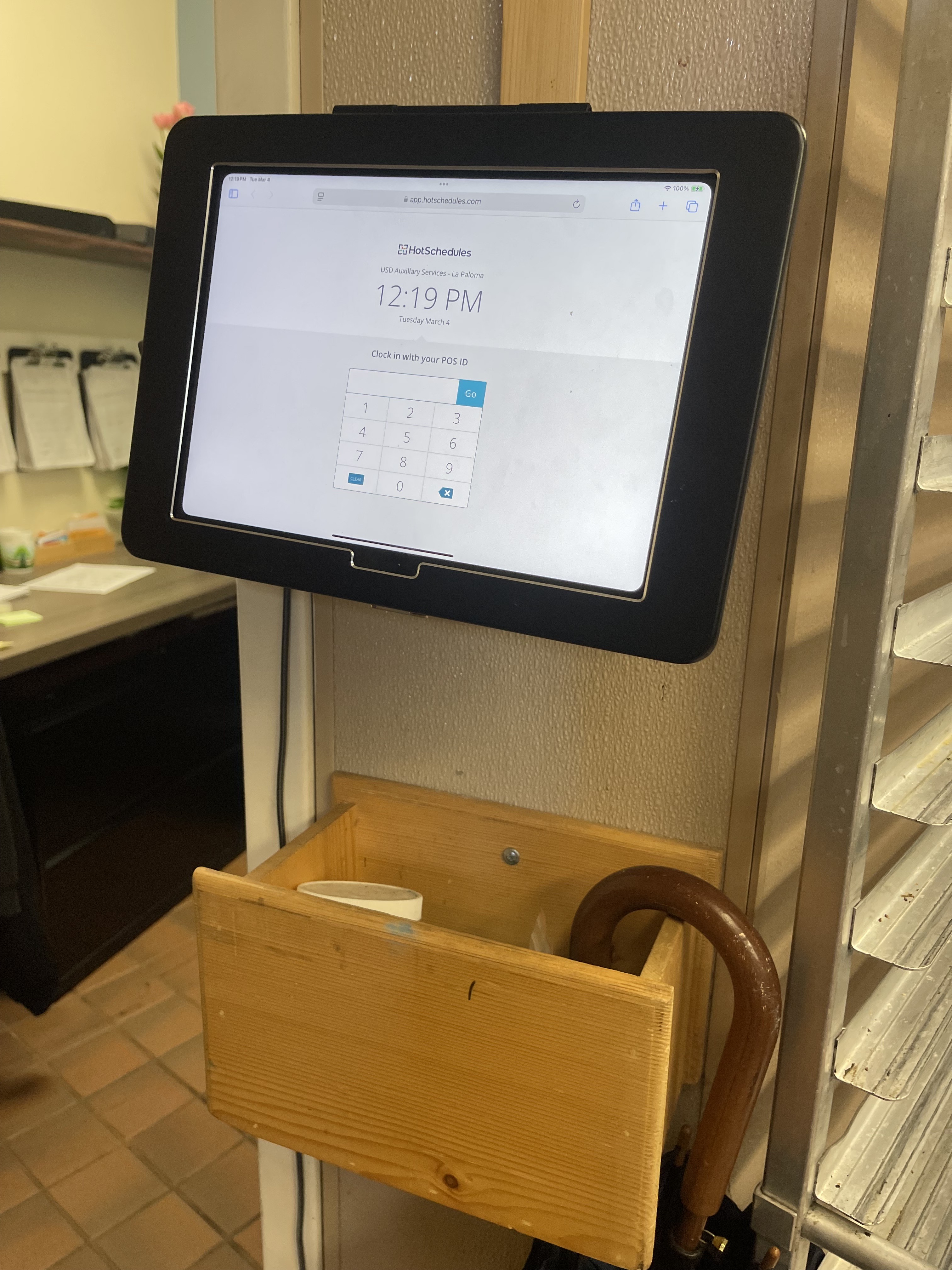
New iPads have been implemented campus-wide so that workers can clock in and out for shifts and breaks. Photo courtesy of an anonymous employee
“Defendants maintained a policy and practice of not paying Plaintiff and the Class for all hours worked, including minimum, straight time, and overtime wages,” the lawsuit claimed. “Defendants required Plaintiff and the Class to work ‘off-the-clock,’ uncompensated, by, for example requiring Plaintiff and the Class to perform work prior to clocking in for the workday, during unpaid meal periods, and after clocking out for the workday … In failing to pay for all hours worked, Defendants also failed to maintain accurate records of the hours Plaintiff and the Class worked.”
According to the lawsuit, California law requires a ten minute uninterrupted rest break for every four hours of work, or major fraction of four hours. Similarly, as stated in the lawsuit, California law requires that employees take meal periods before the sixth hour of their shift. If a break is missed for any reason, then an employer must legally compensate the employee an additional hour’s worth of pay.
The USD Vista contacted the attorneys representing Verdugo and the class and the plaintiff to learn more about the case and Verdugo’s employment history at USD. Despite three attempted contacts, the attorneys did not respond.
The USD Vista reached out to the University’s media relations team for comment on the case. However, they declined to comment on the pending litigation.
Although the lawsuit does not mention the departments that the case focuses on, USD Dining has implemented campus-wide changes to how employees clock-in and out for shifts and breaks. On Jan. 31 of this year, five months after the first suit was filed, managers at different dining locations across campus contacted employees to emphasize policies regarding breaks, as explained in emails that The USD Vista obtained anonymously from student-workers.
“We are now utilizing a manual clock-in the system,” an email to Bert’s Bistro employees stated. “The clock on the iPad is located right outside the office. You will be required to clock out for every single break to document you are taking your breaks. This has been implemented campus-wide.”
Another email explained the campus-wide push to enforce breaks.
“It’s extremely important that we use the WebClock,” an email sent to workers at Tu Mercado read. “We have to punch in at the beginning of each shift and at the end of each shift. We also have to punch in / punch out for Every Break in between. This is being monitored.”
WebClock refers to a time-keeping program which is often utilized by workplaces to accurately record hours worked by employees.
In addition to reinforcing the rules about breaks, employees were required to sign documents acknowledging USD’s policies regarding breaks.
“I have been reminded about and I am aware of USD’s policies governing meal breaks and rest periods,” the acknowledgement read.
The document further cited regulations about when to take breaks and emphasized that employees are responsible for taking the breaks as scheduled by their supervisor.
The lawsuit has impacted the day-to-day experience of student-workers on campus. Student-workers from different locations within USD Dining noticed a shift in operations following the lawsuit. A student-worker who has worked at an on-campus restaurant in West Campus for at least the past year explained the environment surrounding breaks before the lawsuit came to light. The student declined to have their name published due to fear of retaliation.
“Prior to this semester, we were allowed to take breaks basically whenever we wanted,” the student worker said. “But there was really no one telling us when to take our break, and there was also no one checking to make sure that we took our break.”
However, at the start of the semester, the same student-worker began to notice a change in how their managers handled breaks. The worker elaborated on this change.
“Now, we have scheduled breaks,” the employee said. “So they tell me when to take it. I also have to clock in and clock out for my break. Prior to that, they had no restriction on your break.”
Another student working at the same location since last year also noticed the shift in their working environment. The student also declined to have their name published due to fear of retaliation.
“I feel like they’re a lot more strict about [taking breaks],” the worker stated. “In the fall, it was kind of like, ‘Oh yeah, you can waive your breaks, you can kind of just take it when you want, when it’s convenient for you,’ and now it’s ingrained in your schedule. If you have a long enough shift, your 15 minute break is on HotSchedules.”
HotSchedules is an application that schedules shifts and meal/rest periods for employees to ensure accurate recordkeeping. On top of scheduling breaks using HotSchedules, USD Dining has also implemented new iPads in all dining locations to track breaks.
Another student employee employed at a dining location in the Student Life Pavilion (SLP) since last school year, corroborated the notion of a stricter environment regarding breaks and spoke on the new implementation of iPads to track breaks at the start of the semester. Like other student-workers, the student declined to have their name published due to fear of retaliation.
“In essence, when you come into work every day you have to check-in using the iPad and clock in and clock out, in addition to adding your hours on Workday,” the student-worker said.
While campus dining locations have changed the way they track hours and breaks, the class action lawsuit against the University is still ongoing. Both parties addressed the court during a virtual appearance in January to present their arguments for and against the consolidation of the cases. This motion has not been decided by the court yet. A future hearing is currently scheduled for May 9, 2025. The USD Vista will continue to provide updates on the lawsuit as the case progresses.
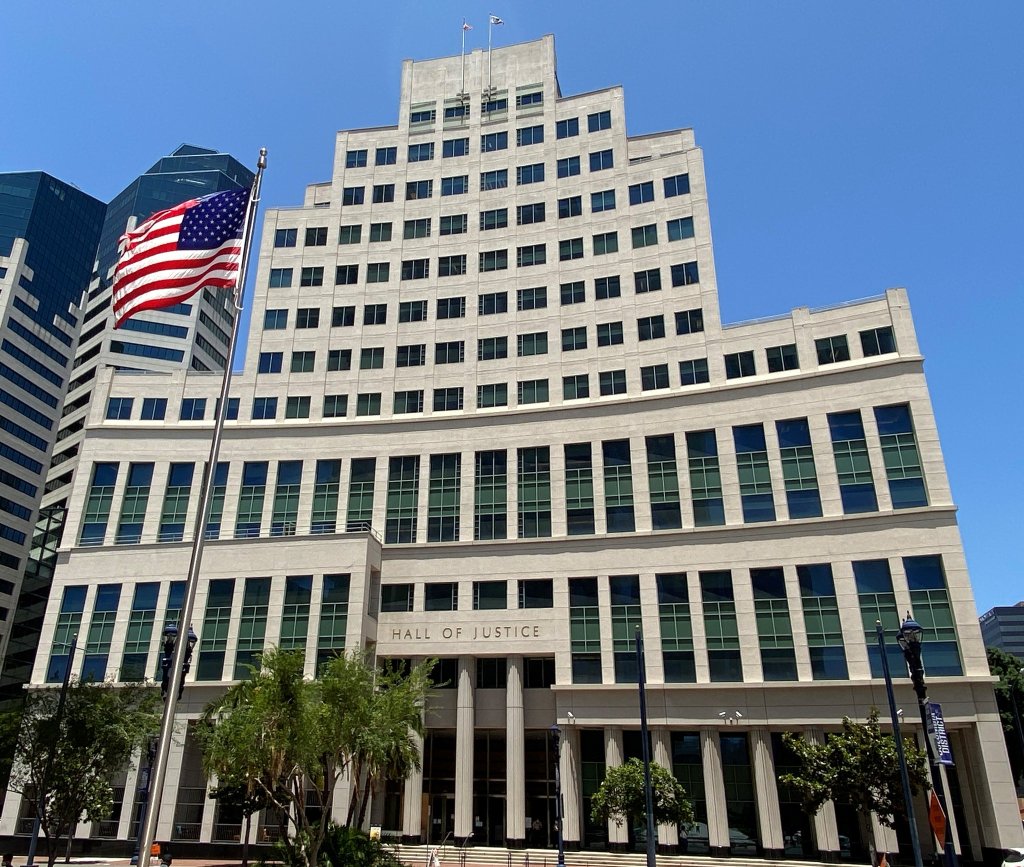
The next hearing will take place in San Diego’s Hall of Justice courthouse on May 9, 2025. Photo courtesy of @sdsuperiorcourt/X

 The USD Vista
Leave a comment