ELLIE SKJERSAA / A&C EDITOR
LARA DOMINIQUE SOLANTE / COPY EDITOR
Every Wednesday night, locals and tourists alike gear up and head to PB Shore Club for the weekly 9 p.m. goldfish racing tournament. Participants buy a spot in the bracket for $5 to get a chance to be that week’s goldfish racing champion.
Before the race, goldfish sit in clear plastic cups filled with water and wait their turn to compete. Participants use straws to blow the goldfish across the finish line in side-by-side tanks filled with water. Whoever gets their goldfish to the edge of the pool the fastest, wins. Then, the winner of the race moves on to the next round in the tournament.
This area is known for its vibrant nightlife, large variety of restaurants and of course, the beach. With the bar not being too far from the crashing waves, USD students often find themselves joining in on the excitement.
USD senior Katie Berris has attended two goldfish races largely due to the fact that her friends were going.
“It’s definitely a social phenomenon,” Berris said. “I go [to the goldfish races] for the social aspect. I like being with people and because there’s an activity it’s always really crowded, so you’ll always find someone to talk to.”
For USD junior Sophia Zaboukos, attending the goldfish races was a no-brainer for her and her best friends’ 21st birthdays, which just so happened to land on a Wednesday.
“We brought as many friends as we could and all had a fun time,” Zaboukos said. “Luckily, because it was our birthday, they let us race, but usually you have to get there super early to buy a spot in the bracket. We didn’t take it too seriously, it was just because it was a super fun idea. I did win a round, which was so fun.”
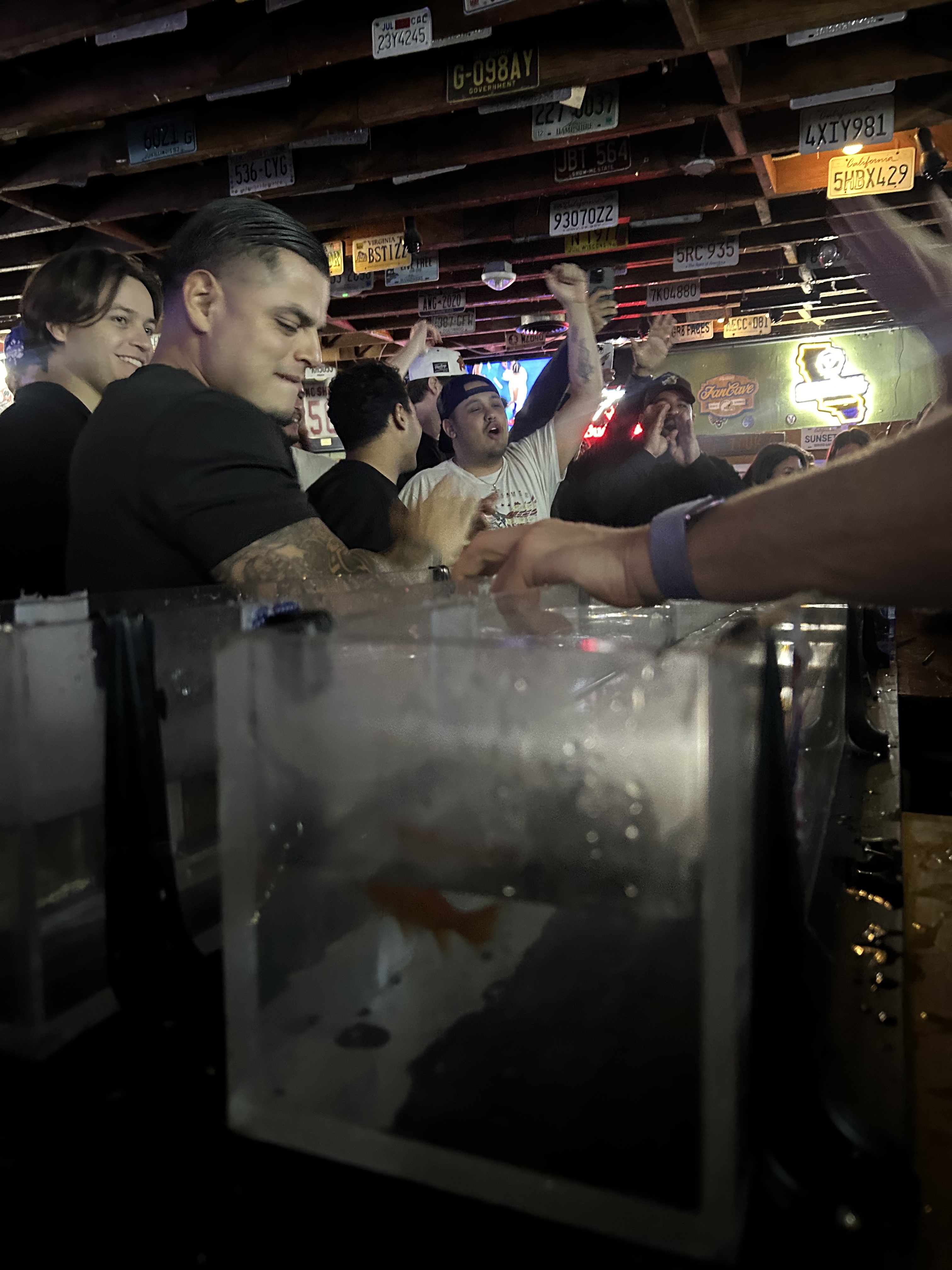
The fish races take place weekly on Wednesdays. Lauren Ceballos/USD Vista
The infamous goldfish races have taken place weekly since the establishment of the PB Shore Club in 2007. Every Wednesday, people gather in lines which wrap around the street as a result of the race, signaling the competition’s immense success throughout the years. Employees enthusiastically work their rounds through the bracket. Throughout the heats, one employee utilizes a megaphone and acts as the emcee for the crowds in the room. While the fish races are in full force, simultaneously there are TVs set up with other sports games outside, yet the crowds flock to the tanks on floor two of the venue. However, on the ground below, animal advocacy groups have began calling out the bar for their practices – protesting the races altogether with signs and chants.
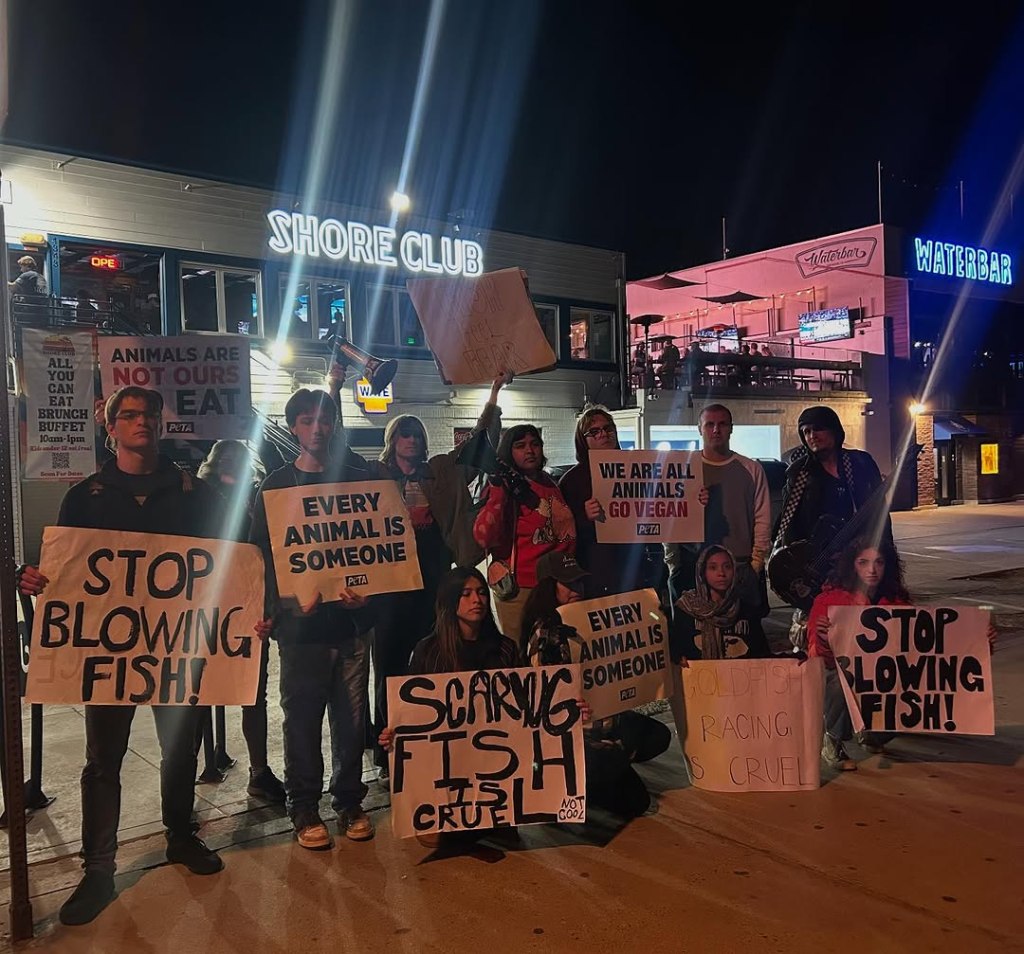
Occasionally, protestors have gathered outside of PB Shore Club, holding signs that say, “EVERY ANIMAL IS SOMEONE” and “STOP BLOWING FISH!” Even on her birthday, Zaboukos saw the protestors in action.
“There were protestors outside Shore Club when we went,” Zaboukos recalled. “I completely understand where they’re coming from, but personally, I don’t have too much of a problem with it. Those fish brought all my friends and I out on a Wednesday night, and it was the best time.”
The recent protests against the PB Shore Club have raised concerns about the morality behind the practice. Using live animals for entertainment has been criticized over the years as unnecessary and cruel. Circuses, zoos and places like SeaWorld have been confronted with these critiques for years due to the harsh living conditions and treatment that these animals receive behind the curtain of glitz and glamor. Groups like People for the Ethical Treatment of Animals (PETA) and the Animal Welfare Institute have used their resources to fight against the maltreatment of animals.
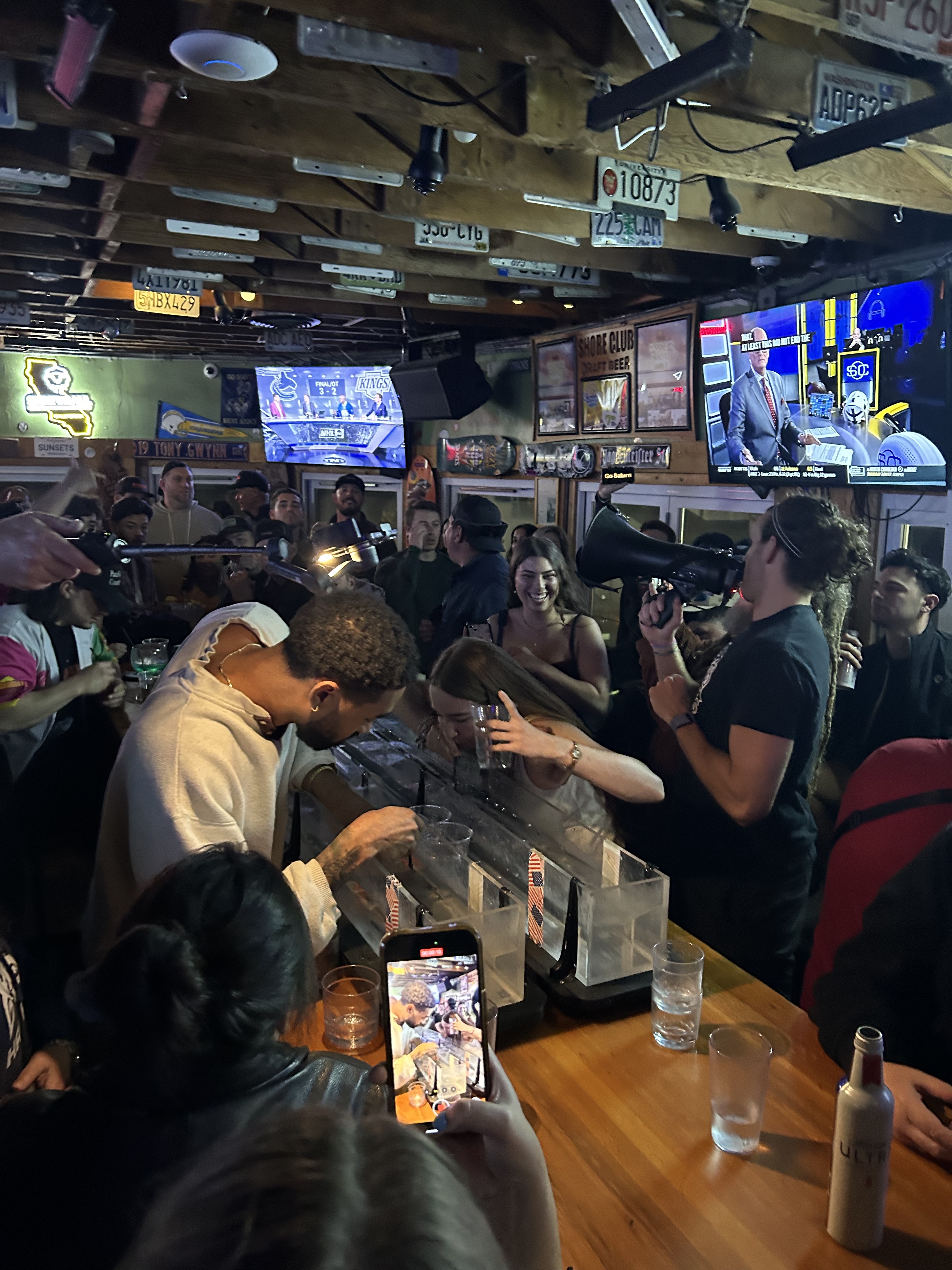
Contestants compete against one another by blowing the fish through straws. Lauren Ceballos/USD Vista
“Animals aren’t actors, spectacles to imprison and gawk at, or circus clowns,” PETA said in a statement on their website.
Most of the criticism from activists stems from the idea that animals are not ours to use, especially because animals have no choice when it comes to their presence in the entertainment industry.
The treatment of animals is another driving point. Animals such as elephants and bears are often stuffed in cages, forced to perform life-threatening stunts and are separated from their families. Similar points have been made about PB Shore Club’s goldfish races.
“The principle of what we are doing is wrong,” Berris said. “I think the only justification that people have is purely the fact that goldfish brains are so much smaller, but still, they are definitely not treated well. You see them swimming and to make them move you literally blow through a straw. My first thought was, ‘What if someone was blowing through a straw and making me move?’”
USD senior Sarah Attia shared a similar sentiment. During one of her first visits to the bar, she participated in the tournament for her first and last time, simply because she felt bad about the goldfish afterward.
“I do feel bad about the fish,” Attia shared. “I feel like it wouldn’t be as bad if they just used a different type of object. Like why torture an animal when you could probably have the same game with the same effect if you, like, put a fruit loop in the water and blow on it.”
Although the PB Shore Club’s goldfish racing has garnered a lot of negative attention, the event still persists weekly, attracting Pacific Beach locals, tourists and USD students alike. Some may see it as harmless fun, while others criticize the establishment for its use of live animals for entertainment. As the goldfish take their turn each week being blown across the tanks, participants will continue to consider whether or not the fun is worth the ethical cost.
Protestors with PETA are seen on Wednesdays outside of PB Shore Club. Photo courtesy of @boldactivists/Instagram



 The USD Vista
Leave a comment