JOSHUA FEINGOLD / CONTRIBUTOR
This past spring break, USD’s University Ministry (UM) sponsored a week-long education and service trip for students called “Tijuana Spring Breakthrough” in San Diego and Tijuana, Mexico.
I went along with them to explore Tijuana and gain experience working in communities across the border. University Minister Alec Hartman led the trip, along with USD seniors Giulio Fernandes and Emma Vigil. Hartman, who has led many trips to Tijuana with UM, explained the essence of these trips.
“Grounded in the Catholic Social Thought principles of human dignity, solidarity, the common good and the preferential option for the poor, this experience seeks to build relationships that transcend physical, cultural and societal barriers, uniting us through our shared humanity,” Hartman said.
For two nights, the group slept in the Our Lady of Guadalupe Church shelter in San Diego, which was previously migrant housing. The funding for the shelter had been shut off the week before due to sprawling federal cuts.
During this time, the students visited the San Diego Border Patrol Sector headquarters in Chula Vista and learned about the functions of border patrol and the Department of Homeland Security.
The group also visited the Otay Detention Center, a privatized detention facility which contributes profit to a billion dollar industry. After that USD students attended a Mass at a makeshift church along the border where everyone joined together in a prayer service with the hopes that Friendship Park would reopen soon. Friendship Park was an initiative that created a shared space at the border where Mexicans and Americans could spend time together and connect. It first closed due to COVID-19 in 2020 and subsequently for the construction of a new border wall.
The following day, the group paid a visit to the Neighborhood Peace Church. USD alumni and MECHA member, Pedro Rios, Director of the U.S. Mexican Border Program
of the American Friends Service Committee, talked to the group about the work he does. The organization helps people with legal documentation, offers attorney information, promotes allyship, works with the police and now provides “Know Your Rights” training with community members. They also provide water, food and medical care to migrants. The federal cuts affecting Our Lady Guadalupe Church also cut off funding for organizations like the one Rios works with.
“We’re on defensive mode because so many programs are being shut down,” Rios explained.
Rios has not been deterred and continues to assist the community through advocacy work.
“Join something that already exists and go to community groups,” he stated in reference to those who want to help people in need.
As the weekend in San Diego came to a close, the group set out for Tijuana. They made their home-base the Parroquia María Inmaculada, a Catholic church that serves communities in the eastern outskirts of Tijuana. It has welcomed USD students, faculty and staff for decades. The Parroquia is a center of community in a region affected very tangibly by poverty. Their work primarily serves the impoverished.
After their fill of welcome flautas, USD students took the opportunity to sit in on a roundtable meeting with the parish workers. These people all come together from different fields to satisfy the needs of their community; there were young men and women in medicine, law, divinity, industrial engineering, communications, psychology, music, education and social work.
The parish leader, Father Jesse, stated that their work is need-based. They interact directly with the community to determine the issues at hand and then address them. Rather than a top-down bureaucratic approach, the Parroquia utilizes a grassroots bottom-up strategy, which delivers services directly and efficiently.
The following day, the group visited a school for children with special needs. Because it was raining the day they visited, school was cancelled. In certain areas of east Tijuana, the infrastructure is unprepared — rain can cause flooding and make it difficult for regular functions to occur.
On Wednesday, they visited Casa Del Migrante, a shelter for migrants, deportees and refugees. The aim of Casa Del Migrante is to support families until they receive employment. Along with free room and board, people are offered job training, spiritual help, guidance, basic medical attention and human rights support. Legal advice and social services are provided as well. A Mass was held and people from Guatemala, America, Nicaragua, Mexico and El Salvador gathered together in communion.
As students entered the building, a hallway opened up to three stories with a small area in the middle for communal activities. Colorful decorations lined the bannisters, leading to rooms on all sides. Everyone began playing games with the children that were there, and laughter echoed to the ceiling.
USD first-year Maximiliano Acosta reflected on his time at Casa Migrantes.
“[A] great part was how a simple game of Loteria, despite most of the group not speaking Spanish, brought us all together in joy and happiness,” Acosta explained. “This showed me that no matter where you are from, or what language you can speak, you can always connect and create meaningful memories with one another. This trip brought me hope and taught me that anyone can make positive change in whatever community they are in.”
It was evident there was a disconnect between the elation of the children and the despair of their parents. Tearful mothers took refuge in their sullen husband’s arms. This was their last resort. A pair of migrant brothers were discussing that after one more night, they were going to go back to live on the street. This was their reality.
Co-leader Fernandes was able to relate the trip to his own upbringing.
“The experience revealed the deep injustices and resilience woven into the borderlands,” Fernandes stated. “As a product of immigrant parents, these realities are something I’ve always been familiar with. Solidarity — rooted in presence, humility and mutual respect — is more powerful than charity could ever be.”
Later in the week, the group were guests of Albergue las Memorias, a medical facility assisting and caring for adults and minors living with HIV/AIDS, tuberculosis and related diseases. The facility is run by the Las Memorias Shelter Civil Association, which provides these services to all residents for free. As the group was leaving, an ailing woman called out from her wheelchair in a dimly lit corridor.
“Don’t forget about us,” she said.
USD senior Julia Swenson-Wilkes responded as everyone trod out the door onto a rain soaked sidewalk.
“We won’t,” Swenson-Wilkes replied.
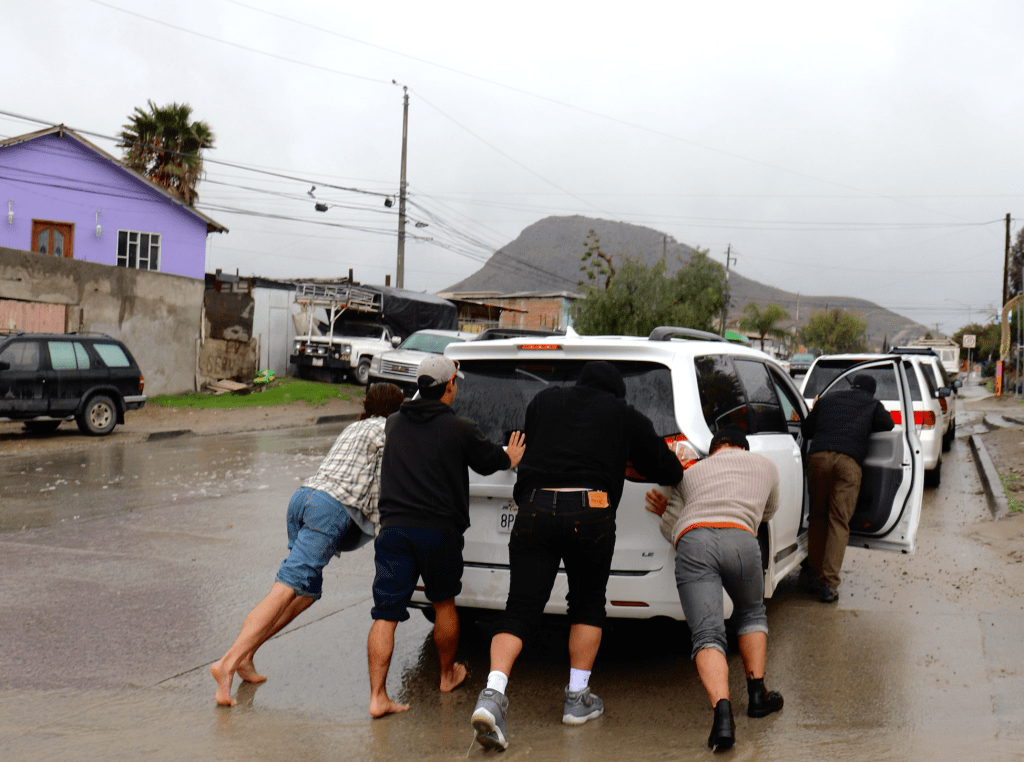
While returning to the parish from Albergue las Memorias, the group came across a flooded intersection. Cars were strewn about on the side of the road as a torrential downpour soaked a concerned owner of a disheveled vehicle, peering at the damage to their frame. Students eyed the flooding ominously, knowing that a treacherous impasse was approaching. The engine revved and the car plunged forward. Torrents of water gushing from the mountainside rose up over the bumper — going, going and nothing. The engine cut. It took only a few moments for everyone to look at each other, get out and push the van to safety.
Luckily, workers from a nearby hardware store raced to help and tried to jump the van to no avail. Hartman called the parish and had them tow it back and fixed it for no cost. Despite having no obligation to help out, the community was graciously offering their services.
In one of the two remaining vans, some of the students dropped off toys to a local orphanage.
That night, UM gathered to deliver care packages with basic necessities to those most in need around the community. They finished the evening with a community karaoke competition equipped with dancing, tamales and USD’s own Izzie Ramirez, a senior, taking home the prize as karaoke champion. Ramirez donated the prize back to the Parroquia.
“In these conversations, these stories, this vulnerability, we are called to action with a newfound understanding that all are welcome, and being able to experience that firsthand,” Ramirez reflected. “[It] put a fire in my heart for social justice rooted in humility and love for my neighbor.”
Tijuana Spring Breakthrough was a glimpse into the real impacts of injustice and the power of community. Students returned to campus with a deeper sense of responsibility and shared humanity.
In Tijuana, the engine of the University Ministry’s van gave out, and the community came together to fix it. Photo courtesy of Joshua Feingold


 The USD Vista
Leave a comment