MAE O’MALLEY / ASST. NEWS EDITOR
As the Class of 2025 graduates this spring, students are preparing to take on the job market and enter the workforce. The new Department of Government Efficiency (DOGE), created by President Trump at the beginning of his second term, is making efforts to increase productivity within the government by initiating layoffs. Not only are these employees’ lives affected by losing their source of income, they will now enter the job market and compete with the incoming Class of 2025.
Though Trump’s orders to increase layoffs have intensified the competitiveness of the job market, other factors have led to increased pressure since the pandemic.
Additionally, some hiring managers have admitted to posting “ghost jobs” on job boards, meaning that the positions are nonexistent or have already been filled.
According to a 2024 MyPerfectResume survey, 36% of employers admitted that a quarter of their job postings were made up.
Other potential candidates have complained about strenuous application processes, with some jobs reportedly mandating over five interviews before being notified of a decision.
While these statistics affect all potential employees, college graduates face their own set of issues. The U.S. Chamber of Commerce has reported that the past two decades have seen a 117% increase in workers aged 65 and over remaining in the workforce. This entails that the rate of jobs being turned over from retirees to recent graduates has decreased.
Additionally, Gen Z and millennials are gaining a reputation for only accepting jobs or projects that align with their values and ethics. This distinction has kept 50% of Gen Z workers and 43% of millennials from taking on assignments that combat their personal beliefs.
These generations have also started taking into consideration the mental health benefits that workplaces may offer or the practices put into place to combat inequality.
USD sophomore Brandi Upshaw is a biochemistry major who is working on a research project this summer. Upshaw weighed in on the requirements she had when it came to looking for a job.
“Honestly I was just trying to find a job, I wasn’t really picky,” Upshaw said. “As long as it was related to biotech or bio-pharmaceutical internships, it worked for me. I am just trying to do anything to gain relevant work experience that will help me in the future.”
The need for a bachelor’s or more advanced degree has also become an important distinction when it comes to choosing one employee over another. In the past 24 years, there has been a 7% increase in the number of bachelor’s degrees earned and a 5% increase in the number of master’s and doctoral degrees earned. The most popular bachelor’s degrees in the last decade have been in business, health care and social assistance and social sciences.
Some students debate whether or not college degrees are necessary in today’s job market. USD junior Simon Diaz spoke about his feelings towards needing a degree.
“I think it really depends on what you’re interested in,” Diaz said. “I feel like social skills and connection will get you further if you’re going into sales or something, but obviously going into a medical field you would need a degree. I do think a degree can show commitment and a strong work ethic which I feel like a lot of employers look for.”
USD junior Hannah Park majors in biochemistry and plans to attend med school after taking a gap year. Park commented on the burdens she has faced when preparing for her future in healthcare and pursuing certain professions.
“As there becomes a shortage of essential healthcare workers, there seems to be more barriers of entry for us undergraduate students who want to pursue a career in healthcare which, in my opinion, doesn’t make sense,” Park stated. “On top of that, so many different sources will tell you that there’s a shortage of anesthesiologists, emergency doctors or therapists and will try to urge people to go into those areas. I feel like this pressure overshadows other vital jobs such as becoming a nurse, [physician’s assistants] or going into public health.”
The U.S. Chamber of Commerce has reported that some of the most important skills recruiters look for in potential employers today are understanding of artificial intelligence, sales leadership, creativity and persuasion. While some students are not graduating yet, many continue to boost their resumes with the use of internships and other work experience in order to prepare themselves for the day they enter the job market. USD junior Gianna Eaton spends her summers working as a door-to-door salesperson.
“I honestly think it’s better than any internship because it’s soft skills that you can use for any job,” Eaton said. “If I don’t end up going to law school, I would probably be able to get a great sales or marketing job because of the experience I am gaining from this.”
As further cuts are being made by DOGE, those entering the job market will continue to be on the lookout for new opportunities.
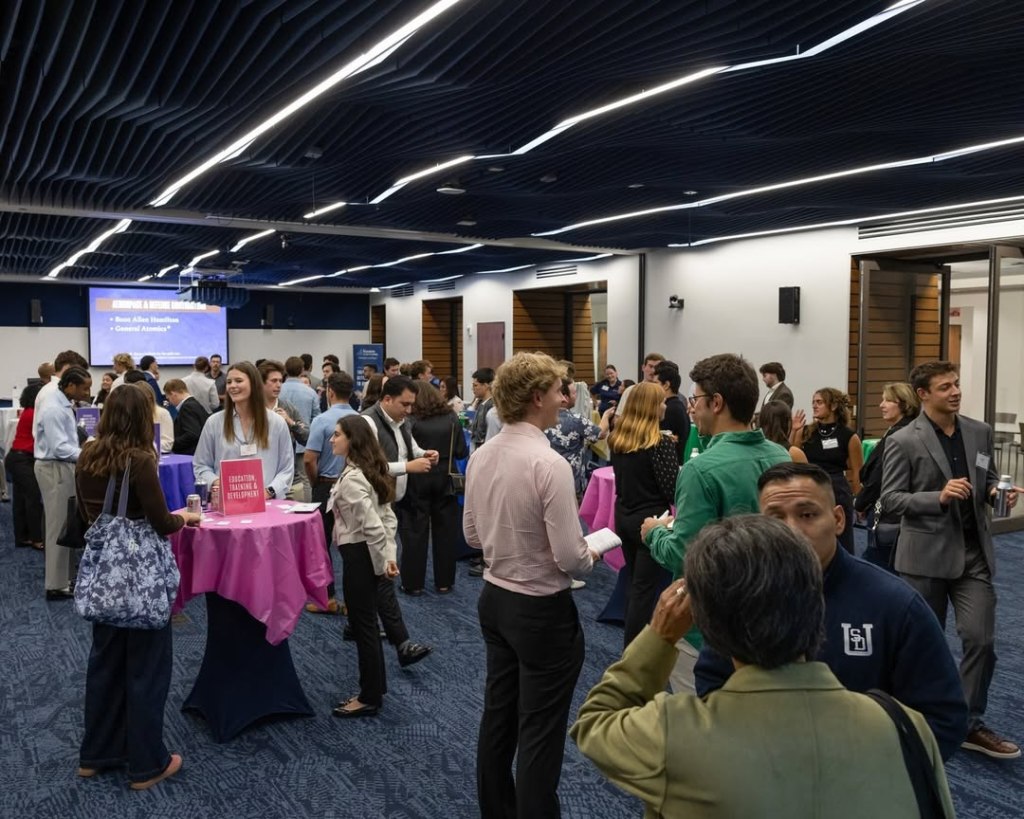
Students in the Knauss School of Business often attend networking events in search of jobs.
Photo courtesy of @usd_business/Instagram


 The USD Vista
Leave a comment