CADEN HAYNOR / ASST. NEWS EDITOR
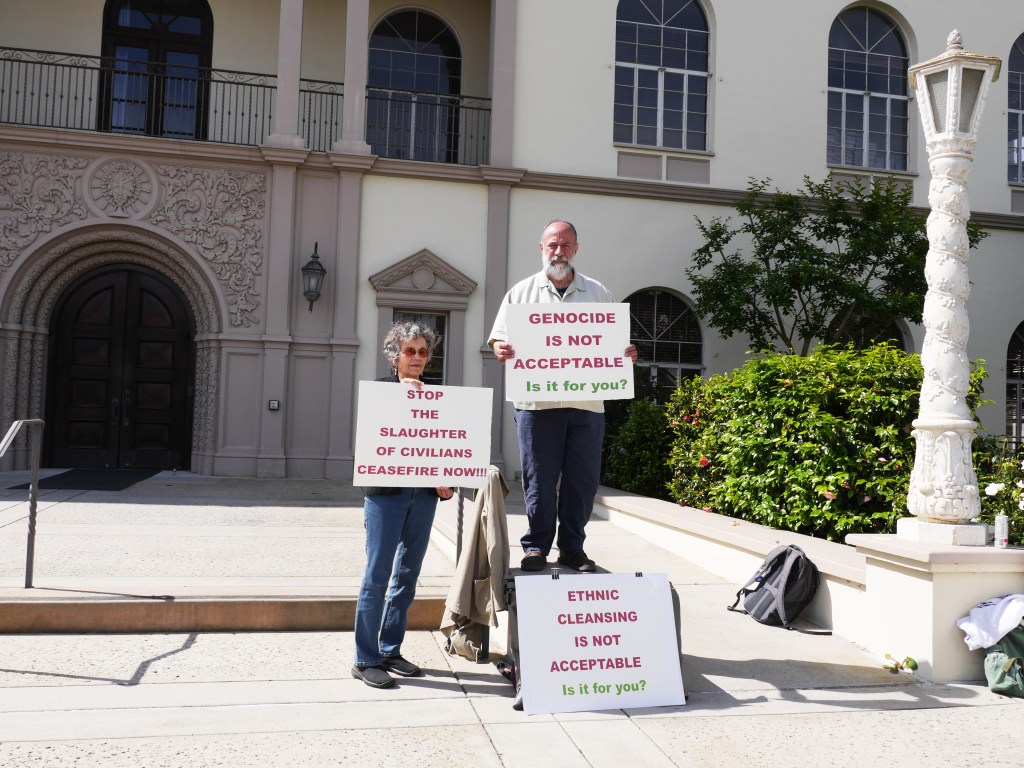
USD professor John Halaka practiced a silent vigil in the mornings from 8:30 to 10:15 a.m. for the past two weeks, standing outside the USD law school entrance with two signs drawing attention from passersby. The first sign read, “Genocide is not acceptable. Is it for you?” The second sign, placed at his feet, read “Ethnic cleansing is not acceptable. Is it for you?” Halaka is protesting a motion presented in the USD faculty senate that would change the language regarding the actions of Israel in Palestine.
Halaka, who has been a professor at USD for 35 years in the department of art, architecture and art history, helped develop a series of teach-ins on Palestine as part of the Gaza at USD Coalition. This teach-in currently consists of 40 events, educating and engaging the community to think critically on the topic of Israel’s actions in Gaza.
Halaka explained why he is protesting.
“I am here as part of an educational mission as a professor at USD,” Halaka stated. “I am here to continue the process of getting students to question that relationship to genocide, whether they agree with genocide, and if they do that’s their right to agree, and if they don’t, are they just passively walking by? Secondly, I am here in front of the law school because there appears to be faculty within the law school that either think that genocide in Palestine is okay, or they think that there is no genocide going on. They are uncomfortable with criticism of Israel, and some of them have tried to shut down a resolution in front of the USD Senate.”
The USD faculty senate has elected representatives and deans from each of the colleges as voting members. President Harris and the Provost also serve in the Senate as non-voting members.
The USD faculty Senate minutes from April 24, obtained by The USD Vista, explained the initial resolution brought forward by Professor Kevin Guerrieri in support of the USD Gaza Coalition.
“This version references the persecution and punishment of those protesting against the genocide in Palestine, and the general assault on all immigrants without due process,” the resolution explained.
Guerrieri explained the broader reason behind introducing the resolution.
“Ultimately, one of the main things that [those who have been working in the coalition] want to do is to continue the education on Palestine, which includes the history behind everything,” Guerrieri said. “I think that our collective and individual responsibility is to be as informed as possible, to seek information from different sources and to raise our voices. That’s what we have been doing as a coalition and Professor Halaka’s silent vigil is a part of that.”
The minutes further explained that there was a motion by USD Professor Herbert Lazerow, a senator in the law department, to amend the resolution by deleting “against the genocide in Palestine.” Lazerow explained why he motioned to delete those words from the resolution.
“My initial view was that the resolution was unnecessary, as the senate had already endorsed freedom of speech on campus in its commendation of President Harris,” Lazerow stated. “[Second,] I thought the references to the conflict in the Middle East unwise because they extended beyond the senate’s expertise … A third reason is that I want a ‘clean’ resolution passed by a substantial majority. A resolution endorsing free speech without taking sides in the middle east was likely to pass almost unanimously … [Fourth,] I believe that taking a position on the conflict in the middle east would reduce the influence future senate recommendations might have on USD’s decision-makers.”
Following Lazerow’s amendment, there was a motion by USD Professor of Integrated Engineering, Gordon Hoople, to amend the Lazerow amendment to include “the catastrophic war in Palestine.” This motion passed with 15 senators in favor, 12 opposed and four abstentions. Hoople explained why he did this motion.
“My motion was a procedural one — I was attempting to modify Lazerow’s motion to more closely align with comments I had heard from several senators during debate,” Hoople stated. “My hope was that this would allow us as a senate body to vote one way or the other to reveal where the majority of senators stood on the issue. This was not a reflection of my personal views on the issue, but an effort to help move the debate forward.”
The resolution was brought up again by Guerrieri, the senator who initially proposed the resolution, at another meeting on May 1. Guerrieri explained what occurred when he brought the resolution back up.
“When we got to the resolution on May 1, deliberations were opened again,” Guerrieri stated. “I previously had sent to the [Executive Committee] alternative language to be used instead of the word genocide in the event that the senate decided not to include it … I made some final arguments in favor of maintaining the original language and also shared a lot of resources on genocide in Gaza. After making those arguments, another senator made an argument against the overall resolution and then made a motion to table it.”
The USD faculty senate minutes for May 1 have not been approved yet, so they are not publicly available. Now that the resolution is tabled, it is not considered again unless someone makes a motion, with a second, to bring it off the table.
The University responded to what occurred in the Senate and the silent vigils.
“As has been expressed previously, USD supports academic freedom and freedom of speech and encourages members of the community to engage in respectful dialogue, explore topics with compassion, work for peace and lead with love,” the University stated. “Antisemitism, Islamophobia or any form of discrimination have no place at USD and are contrary to our values of inclusivity and respect for human dignity.”
Halaka is planning to practice the silent vigil on the mornings of Mondays, Wednesdays and Fridays until the end of finals. As the USD faculty senate meetings continue, and as Halaka continues his silent vigils, faculty senators and USD community members consider the weight and language of these significant events.
Halaka protesting outside of the Law School on May 12. Emma Pirhala/The USD Vista


 The USD Vista
Leave a comment