
EMMA PIRHALA / MANAGING EDITOR
As many Toreros began packing to return to USD, some students headed back to campus early to prepare for OLÉ! Weekend and first-year orientation. From the Welcome Team to Residential Assistants (RAs), Commuter Assistants (CAs) and Scholastic Assistants (SAs), students serve as a driving force in the preparations for orientation.
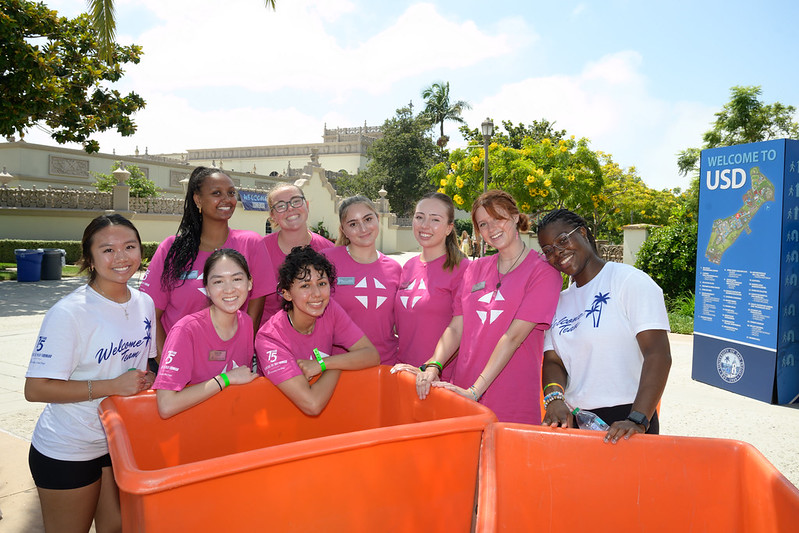
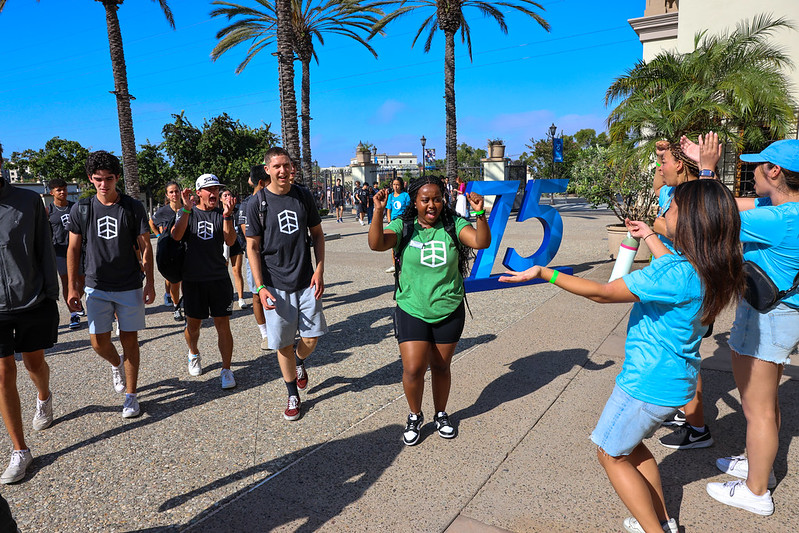
Student leaders are the first faces to welcome incoming first-years. Photo courtesy of @usandiego/Flickr
The student leadership program, which encompasses RAs, CAs and SAs, kicks off their training two weeks before most first-years arrive for OLÉ! Weekend. During the weeks of training, student leaders learn how to care for the students under their supervision, enforce school policies and approach difficult conversations.
USD Director of New Student Programs Gabriella Rangrej provided behind the scenes insight into the annual training.
“Student leaders go through a variety of trainings from logistics, campus resources, team building, and everything in between,” Rangrej explained. “Some highlights of their training include Wellness Rotations, scenario based role plays called Day in the Life or Behind Closed Doors, Using Your Strengths to Build Your Leadership Style, and facilitation training for their OLÉ! Weekend small groups that they lead.”
Student leader training is set up to prepare students for their roles and responsibilities. Rangrej explained that the training program is designed to go beyond schedules and rules — giving leaders the tools they need to support new Toreros in meaningful and impactful ways.
“We strive to offer a variety of training types that will help prepare student leaders to support our new incoming and continuing students,” Rangrej said. “Some sessions are logistics based such as when we are reviewing the OLÉ! Weekend schedule and scripts … While other sessions are on campus resources so they know what resources to refer and get their assigned students connected to should they need support.”
Rangrej elaborated on the importance of less technical skills in the day to day work of student leaders.
“However, we also feel as though training on ‘soft skills’ are just as important such as group facilitation, role modeling, boundary setting, and leadership style so that student leaders can lean into their skills,” Rangrej explained.
But, the weeks of preparation aren’t all work. Team building activities are woven throughout the training to establish communities before first-years arrive. Each day during the training has a set spirit theme. Students can show up and show out for their hometown, favorite pop culture icons and more. USD sophomore Ava Hoesel serves as an SA and has enjoyed the bonding activities.
“The unpredictability of the team-building activities has really kept me on my toes,” Hoesel said. “The events are silly and light-hearted—like building a tower with marshmallows and toothpicks—yet they’ve helped me learn how to adapt to various group settings, get more comfortable with public speaking, and overall feel more connected to the USD community.”
These special moments create lasting memories and stronger teams for incoming students. Rangrej explained that the team-building aspect is one of the greatest benefits of training.
“Besides the fun icebreakers where you may see a staff member in a banana costume, one of the best moments of student leader training is seeing the friendships and joy that come out of this experience,” Rangrej said. “Training and OLÉ! Weekend is long and important work, and after spending 1-2.5 weeks together student leaders build strong and deep friendships with one another. This unique opportunity where students can be around peers with like minded passions for leadership and service is truly one of a kind.”
All the preparation leads up to OLÉ! Weekend when student leaders get to meet their mentees for the first time. USD sophomore and SA Rebecca Demonteverde shared her excitement for her new role.
“Honestly, while training has been tedious, it’s been nice to connect with other first time SAs and bond over our experiences these two weeks,” Demonteverde explained. “I am excited to meet the first year students, especially because that’s what all the lectures and sessions have been building us student leaders up to.”
Beyond trainings, OLÉ Weekend relies on the devotion and creativity of students to help host one of the most anticipated Torero traditions. Neon Night, a long-standing orientation tradition, gathers first-years for an evening of dancing, games and brightly-colored outfits.
Planning for Neon Night begins months in advance, with collaboration between the New Student Programs, Learning Communities, Residential Education and Community and Leadership Development teams. And on the night of the event, 225 student leaders come together to put on a show.
Students hold a unique role in making this event one of the most memorable for first-years.
On Neon Night, upperclassmen can be seen donned in fluorescent shirts helping to get the party started. From running stations to encouraging first-year students to open up, student leaders have a crucial role in the success of the event.
Hoesel shared the positive impact that Neon Night has on new students.
“Making familiar faces at Neon Night definitely made me feel more socially assured and prepared going into the School Year. Seeing all the Student Leaders bring the energy really lifted my sense of school spirit, and I’m excited to be part the new students’ first impressions this year.”
After weeks of preparation, OLÉ! Weekend will soon fill campus with neon lights, music and first-year jitters. Behind it all are the students who will be there, ready to welcome the class of 2029.
Student leaders spend up to two weeks together learning how to suceed at their roles. Photo courtesy of @usd_orientation/Instagram

 The USD Vista
Leave a comment