
CADEN HAYNOR / NEWS EDITOR
SONOMA MULVIHILL / CONTRIBUTOR
President Trump announced that he federalized 200 Oregon National Guard troops for a 60-day period in Portland on Sept. 27. The President stated that this activation of troops was due to protests around the U.S. Immigration and Customs Enforcement (ICE) facility in Portland. Trump followed with statements related to the lack of safety in the city, saying that it is war-ravaged.
USD sophomore Noah Kerr is an Oregon resident and regularly visits downtown Portland. Kerr reacted to Trump’s comments about Portland’s safety.
“I think it’s all quite silly,” Kerr stated. “From my experience of Portland, as I go there regularly and walk downtown regularly with my younger siblings, ‘war-ravaged’ is more than hyperbole, it’s just false.”
Kerr continued by speaking on Trump’s actions in sending the National Guard into Oregon.
“It’s appalling to think about sending troops there,” Kerr said. “It’s a very high bar to involve the National Guard. There are a lot of homeless people who do, admittedly, take over downtown and they are a bit of a nuisance. Calling the National Guard for that is ludicrous and it’s insane and unbelievable because there’s nothing happening that deserves any federal attention.”
These protests were in opposition to federal immigration enforcement and public space militarization. These protesters marched from a park to the ICE facility, where federal officers used tear gas and Pepper Balls. The cause of this escalation is unknown. Oregon and Portland filed a lawsuit, challenging the legality of the deployment — arguing it exceeded presidential authority.
In response, a Trump-appointed federal judge temporarily blocked the deployment through a restraining order, stating that the action was done without a sufficient reason.
USD senior Hallie Rhodes gave her take on the Trump administration’s actions with these troops.
“His actions are inhumane and evil,” Rhodes explained. “I understand it’s difficult with the policies and laws about immigrants in general, but it’s unethical.”
On Oct. 5, within 24 hours of this ruling, the Trump administration federalized 300 California National Guard troops. With the continuing government shutdown, these troops are essential services for national security and, while they are not currently being paid, they will receive back-pay when the government reaches a spending bill agreement. Oregon Governor Tina Kotek reported the arrival of 101 California troops in Oregon that same morning.
Kerr reacted to Trump sending California National Guard troops to Oregon, after spending time in California for school.
“With my connection to California and looking at it in general, it’s ridiculous,” Kerr stated. “Sidestepping a court order like that is blatantly unconstitutional and it’s pulling away from the real services and duties of the National Guard. It’s a slap in the face of anything any Americans should be upholding. I love my country, but I don’t love to see that. It’s a mockery of the US. It makes me worried, like what if something happens in California that needs our national guard and they’re in Portland.”
USD senior Zadie Nguyen reacted to the implementation of these federal troops on U.S. soil.
“I think it is an over excessive use of force,” Nguyen said. “We need to be utilizing more of our time and money on our infrastructure instead of using it to send immigrants away. It seems kind of familiar to bad things that have happened within our world’s history.”
The same federal judge held an emergency hearing on Oct. 5 and issued a second temporary restraining order, blocking the deployment of all troops from any state to Oregon. This judge stated that there continues to be no constitutional basis for these actions.
In order for these actions to be constitutional, a judge would have to interpret them to “execute the Laws of the Union, suppress Insurrections and repel Invasions.” This is a power of Congress, given to them through Article I. The Constitution grants the president the title of Commander-In-Chief, but does not give him unilateral domestic deployment powers.
USD senior Alex Roman questioned the use of the National Guard and the legality of the Trump administration’s actions.
“I think that it’s wrong that he’s doing something illegally,” Roman stated. “He’s using his power in a way that negatively affects people. I think that the National Guard could be used for better things than clearing out illegal immigrants.”
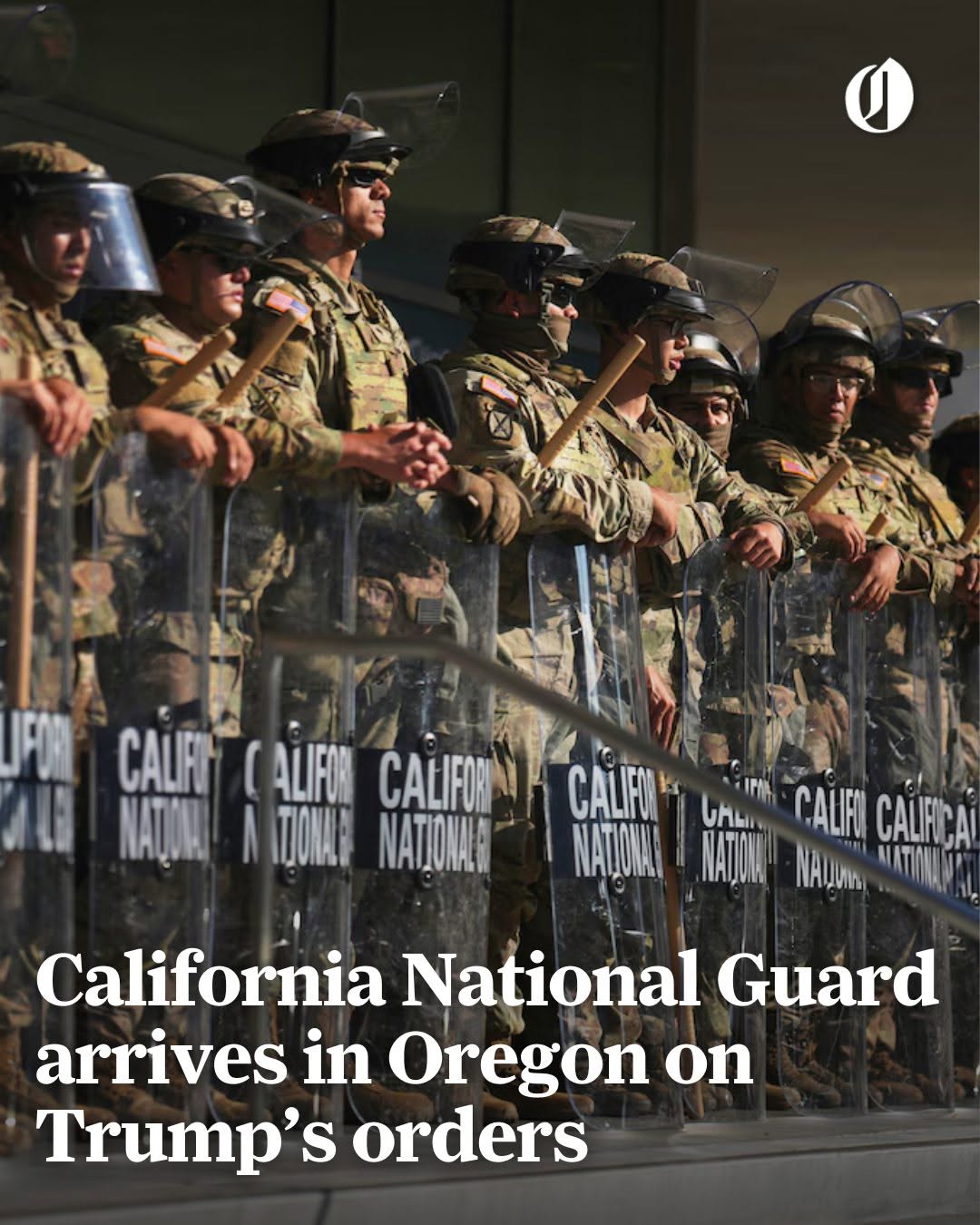
101 California National Guard troops arrived in Oregon on Oct. 5. Photo courtesy of @theoregonian/Instagram
This mobilization in Portland was among various federal interventions in cities led by Democratic mayors — including Los Angeles, Washington, D.C. and Chicago. These federal troops operate under Rules of Engagement that define when and how force can be used. This means that they can only detain civilians if martial law is declared and only carry live ammunition if they are facing armed threats.
USD sophomore Elias Herrmann explained his thoughts on the use of the National Guard by the Trump administration and the political topic of illegal immigration.
“I don’t think he’s doing it in the best way, but at the end of the day, they’re illegal and I don’t think that they should be here,” Herrmann stated. “Of course, it should be done in a more humanized way, but Donald Trump is sending the National Guard because no one is doing anything about them. The states don’t care and aren’t taking action. There are always better ways to do things like this but there will be no change if he does it in a nice way.”
Multiple political figures are citing the Posse Comitatus Act, which prohibits the use of federal Armed Forces for civilian law enforcement as a method to combat his actions. The lawsuits against the Trump administration are ongoing and will continue as these troops patrol U.S. cities.
Trump issued multiple executive orders deploying National Guard troops to various states in October. Emma Pirhala/The USD Vista




 The USD Vista
Leave a comment