
RILEY RAINS / ARTS & CULTURE EDITOR
This spring, Dean Noelle Norton was notified that her book “Creating Gender” was among the titles banned by the Secretary of Defense at the U.S. Naval Academy Library. USD’s College of Arts and Sciences Dean was just of the one authors out of over 400 writers whose books were pulled from Nimitz Library in a wave of censorship this April.
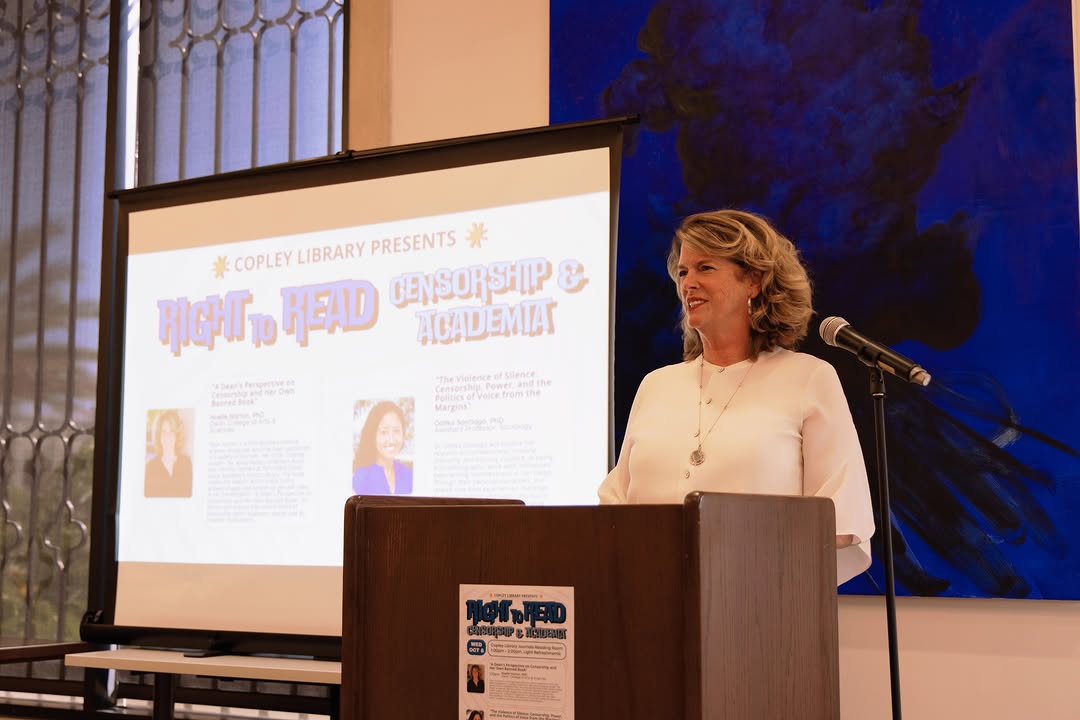
Dean Noelle Norton giving a lecture about her banned book, “Creating Gender.” Photo courtesy of Michelle Kennedy
Book bans are at their highest level in decades, with organizations like PEN America and American Library Association (ALA) documenting over 6,000 bans in the 2024-2025 academic school year. The commonly accepted definition of a “book ban” is any action taken against a book based on its content that leads to a previously accessible book being completely removed from availability. Settings of academia, such as local libraries and public schools, are the most affected areas when it comes to books being banned.
USD Associate Dean of the University Library, Professor Laura Turner, offered her insight.
“We need to understand that books are the breadth of human knowledge,” Turner urged. “As a Librarian, when I am told to remove a book from my collection because they aren’t appropriate in content, it’s a foreign concept to me. We carry [books] that may make you really uncomfortable. It’s our job as librarians to hold intellectual freedom for students, no matter the content.”
The initiators of these book bans are largely organized pressure groups. ALA’s Office for Intellectual Freedom performed a study and found that in 2024, 72% of demands to censor books in schools and public libraries came from government entities, while only 16% stemmed from parents. Complainants argue that books containing themes of race, LGBTQIA+ narratives and gender exploration should be removed for illegal obscenity for minors.
However, a large majority of titles include esteemed classics that criticize government and encourage open-mindedness: George Orwell’s “1984,” Khaled Hosseini’s “The Kite Runner” and Harriet Beecher Stowe’s “Uncle Tom’s Cabin” being just three of the many.
USD sophomore Olivia Sullivan recalled her experience with these famous banned books.
“A lot of the books like ‘1984,’ ‘Animal Farm’ and ‘Fahrenheit 451’ were books that I read in high school,” Sullivan remembered. “I personally think that it is important for people to keep reading them because I feel like the censorship isn’t doing education any good.”
National Banned Book Week — Oct. 5 through Oct. 11 — started in 1982 by First Amendment activist Judith Krug as an attempt to quell the sudden increase in challenged and banned books in public libraries and schools. The ALA encourages educators and universities to participate in events to raise awareness in settings of academia – USD was no exception.
Copley Library hosted a variety of events during National Banned Book Week, one example being Torero’s opportunity to go on a “Blind Date with a Banned Book.” USD librarians wrapped up novels and marked the reason(s) why they were censored – whether the ban for depictions of sex, violence, racism or LGBTQIA+ themes, there were enough “dates” to fill Torero’s shelves.
Copley Library also celebrated National Banned Book Week by hosting an annual “Right to Read” lecture presented by Dean Norton and Dr. Odilka Santiago — a sociology professor who specializes in research surrounding homelessness, housing insecurity and housing injustice.
Dean Norton began the lecture by describing how shocked she felt when she discovered that “Creating Gender” had been removed from the Nimitz Library.
“When the notice came that this book was banned, I was beyond surprised,” Norton recalled. “I was minding my own business when almost 20 years later, in comes an email that shocked me. I felt very weird. I’m still not sure why it’s banned.”
“Creating Gender” is a statistical based research collection that focuses on how U.S. welfare policy creates gender paradigms. Dean Norton was one of three authors who tackled the topic: Cathy Marie Johnson and Georgia Duerst-Lahti also contributed to the book outlining dangerous gender roles in welfare. U.S. defense secretary Pete Hegseth – who initiated the mass censorship – never explicitly stated the reasoning behind the removal of “Creating Gender.”
After Dean Norton’s explanation, Dr. Santiago continued by outlining her graduate research, and its relevance in censoring voices in marginalized communities. By talking to over 50 homeless people in San Diego alone, Dr. Santiago urged students to humanize individuals without an abundance of advocates.
“The violence of silence is not about what goes unsaid, but is also about the denial about who has the right to be heard,” Santiago emphasized.
Toreros are aware of the detrimental effects of banned books in America and offered their opinions. USD senior Greta Palmiter explained her thoughts.
“I think that removing voices is really dangerous,” Palmiter argued. “If you don’t hear from people you can’t learn or grow from what they have to say.”
As a Catholic liberal arts institution, USD prides itself on inclusivity – especially in scholarship. Copley Library provides a plethora of academic resources and data-bases written from a diverse set of voices. As organized pressure groups continue to challenge beloved novels, universities and libraries all over America are taking a stand for their right to read.
Just to be clear: since USD’s chartering in 1949, the University has never banned, censored or hidden a book from its students.
Pictured is a spread of different ‘Blind Dates with a Banned Book’ at the Copley Library. Photo courtesy of Michelle Kennedy


 The USD Vista
Leave a comment