ANJALI DALAL-WHELAN / ASSOCIATE EDITOR
Trigger warning: This article contains mentions of suicide, death and war.
“We would like to stop making veterans.” That’s the goal that Veterans for Peace San Diego Chapter President Gary Butterfield shared with attendees of the Department of History and Copley Library’s fifth annual event on Nov. 13.
Veterans for Peace is an international organization with 120 chapters, including San Diego’s Hugh Thompson Chapter. Their goals include increasing awareness about the costs of war and ‘abolishing war as an instrument of national policy.’
Three members of Veterans for Peace shared their diverse experiences at the event — with many more veterans in the audience supporting.
Jack Doxey, a 94-year-old Korean War veteran, came to the podium first.
Doxey described his experience being drafted to the war while still in college.
“Uncle Sam sent me this letter saying they could not win the Korean War without my help,” Doxey shared. “And I said to them, ‘Are you talking to me? Have you seen me? I’m five-foot-five, 130 pounds. I cannot help you.’ And they said ‘shut up and show up.’”
Doxey never wanted to go to war, and his experience fighting further enhanced his belief in peace. Even now, 74 years after his service, Doxey is still writing and reflecting on his experience. He shared some of his poetry with the audience.
“I saw myself in my enemy,” Doxey recited. “Yes, the color of their skin was slightly different. The shape of their eyes were not quite like mine. But, so much more was just like me. Like a thunderbolt it struck me. Never again will my country convince me that the others are not like me, because I saw myself in my enemy.”
After returning to the U.S., Doxey became an activist for peace. During the Q&A period, Doxey urged the audience to resist any call to join the military that could come in the future.
“I’m looking out at all of you, and I see [in] your eyes, and your youth that you have plans for your life,” Doxey said. “Don’t let anybody take that away from you. If they establish the draft again, I would ask and plead to all of you to get out on the streets and yell like bloody hell. And if I’m still alive, I will be right there with you.”
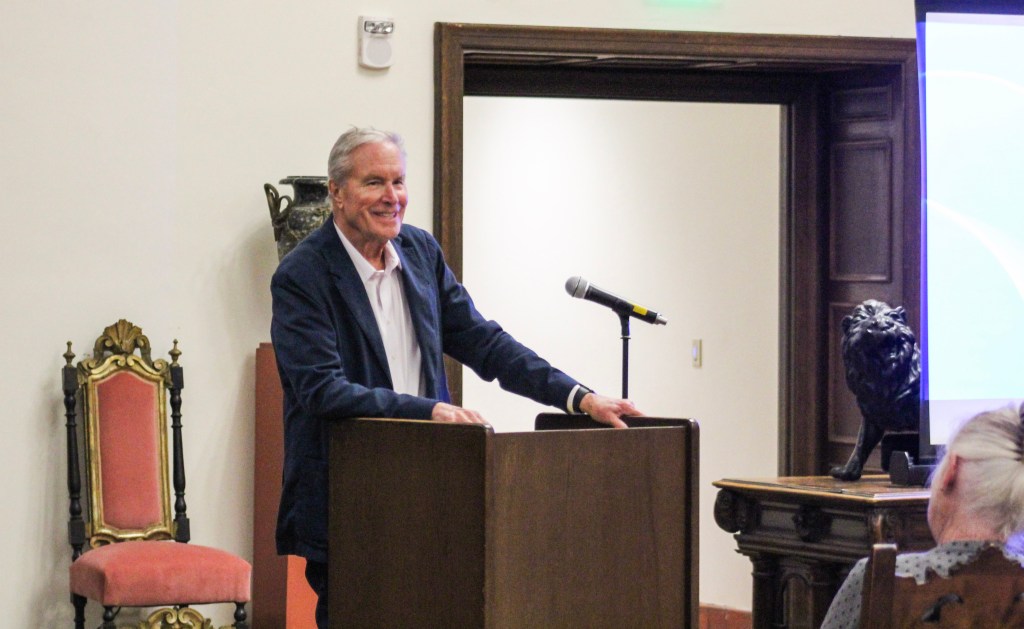
Unlike Doxey, the second speaker, USD Law alum Barry Ladendorf, planned to serve in the military. Growing up in a community of veterans, Ladendorf felt that it was his duty to serve. After college, he went to Navy Officer training with the goal of proving himself in the Vietnam War. But, his experiences during his two-and-a-half years of service changed his perception on the necessity of war.
Ladendorf served as an engineering officer on the USS Valley Forge. On this ship, he completed three cruises off the coast of Vietnam, from 1965 to 1968. He supported Marines in major battles as the United States started to lose control in Vietnam. During this period, Ladendorf described that “All hell began to break loose.”
Although Ladendorf was not physically on the ground fighting the war, he witnessed horrific events, which have persisted in his memory. On the ship, helicopters regularly landed carrying dead and dying Marines. When the morgue on the ship filled up, they had to leave body bags along the passageways that Ladendorf would walk through.
“I remember thinking I just couldn’t pay attention to it,” Ladendorf described. “I would just block it out and pretend it wasn’t there. And we couldn’t pretend it wasn’t there.”
But, Ladendorf couldn’t pretend when flying back to the United States with five or six other people — and over 150 caskets.
“I thought of the families,” Ladendorf said. “At this time we were opposed to the war, we thought, ‘this is crazy, what are we doing here’… I remember thinking, ‘I’m never going to do this again.’”
After returning, Ladendorf attended law school at USD, and worked as a Deputy Attorney General for California.
Ladendorf shared how Veterans for Peace helped him cope with his memories of the war.
“I’m so glad that I found Veterans for Peace in 2005,” Ladendorf said. “That was a saving grace for me … I don’t want this to happen again, I don’t want to see other young men and women go to war.”
The final speaker was younger, and different from the image that many may have of what a veteran looks like. 22-year-old Joshua Lewis was medically discharged from Marine Corps training at the age of 20. Now, he advocates against what he calls the predatory nature of military recruitment.
Lewis explained the factors that pushed him to enlist out of high school, including recruiters he met at his school. Lewis’ story was relatable to some USD students in the audience.
USD senior Lauren Roberson explained how she was impacted by Lewis’ story.
“As someone who is almost 22, it was a very opening experience to the timeline that he was talking about that directly matched my timeline of military in my life,” Roberson said. “In the sense of [recruiters] coming into your high school and them being at the tables. He talks about how he knows a lot of friends who are still in the military who signed up out of high school, and I have numerous people from my high school that I know are in training right now.”
During the event, Lewis shared how his poor performance in school and mental health challenges motivated him to enlist in the Marines.
“To be brutally honest with you, I wanted to die in a blaze of glory overseas rather than taking my own life at home,” Lewis revealed.
Lewis started training at MCRD San Diego in September 2021 and was medically separated in January 2023 due to injuries sustained in training.
Lewis described the trauma that he experienced during training.
“I was present for many suicide attempts, and three Marines did end up taking their own lives,” Lewis described. “In a short, two year career, where all I did was train, I managed to disable myself, have friends die and I worsened my mental health significantly.”
Two years after he left training, Lewis has learned more about the military, and is using his title as a veteran to effect change.
“I decided that willful ignorance was not a valid excuse to choose a life of violence,” Lewis said. “So I began educating myself. It never really sat right with me that military recruiters were allowed to target underage teenagers in high school, especially those high schools in lower income areas.”
USD history professor Dr. Kathryn Statler organized the event alongside Copley Library. Statler explained why she believes this is an important conversation to have at USD.
“For me, it’s really important that students think about Veterans Day and what that day actually means,” Statler said. “Instead of it just being Nov. 11, maybe I have the day off, you’re going to go shopping. But no, this comes about because of the end of World War I, the tremendous sacrifice of many men all over the world; and a push for world peace that came out of World War I.”
Statler also explained the history of Veterans Day — formerly called Armistice Day — a day to celebrate world peace. In 1918, Nov. 11 marked the end of hostilities in World War I, which many believed would be the “war to end all wars.”
“Woodrow Willson recognized Armistice Day in 1919,” Statler explained. “After World War II, and during the Cold War, there’s a shift to thinking, ‘maybe we focus more on the sacrifice of the United States and American veterans,’ and so they shifted it to Veterans Day. And so what I really want students to think about now, is do we keep it Veterans Day? Do we go back to Armistice Day? Is it a combination of the two? But we’re thinking long and hard about the sacrifice of those veterans and what that means today.”
During the event, veterans expressed different views on what Nov. 11 showed mean. Lewis believes that the U.S. should go back to celebrating Armistice day instead of Veterans Day.
“As a veteran, I want to celebrate laying down my weapons,” Lewis shared. “Because, laying down weapons, ultimately, is what ends the blood shed.”
Veteran and USD Law alumnus Barry Ladendorf speaks about his experiences in the military to USD students. Hailey Howell/The USD Vista

 The USD Vista
Leave a comment