EMMA PIRHALA / MANAGING EDITOR
RILEY RAINS / ARTS AND CULTURE EDITOR
Whether Toreros are falling asleep in class or tanning outside Maher, one thing is for certain: when the clock strikes 12, ears perk up to hear the familiar tolls of the bells The Immaculata.

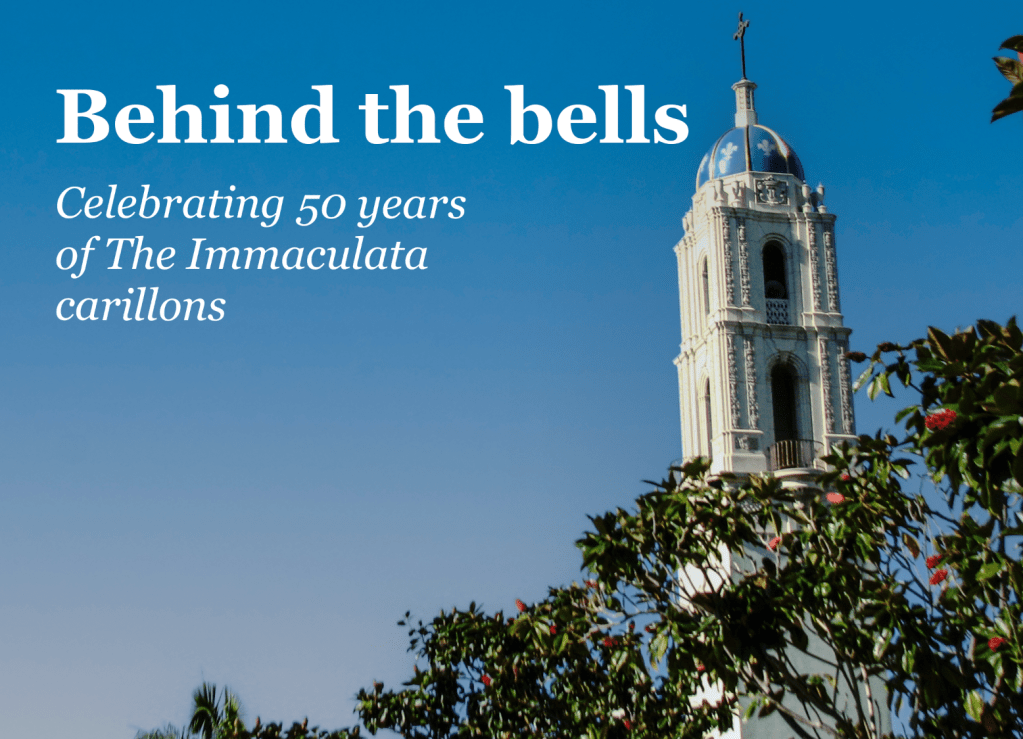
The bell tower over looks the whole campus, raining it’s melodies on all students. Emma Pirhala/The USD Vista
At each ring, students look up toward the bell tower in awe, but also in confusion. Glancing at the tower’s turquoise tinted dome, Toreros are met with the sight of speakers — rather than bells, as suspected.
USD first-year Noah Carlsson described his confusion surrounding the twice hourly sound.
“I have absolutely no clue how the bells work,” Carlsson admitted. “They’re always going off in this class, and it lets me know when we’re done.”
The lack of knowledge echoes beyond just first-years.USD senior Quinn Edwards confesses her ignorance.
“I don’t really imagine a man up there ringing the bells,” Edwards joked. “If I really think about it, maybe it is digital? I don’t know the difference between any of the bells.”
Built in 1959, The Immaculata Chapel never held the large brass bells that many students assume are hoisted in the 167-foot-tall tower. For the first fifteen years of the chapel’s history, the bell tower was silent — until a donation from former trustee and builder of Pechanga Arena A. Eugene Trepte caused the University to make noise.
In a 1979 interview with The USD Vista, Monsignor John Portman — The Immaculata’s pastor at the time and founder of the theology and religious studies department — explained the significance of the sound of music across campus.
“Here we had a bell tower, a beautiful symbol of a Catholic university,” Portman commented. “But without bells, the tower simply was not fulfilling its function.”
The acquisition of the carillon system, Portman expressed, “added a great deal to the atmosphere” of the church and campus.
The parish opted for a digital system, since the structure could not support the two-ton bells many might imagine. The current setup is a digital carillon system designed and implemented by Mass-Rowe Carillons on Dec. 19, 1975.
The company, headquartered in Escondido, Calif., developed an instrument which utilizes miniature bells that are then amplified and projected from speakers up in the spire. The same system is used at landmarks across the region such as Balboa Park’s California Tower and Old Mission San Luis Rey in Oceanside.

Buckley uses a dgital carillon to produce the sound of the bells. Emma Pirhala/The USD Vista
David Buckley, a Navy veteran and volunteer at the Immaculata Parish, operates the bells and is responsible for many of the technical aspects of running the system. Although he didn’t have any experience operating the digital carillon, Buckley took over the position and learned the process as he went along.
“I messed up a couple of times at first, but I learned,” Buckley explained. “I panicked the first time I had to change it. But I took out the manual and figured it out.”
The manual Buckley referred to is a hefty binder with hundreds of pages marked and sectioned between the six liturgical seasons and the corresponding hymns. Liturgical seasons mark six distinct periods within the Christian year which are defined by pivotal events in the lives of Jesus and Mary: Advent, Christmas, Ordinary Time, Lent, the Paschal Triduum and the 50 days of Easter. With each season, comes different hymns which are played from the bell tower after the alma mater at noon. The system comes pre-programmed with a full library of hymns, and Buckley updates the songs at the start of each season. USD sophomore Makenna Dase shared what she looks forward to each year.
“I love the seasonal hymns,” Dase exclaimed. “Its good vibes with the Christmas season you know.”
However fun the varied tunes are, Buckley explained the significance of silence in the times when the bells are not tolled.
“During the Triduum, the three days of Holy Week, no music whatsoever,” Buckley said. “The bells are turned off completely. They don’t even ring. At the Easter Vigil, that’s when all the lights go on, we start everything, and we peal the bells manually. During those three days, there’s nothing … It’s part of the observance.”
Other traditions also take place where the bells ring at times deviating from the normal thirty-minute rotation.
“We also toll a bell during funerals,” Buckley shared. “So, after Mass, as people come out, you can toll it from [the choir loft] for three to five minutes … It’s just tradition … If I turned [the toll] on, you’d just hear ‘boom, boom, boom.’ Anytime during the week when you hear that, it means a funeral.”
USD junior Almedina Hozdic appreciated the scarcity of the bells in times of loss.
“I think the funeral aspect is respectful,” Hozdic said. “I don’t find any of the rule variations surprising.”
The booms of funeral tolls are just one of the many specialized sounds that come from Buckley’s handbook. As the bells have reverberated around campus for the past 50 years, students began to memorize and anticipate the tolling of the carillon. USD sophomore Maeve Joyce shared her fond association with the bells.
“Personally I love the immaculata bells,” Joyce expressed. “For me there’s a bit of a nostalgia factor … When I got here freshman year I taught all of my friends how to tell time using the bells, which is an awesome life skill to have … I like the bells, I think it connects our university with the Catholic-San Diego community which is special.”

This photo was originally published in The USD Vista in 1979. Photo courtesy of The USD Vista archives
Synonymous with USD culture, the bells are the heartbeat of Alcalá Park. Their harmonies heard from the Garden of the Sea to the Valley stitch the campus together.
The Immaculata’s spire, constructed in 1959, never held the two-ton bells some imagine. Emma Pirhala/The USD Vista


 The USD Vista
Leave a comment