CADEN HAYNOR / NEWS EDITOR
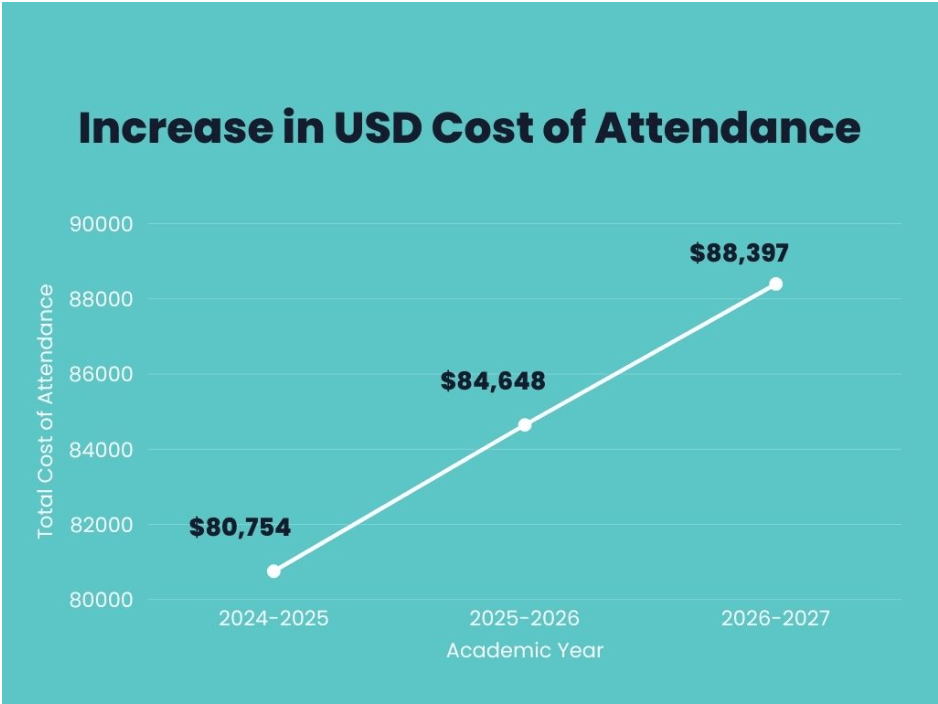
The total cost of attendance at USD has increased by nearly 5% for the upcoming school year. The difference amounts to $3,749, including a $2,760 increase in the tuition students pay per year. This school year, the total cost of attendance increased 4.7%.
USD sophomore Isabelle King commented on the increased cost she will have to pay to attend USD.
“I’m mad because why would they increase it by that much for no reason,” King said. “I am on scholarship and I would not come here without that. It’s just too much money. All my friends from home don’t have to pay for their laundry and their tuition is significantly cheaper.”
Some Toreros have scholarships, grants and other financial aid to help them pay to attend USD, which means every student walks campus paying a different amount to attend. Tuition is not the only cost students must consider when deciding whether to attend USD, or to stay here.
The total cost of attendance at USD includes a ballpark cost for tuition, health insurance, housing, meal plans and fees, which generally encompasses the fluctuating cost for each student to attend the school.
Around 75% of USD students receive scholarships or grant aid, averaging $37,818 per recipient. The USD Vista reached out to the University’s public relations team and asked for a comment from a representative with questions. The public relations department responded with the following statement.
“For many students, annual tuition increases can be a source of concern, but these funds are the primary way the university fulfills its educational mission and supports our students and the university’s operations,” the media relations representative wrote in a statement to The USD Vista. “Over 90% of the resources generated from the annual tuition increase continue to be directed towards two key strategic priorities: 1) increasing student financial aid to recruit an academically prepared undergraduate class and reduce debt at graduation and 2) salaries and benefits for faculty and staff to continue attracting and retaining world-class employees.”
The University includes additional costs for classes, fees for the Wellness Center, Student Life Pavilion and the production of student media.
Despite the high cost of attendance, King described a benefit she experiences from attending USD.
“I would say the benefits of going to a more expensive school is that a small school is good for networking,” King said. “There are so many people that go, for example, to my sister’s public school, and so many of those people I would not want to have business connections with in the future.”
USD also funds student clubs primarily through the Associated Student Government (ASG) Budget Committee (ASGBC), which distributes an over $1.6 million per year annual budget.
USD first-year Ron Aquino and member of ASG outlined his take on the University’s allocated funds.
“In ASG, we do always hear funding requests get rejected, so there’s definitely room for more funding,” Aquino said. “The goal of ASG is to help all clubs on campus get their initiatives and things done, so more funding would be great. I don’t know where this extra money that is being collected is going, so I can’t say whether it will help ASG.”
This annual budget is allocated to the Torero Program Board, the ASG Executive Team, which all have events that they fund and multiple centers on campus. The budget also funds student-run clubs, which must request funding from ASG for their costs.
Some students who are a part of clubs feel that the ASG funding does not support them enough. USD sophomore Brian Kircher, the finance chair of Food for the Soul theology club, described his experience with club funding from the school.
“I mean ASGBC is not super generous with their stuff,” Kircher said. “I’m the finance chair for one of my clubs and for general body meetings, you get seven dollars per person, per meeting. You get four meetings a semester with your club that the school pays for food for, so you get seven dollars per registered member. We do weekly meetings, so I have to stretch that budget really thin. I wish they did more funding. I respect that they have guidelines, but if they want more cool stuff, then they can’t restrict funding.”
As a private university, professor salaries are generally higher than many public institutions, according to UnivStats. The USD Vista contacted the University’s public relations team, which outlined how the increases in cost of attendance affect professor salaries in the following statement.
“USD works to provide market-based salaries to attract faculty and staff that reflect the high cost of living in San Diego,” a USD media relations representative wrote. “University employees, including faculty, are eligible for salary increases each year based on our annual compensation review process. About 40% of the available funds for annual compensation increases are reserved for faculty salary increases.”
Almost half the added charge to students goes to professors, and much of the rest is due to market changes and inflation. Students facing more years at the University remain alert of how the cost of attendance has changed over the years.
USD cost of attendance increased 4.7% for the upcoming school year.




 The USD Vista
Leave a comment