DAVID COOK / OPINION EDITOR
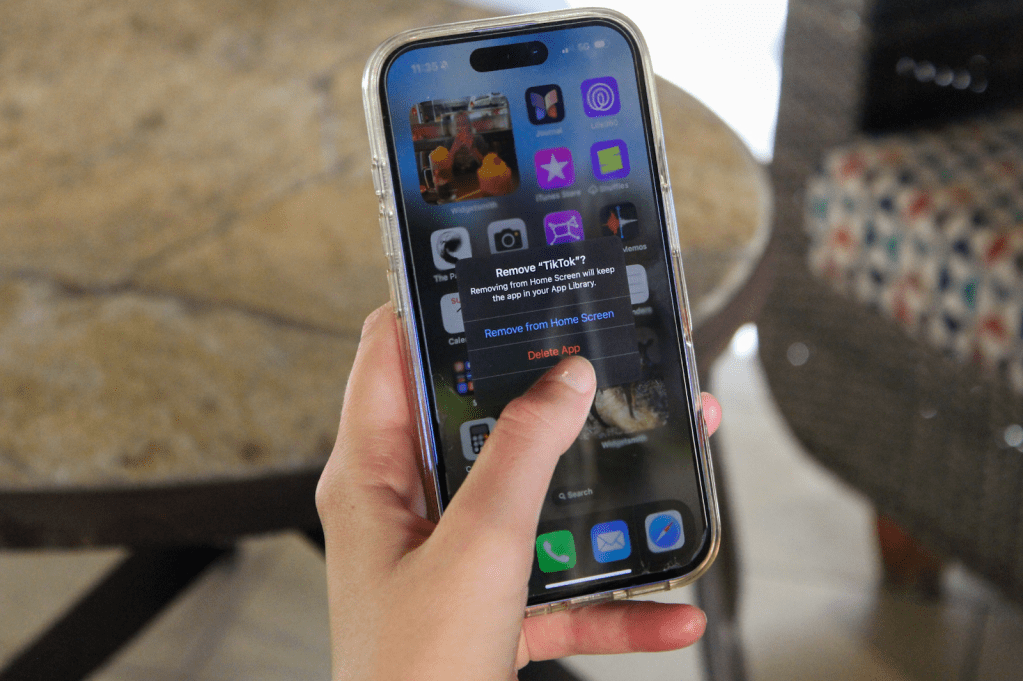
Last week, I finally pulled the plug. After years of spending multiple hours a day doomscrolling through TikTok, I terminated my account.
Every week, my phone would send me the same screen time notification, displaying statistics that felt almost impossible to believe: “You averaged seven hours per day on your phone.” “You averaged two and a half hours per day on TikTok.” Still, there it was, quantified and undeniable.
While a last-ditch effort to save my brain’s dopamine receptors was a major catalyst for the decision to delete the app, a change in TikTok’s ownership was what finally pushed me over the edge.
On Jan. 22, a new U.S.-based TikTok entity was established. TikTok announced a deal led by major American investors, including Oracle, a prominent tech company, and Silver Lake, a Silicon Valley private equity firm. The agreement allowed the app to remain available in the United States, ending years of uncertainty about its future.
The process of banning TikTok for American users began in 2020, when President Donald Trump, during his first term, attempted to block the app via executive order over national security concerns tied to its Chinese parent company, ByteDance. Those efforts ultimately failed in court, but the issue resurfaced under President Joe Biden.
In April 2024, Biden signed legislation with bipartisan congressional support, requiring TikTok to be sold away from ByteDance or face removal from U.S. app stores. The plan included a grace period during which American buyers and ByteDance could negotiate a deal, with a 2025 deadline, effectively leaving the final decision to the next administration.
When Trump was elected president in November 2024, he immediately began signaling that the deadline would be enforced. Once back in the Oval Office in January 2025, his administration applied renewed pressure on TikTok’s ownership to finalize a sale under the terms outlined in Biden’s plan.
Many Americans may look back and remember what it felt like when TikTok briefly disappeared from their phones last January — when an app that had come to feel permanent suddenly wasn’t there. After just a few days, though, TikTok returned to the app store and American users were able to scroll away through their TikTok feeds. Despite this, due to regulatory pressure, ownership disputes or future enforcement of federal law, TikTok’s presence in the United States did not always feel guaranteed.
All of these factors are what ultimately resulted in the recent January deal, but it also raised new questions. Oracle is now deeply involved in TikTok’s backend infrastructure, particularly around data storage and cloud services. While TikTok has stated that Oracle does not control the platform’s recommendation algorithm, infrastructure is not a passive role. The companies that manage data, servers and technical architecture hold real leverage, whether or not it is publicly acknowledged, since control over a platform’s infrastructure can quietly shape what content is promoted, limited or deprioritized.
Those concerns intensified after reports surfaced that TikTok had censored or limited content critical of Donald Trump, Immigration and Customs Enforcement or references to Jeffrey Epstein. In response, California Governor Gavin Newsom launched an investigation into the platform’s content moderation practices during the transition of ownership.
TikTok has denied the allegations, attributing the incidents to technical issues.
“It would be inaccurate to report that this is anything but the technical issues we’ve transparently confirmed,” TikTok spokesperson Jamie Favazza said.
Still, the situation underscores a broader shift. For years, the TikTok debate centered on fears of foreign influence and of the Chinese government’s access to American user data. Now, the app is firmly embedded in U.S. corporate and political power structures — a development that raises its own set of concerns.
Oracle CEO Larry Ellison has donated tens of millions of dollars to Republican candidates and causes over the years, including high-profile support for Donald Trump. While political donations alone do not prove influence over content or data, the proximity between partisan power and platform infrastructure is difficult to ignore, particularly given TikTok’s outsized role in shaping news consumption, political discourse and culture.
On top of this, Ellison has his hands in many other cookie jars. His son, David Ellison, is the CEO of SkyDance Media, which has recently purchased Paramount+. Paramount owns CBS, and Larry Ellison was the ultimately financial backer, now owning potentially 50% of the equity of the new SkyDance/Paramount merge.
Ellison has influence and stakes that span across technology, entertainment and national politics. When a single billionaire’s reach stretches across and beyond cloud infrastructure, media ownership and massive campaign donations, it raises concerns about how much influence one individual should have. Ultimately, Ellison’s behavior and influence feels much more like an oligarchy, so choosing to delete TikTok was, in part, a rejection of that concentration of power.
For me, deleting TikTok wasn’t about choosing between China and the United States. In the past, there were plenty of concerns over our American data in the hands of the Chinese government. Now, there is a shift over whether we can trust if what we see on our for your page is really what we want to see, or whether it is what our censoring government wants us to see. The decision was about recognizing how much of my attention and information flow was filtered through systems that feel increasingly opaque and politically entangled.
Walking away didn’t instantly repair my relationship with my phone. But it did remove a platform that had grown too powerful, too consuming and too intertwined with forces I don’t trust.
A user deletes the TikTok app from their phone during ongoing debates over data privacy and digital well-being. Hailey Howell/The USD Vista


 The USD Vista
Leave a comment