EMMA O’CONNELL / ASST. A&C EDITOR
The Humanities Center unveiled a semester-long series titled “On Silence” on Feb. 10. USD Associate Professor of Art History Derrick Cartwright, PhD and Humanities Center Director Brian Clack, PhD introduced the collection of panel discussions and exhibitions at the unveiling. The series will revolve around the themes of silence. The Center’s official webpage outlines questions the series will address.
“What is silence and why might it be of value,” the Center asked. “What space is there for silence in an increasingly loud and noisy world?”
The nuanced questions solicits a nuanced answer. “On Silence” will provide nine academic panels and two exhibitions addressing this inquiry. The series aims to be as expansive as possible. “On Silence” is heavily cross-disciplinary, and the panelists will approach the theme from philosophical, mathematical, musical, theatrical, theological and artistic angles. It is an exercise in the fundamentals of a liberal arts tradition: examining a topic in an inclusionary and sometimes unconventional way.
The topic of “silence” is wide-ranging. To get to the heart of it, Dr. Clack shared his inspiration: a quote from Samuel Beckett, the 1969 Nobel Prize Laureate in literature.
“Every word is like an unnecessary stain on silence and nothingness,” Beckett wrote.
Clack responded to his inspiration and explained the thought behind the theme.
“Our common discourse has a lot of vapidity and meaninglessness,” Clack said. “In contrast with noisy, loud or full of words, what is there to be said about the value of silence? We should maximize silence.”
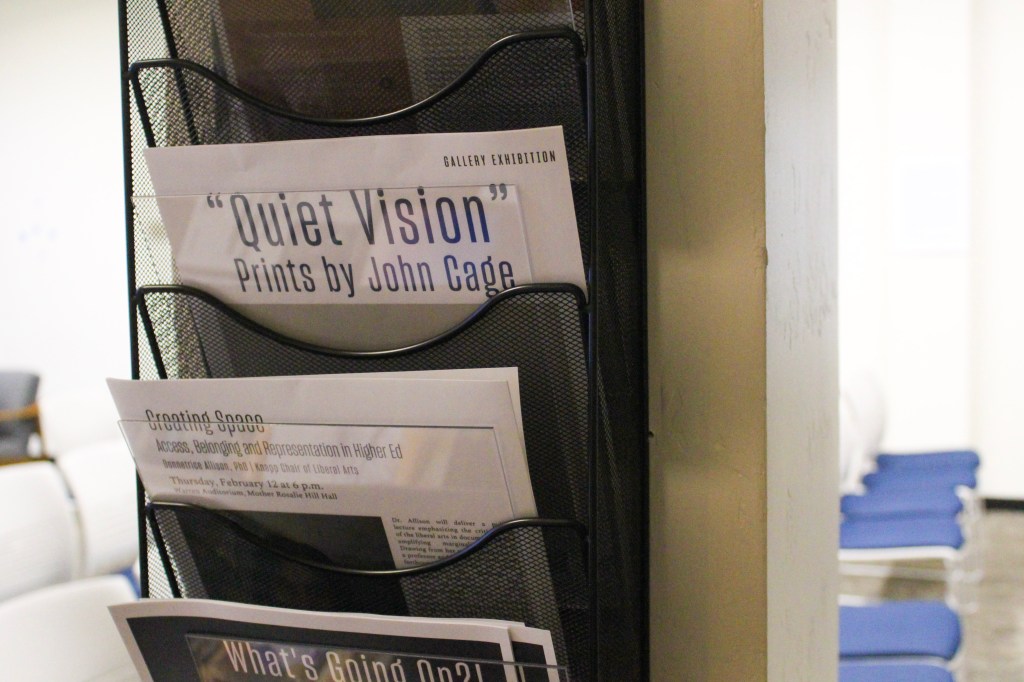
Now more than ever, people are extremely accustomed to constant talk. “On Silence” refines the idea that silence can be powerful and refreshing. The speaker panels will provide a space for “no strings attached” curiosity. The first exhibit, “Quiet Vision: Prints by John Cage,” is now on display until April 5 in the Humanities Center Gallery. This is the largest collection of prints by John Cage in San Diego. Cartwright, who organized the exhibition, provided context to Cage’s work and integrated it with Clack’s vision for the spoken series.
Cage’s career in composition, writing and art was controversial. He is best known for “4’33,” a piece of music that redefines our typical notion of sound. There’s a discrepancy between what people expected Cage to do and what he actually did. The artwork depicts a pianist seated before the piano, never once touching the keys throughout the performance. The debut made concert-goers furious, and the noise of the crowd became the composition. Here, John Cage pushed the envelope of what music actually is.
Cage’s prints challenge the conventional concept of visual art in a similar way. They’re left largely up to chance due to the unorthodox nature of Cage’s technique.
By including Cage’s work, Cartwright introduces another angle to “On Silence.”
“Thinking about silence is dialectic,” Cartwright said. “There’s a tension. We’re addressing this tension.”
In fraught and noisy times — socially, politically or even individually — a decision to be outspoken versus quiet must be made. The decision to be quiet can carry a negative connotation. A familiar example is the protest one-liner: “Silence is Violence.” Against this socio-political backdrop, “On Silence” is timely.
“Quiet Vision: Prints by John Cage” invites students and other attendees to examine what simplification, chance and presence tension based in silence feels like. Clack and Cartwright mapped “On Silence,” and both professors agree on a desired outcome: a conclusion in which nothing is concluded.
The Humanities Center is hosting a semester-long series surrounding silence. Hailey Howell/The USD Vista



 The USD Vista
Leave a comment