AMELIE SEDLACK / FEATURE EDITOR
February marks Black History Month, a time to remember Black history within the United States and to highlight the accomplishments of Black people both from the past and in the present.

A Black History Month banner in the SLP honors all those who participated in the fight for rights. Amelie Sedlack/The USD Vista
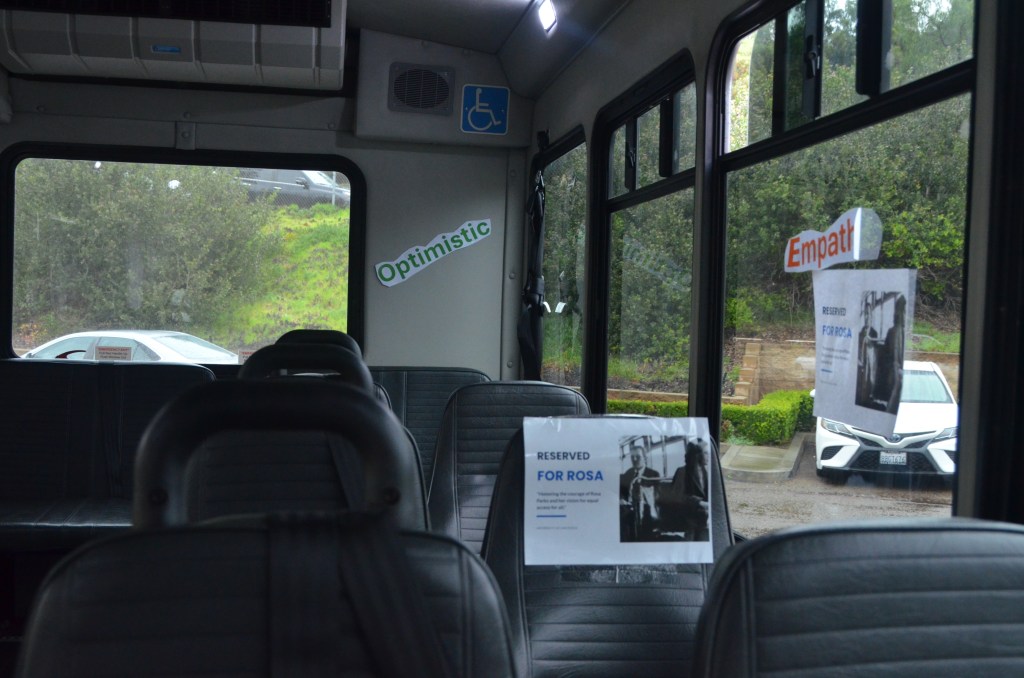
At the start of this month, a “Reserved for Rosa” poster was placed on a seat in one of the East Campus Loop trams by Tram Services. The tram driver, Armis Hutton was born in Alabama and grew up during the ’50s and ’60s. When Rosa Parks protested bus seating, she was only about 100 miles away from him. Hutton responded to finding the posters up in his tram when he started work.
“It’s okay whenever they put posters up,” Hutton admitted. “When you see those posters put up it’s okay for history and it reminds people that they lived through that time period. If you didn’t live during that time you just want to forget.”
Hutton continued to share his experience with education about Black history in the United States.
“When it comes to the South, they want it out of the schools,” Hutton stated. “To me that is mean. I think everyone should learn about what happened in the world. Even though time has changed I see a lot of things repeating itself.”
USD Professor T.J. Tallie, PhD, whose specialties include Southern African history and settler colonialism in the nineteenth century provided the history of Black History Month in the United States.
“What I find amazing is this is 100 years of Black History Month so it’s our centennial,” Tallie explained. “When Carter G. Woodsen first came out with Black history month in 1926 it was N—- History Week … It’s founded specifically because it’s about the birthdays of Frederick Douglas and Abraham Lincoln so there was a reason. The week of February 12 and 14 was meant to center, in the 1920s, a reminder of emancipation, which is Black people being free, which is a relatively new concept in this country.”
It started as a week to mark the freedom of Black people from slavery and expanded to take part throughout the month.
USD senior Abigail Daniel shared why she thinks it is so important to have a month to honor Black history.
“I think it’s definitely an opportunity to take a second to recognize individuals that especially have allowed us to move into these places and have progressed us to where we are now,” Daniel said. “It also takes some time to recognize how much work needs to be done. Obviously it’s something that needs to be reflected on all of the time, but having a time specifically like this, it’s nice.”
Daniel also added that she usually only hears about events for Black History Month through the Black Student Union (BSU) organization and her own circle of faculty and friends.
“I don’t know if in the past I’ve seen as much around USD or promoted by USD ever,” Daniel said. “I think it’s usually the people I surround myself with that are doing the work to advocate for those things that are really pulling the weight on that. So I’m really appreciative of those classes, professors, friends and the resources specifically for Black students that have done the job. For USD itself, there’s always room for improvement with those types of things, I feel like.”
Many students recognized the need for Black History Month and admitted where they view society falls short in fully honoring all that the month stands for.
USD junior John Sanseverino discussed why he thinks the month is important, but also why it may feel as if some do not take advantage of the opportunity to learn their country’s history and act on working toward equality.
“I think it’s important that we take the time to recognize and look back on the history of our country and people who have been through a lot in our country,” Sanseverino shared. “I’m in a class right now that’s ‘Jesus and Justice,’ and it speaks a lot about how we often sanitize our history and pacify it. So I think it’s important that we spend the time to look back and recognize it.”
USD senior Victoria Garcia explained a new way in which she views Black History Month this year.
“I love highlighting everything that happens during Black History Month,” Garcia shared. “I just saw a recent reel from the USD School of Engineering and one of the professors there. She highlighted how Black History Month isn’t just a remembrance month, but it’s also a continuation of the new innovations that are constantly occurring within society. I just think that kind of beautifully explains how we are meant to not only look into the past, but also look at the new innovations that are happening now within Black culture, within society and Black leaders.”
Daniel concluded, adding ways in which students could educate themselves and truly take advantage of the purpose of the month.
“I think the best thing to do this month, and year round, is to continue to put yourself in spaces where Black leaders, Black students, are taking the time to share their experiences and talking about the ways they can encourage and uplift the Black community as a whole,” Daniel stated. “Especially on our campus where the Black student body isn’t exactly the majority, so I think it’s great to sit in these spaces and to allow yourself to humbly learn or educate yourself. And obviously, it’s not something that Black students in general should be leading all these conversations and doing the heavy lifting, and so obviously, that’s the big thing as well.”
Tallie explained that a powerful way to honor Black History is to allow for Black community members to rest.
“Historically, Black people have felt constantly like we have to work so hard to save all of this,” Tallie shared. “So what might a university-wide moment of actually rest, reflection and honor look like? It could be a day of meditation … There’s a movement called the Nap Ministry, and it’s run by a Black woman, which really thinks about what would it mean to honor the work that has been done and give ourselves the permission to rest. And that might be a good legacy of Black History.”
Tallie continued to question how this month is celebrated.
“Black people have built so much and their legacy in this country has been constantly working, everything from enslavement to Civil Rights,” Tallie described. “What would it reframe, if this time, it was about rest?”
USD sophomore Mariana Navarro shared her positive feelings toward the month as an opportunity for education, growth and acceptance.
“I think it’s really cool how, as a community here, we have multiple events, even like food events that we have happening this month that just kind of bring that community together to uplift and support them,” Navarro explained. “I think it’s awesome … I think the best way to honor Black History Month is maybe doing a little less speaking and a little more listening to fellow Black peers or professors, faculty … I think that could fill in the gap of what even is the month, how do we celebrate it.”
Even though Black History Month is namely a time to remember Black history within this country, students recognize that it could also be a time to uplift Black community members and continue to learn about shared history. Buying from Black-owned businesses, learning to be more accepting, working to be more educated and even allowing time for rest, are all steps Toreros are making year-round and promoting this month.
‘Reserved for Rosa’ signs urge students to remember Civil Rights. Caden Haynor/The USD Vista


 The USD Vista
Leave a comment