RILEY RAINS / ARTS & CULTURE EDITOR
EMMA PIRHALA / MANAGING EDITOR
In 1847, under the pseudonym Ellis Bell, Emily Brontë published her first and only novel “Wuthering Heights.” The dramatic love story quickly gained popularity for its revolutionary depiction of obsessive love. In 2026, director Emerald Fennell released a film caricature of the original story, sparking waves of controversy all over USD’s campus.
At the heart of the film adaptation’s controversy is the casting of the main protagonists: Jacob Elordi as Mr. Heathcliff, and Margot Robbie as Catherine Earnshaw — two white actors. The book alludes to Heathcliff’s race in roundabout ways — nonetheless it is obvious to readers that Brontë was deliberate when describing his ambiguous skin tone; while Earnshaw is said to be white but with hair much darker than Robbie’s Barbie blonde.

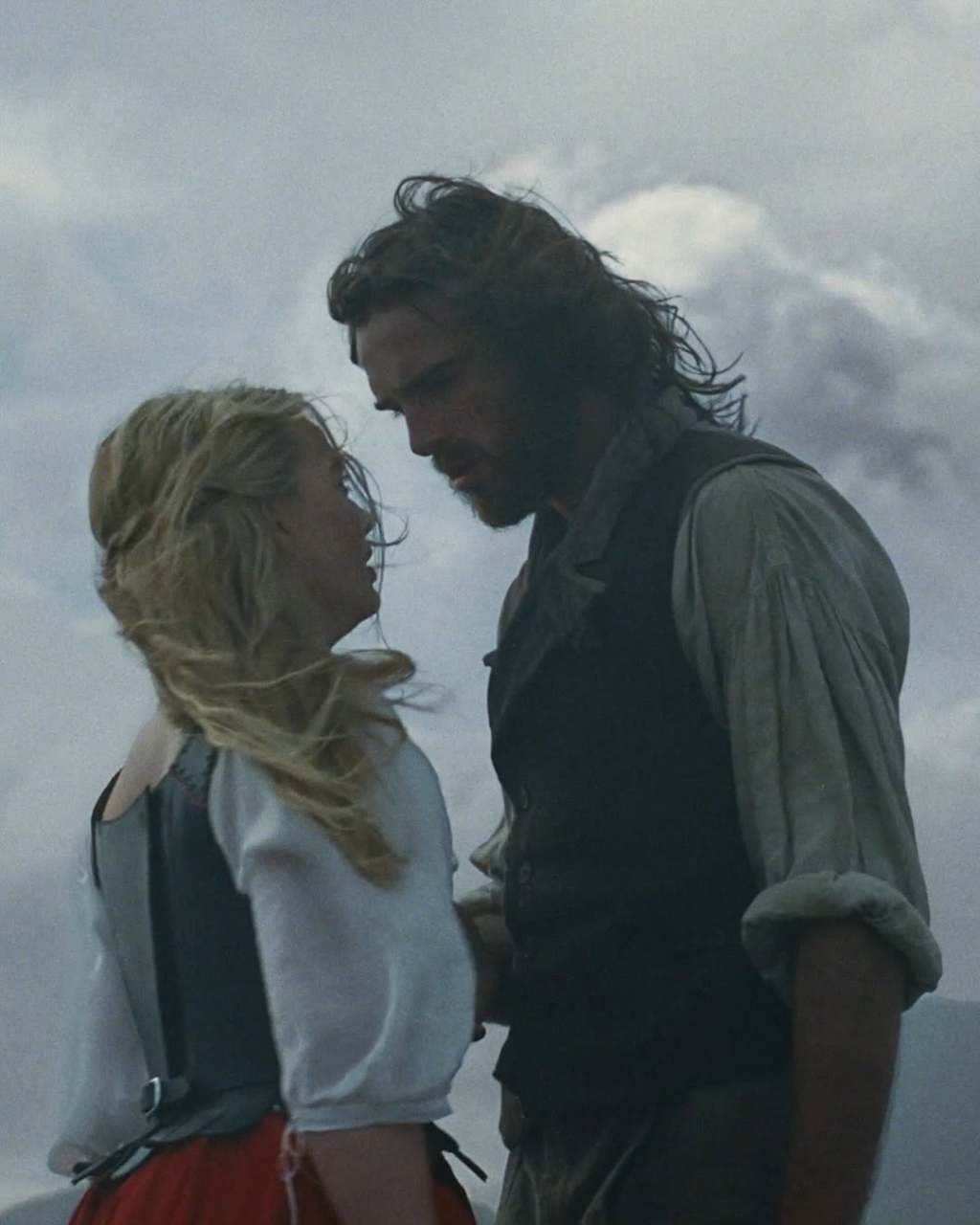
Catherine Earnshaw looking up at Heathcliff in ‘Wuthering Heights.’ Photo courtesy of @newsnomoreports/Instagram
USD junior Bella Stone shared their opinion on the whitewashed recast.
“Instead of focusing on classism, racism and the social norms of Brontë’s time period, the new film dumbs down the story to a white romance,” Stone wrote. “Generally speaking, I think both leads are great actors, but neither encapsulates their characters. Not only does it simplify and misrepresent one of the most beloved classics ever written, but it also whitewashes an important and incredibly complex story and character [Heathcliff]. To make such a film in today’s climate is dangerous – it erases history.”
“Wuthering Heights” — the novel — surrounds an intense and destructive love between a presumably biracial couple, Heathcliff and Catherine Earnshaw. Heathcliff is an orphan taken in by the Earnshaw family. Catherine, the strong-willed daughter, welcomes Heathcliff into the Wuthering Heights estate. Their love story is trailed by conflicts of class, race and personality to paint a wildly dramatic romance.
A film rendition of the classic novel is hardly a first. The “Wuthering Heights” that was released to theatres on Feb. 13 is one of seventeen film adaptations since the first in 1920. Other renditions include television shows, plays, musicals, graphic novels and operas that all reimagine the infamous lives of Mr. Heathcliff and Catherine Earnshaw.
Despite the book’s cult-like following, the motion picture has garnered negative feedback for the casting.
USD Associate Professor Carlton Floyd, PhD, who specializes in African American literature, agrees with Stone’s assertion that the casting tarnishes the film’s merit.
“For someone to take a story whose central character is black by design then remove that character, they’ve removed the story,” Floyd said. “It’s a different story now. It doesn’t include any of the social ramifications. You’re not even doing ‘Wuthering Heights.’”
For a character who was born in a slave town and described as “dark-skinned” and a “Spanish castaway,” some viewers are questioning how director Emerald Fennell rationalized her casting choice.
“I’m curious as to how they justify it,” Floyd asked. “There is historic linkage to removing actors of color and placing white characters in their role.”
Fennell admitted to straying from the original piece, with a few caveats.
“It is my favorite book in the world,” Fennell told The Hollywood Reporter during a “Wuthering Heights” premiere. “It felt right to say it is ‘Wuthering Heights,’ and it isn’t… I am mainly making a version of it. I was focusing on the sadomasochistic elements of [the book].”
Some fans were taken aback by the sexual scenes that Fennell is referring to. In the novel, the narrative is driven by volatile, obsessive and often violent dynamics between Heathcliff and Catherine. Fennell’s adaptation allocated a large portion of screen time for this relationship.
USD senior Isabella Reynolds saw the film the night it came out; she shared her thoughts.
“It was particularly disturbing and also very antiquated,” Reynolds stated. “I didn’t like how misogynistic it was. It was a very male savior arch.”
Aside from concerns of jarring BDSM scenes and character whitewashing, some are concerned about the overuse of above-title billing — the practice of casting A-list actors to produce greater returns in the box office. The overuse of actors like Jacob Elordi, Margot Robbie and others causes some fans to think that films are purposefully being catered for certain gazes.
Stone offered an alternative for directors who reuse familiar faces.
“I 100% believe that whoever was casting the film should’ve thought about casting new actors,” Stone argued. “Someone we haven’t seen before, it could be an incredible breakout role for them both and provide a space for upcoming actors of color to be seen by Hollywood.”
In spite of the backlash, USD students filled busy theaters to view “Wuthering Heights.”
USD sophomore Tatum Mackenzie flocked to AMC as soon as “Wuthering Heights” was released.
“I actually really enjoyed it,” Mackenzie exclaimed. “I went in very excited because I love Jacob Elordi. I do have a life-size cut out of him in my apartment. I was sobbing, crying at the end. I would see it 24 more times.”
With some students raving about the tear-jerking, tragic romance and others criticizing whitewashed casting and sadomasochistic scenes, there is no doubt that the newest “Wuthering Heights” adaptation has sparked controversy on all corners of campus.
Margot Robbie and Jacob Elordi play two characters in an intense romance. Photo courtesy of @wutheringheightsmovie/Instagram



 The USD Vista
Leave a comment