CADEN HAYNOR / NEWS EDITOR
USD professors, Jennifer Olsen, PhD, Saturnino Garcia, PhD and Sophia Krause-Levy, PhD, in the computer science department, are in the data collection process of a study that records students’ voices and screens in computer science classes during lab periods.
The study is being conducted to understand the ways in which students best communicate in the classroom to improve teaching practices in the future. The study also attempts to understand how artificial intelligence (AI) can be used in the classroom as a resource for students to use in coding labs.
Olsen, an assistant professor in the department of computer science, is conducting research for this study as a part of her overall research in the learning sciences. Olsen explained why this study is being conducted.
“We’ve seen that [computer science] is really hard to learn,” Olsen stated. “One of the things that we know is that being able to work together in a group can be good. It can help people build community, it can help with their sense of belonging, but it can also help people to learn. It doesn’t happen spontaneously, right, it’s a skill we have to learn, to collaborate. It’s something we’re interested in, especially with AI becoming more prevalent.”
Olsen continued by outlining the goal of the study, from the perspective of the professors conducting the data collection.
“Our goal is, eventually in the classrooms, to be able to have good support for our students, to be able to understand where they might be struggling so we can put better things in,” Olsen said. “But to be able to do that, we need to understand where they’re struggling.”
This data collection involves placing microphones on students to record their conversations during group discussions and recording students’ screens.
Students in the classes studied are automatically placed in the research and must submit an opt-out form to have their data revoked from the research study.
USD sophomore Bianca Avila is a student in Computational Problem Solving (COMP 110) a class being recorded for the study. Avila explained how the data collection process is conducted in her classroom.
“Everyone has a microphone on them and then they said, if you don’t do it, there’s a consent form that you can fill out which would opt you out,” Avila explained. “But you’re still going to be recorded all through the semester. But they will redact your data at the end when they actually listen to it.”
Some USD students felt confused about the data collection process. USD first-year Chris Mccoy, who is in COMP 110, explained his uncertainty when he heard about the study.
“I was a little confused at first and was very surprised at the fact that we were going to be recorded,” Mccoy said. “It felt as [if] I had to kind of watch what I said.”
USD first-year Sonya Patel is also in COMP 110 and agreed to be recorded for the study, consenting to a microphone being clipped on during her lab times.
“Honestly, we weren’t really told a whole lot about it,” Patel stated. “I think it’s an interesting approach to get access to less formal conversations to see how peers interact and work together with one another to debug and work through computational issues.”
Students are placed to work with a partner. Then, they are hooked up to a microphone connected to a voice box that records their conversations. As the students code on their computers during class, their screens are also being recorded — monitoring their progress.
USD first-year Sara Teferi is a paid research assistant for this study. Teferi described her initial reaction when she was briefed on the study.
“Initially, when [Dr. Olsen] told us that we’re gonna be recording the conversations, I didn’t really know how that was gonna help us understand how they use AI,” Teferi explained. “But then the teachers also have their shared Google Drive. So whatever students are working on, you can see the history of it. Like if you were to log in, you would be able to see the history, almost like a Google Doc. So, once I was told that, it was kind of interesting.”
Any research conducted at USD must be reviewed by the Institutional Review Board (IRB). The IRB is a board, required by federal law, that reviews any research involving human subjects.
The USD Vista requested an in-person interview with a member of the IRB. After multiple email exchanges, a University public affairs representative responded with a statement. Associate Provost for Academic Strategy and Growth Professor Austin Choi-Fitzpatrick explained who is responsible for maintaining the ethical integrity throughout the data collection process in a written statement.
“Once the IRB Administrator approves of a study, it is the researcher’s responsibility to ensure they are adhering to the research plan that was originally approved,” Choi-Fitzpatrick wrote. “Every year the researcher must renew their study, and report on their progress.”
Saturnino Garcia, PhD, an assistant professor of computer science, specializes in computer science education. Garcia explained how the professors work to ensure the rights, safety and well-being of students during the data collection process.
“[The students] may be concerned about being recorded, but we want to make sure that we give them the option to opt out if, for whatever reason they don’t want to,” Garcia explained. “Also, just making them aware of the fact that they’re under control. And we’re always happy to hear feedback from students. If they’re concerned or want another avenue without microphones or something like that, we can discuss that… Obviously, students understand that they can opt out easily and without their instructor knowing it so they wouldn’t be targeted for not participating in the study.”
Students were told that, at any point in the study, they can ask for their data to be deleted and that it will be conducted upon request and without the knowledge of their professor.
Avila stated how she wants her data to be used to help computer science students.
“Whether it’s labs or, in a normal classroom setting, it might help teachers going forward to use methods that will better help us students to be more successful,” Avila said. “I think that this could definitely be beneficial in the future and it may not impact us directly, but it will definitely be beneficial for future students that take the class.”
The implementation of AI into the classroom has reshaped student learning and professor teaching practices significantly. AI follows students everywhere, whether it be a writing coach, a study guide, a translator or a coding partner.
Teferi, the research assistant, is going to stay at USD over the summer to analyze the data with the professors involved, looking at how they work with and without AI assistance to see if their scores are higher and if they are able to remember things.
Teferi explained how students use AI in the computer science classes that are being studied.
“The students are using a program called Copilot GitHub, which is a program where they code, but if they need help, there’s AI built into it,” Teferi said. “So they can ask a question to help them debug whatever they’re working on. Then we record the conversations that they’re doing and later on, in the summer, we’re going to get the transcription of it. Then we’re gonna see how they talk to each other, how they problem solve or if they’re just using it to get answers.”
Garcia, whose interest in educational tools and active learning drew him to this study, explained why he thinks it is important for students to learn how to effectively use AI.
“Just like many tools that professionals are now using, even before AI, there’s a lot of tools that were available that, for a professional, have one meaning because they know how things work and they use those as an expert to help them be productive,” Garcia stated. “But when they become adopted in education, when you have novices who maybe don’t understand how they work, those tools can actually derail the educational process. That’s kind of the approach we were thinking of here.”
While the study has only recently begun, students and professors alike anticipate the results and usage of the data collected.
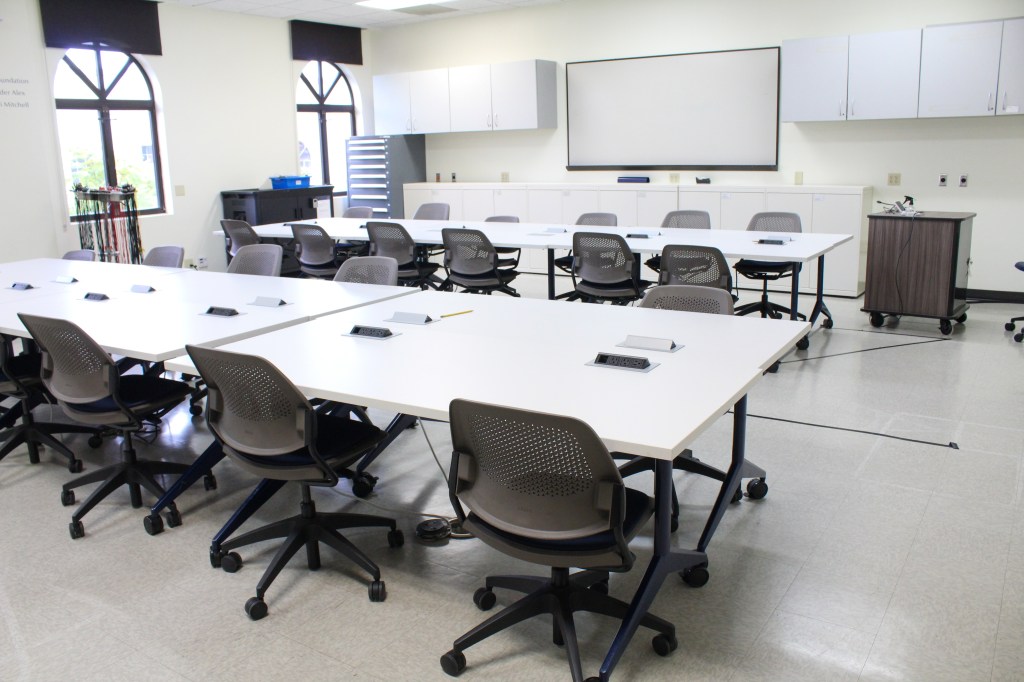
Students clip on microphones that record their conversations with other students in the classes being studied. Hailey Howell/The USD Vista

 The USD Vista
Leave a comment