DAVID COOK / OPINION EDITOR
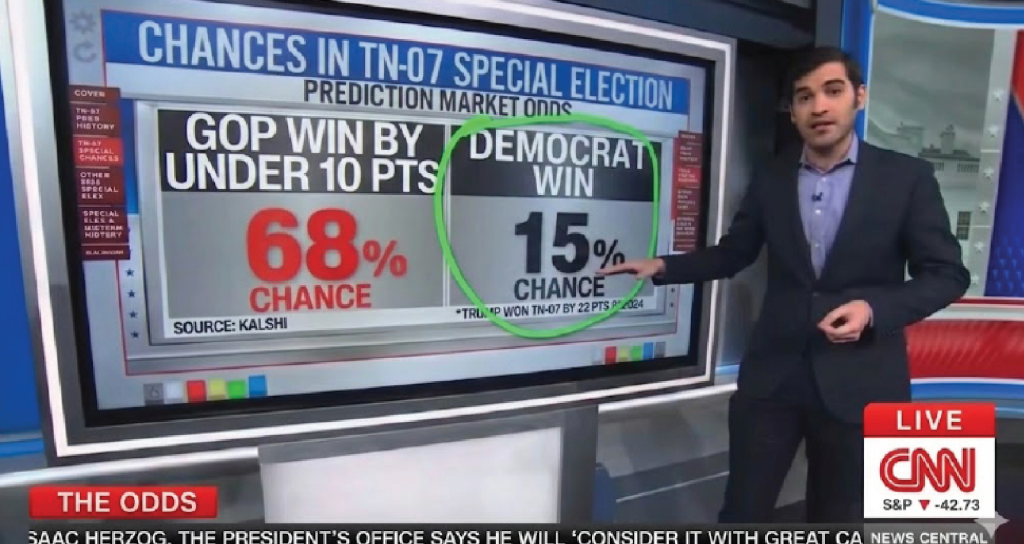
Lately, something strange has started to slip into mainstream news coverage. Betting odds are now appearing next to serious headlines. CNN’s partnership with Kalshi, a regulated prediction market where users can buy and sell contracts tied to future events, has sparked debate. CNN is not alone as CNBC now incorporates prediction market data into its reporting. Even The Wall Street Journal and Yahoo Finance have partnerships with Polymarket, another prediction market.

In early December, CNN and Kalshi announced their parternshipping, coining the introduction of prediction markets in news sources “The future of news.” Photo courtesy of @Kalshi/Instagram
On these websites, people bet on the outcome of future events, ranging from betting on the weather to who will win political elections. Newsrooms and betting markets are increasingly intertwined, and that shift deserves more attention than it’s getting.
At first, it can look like a harmless innovation. Markets are often described as efficient collectors of information, and a probability percentage can feel reassuring in uncertain times. A clean “62% chance” graphic looks objective and precise, but journalism and financial speculation serve fundamentally different purposes.
Journalism is meant to investigate facts, provide context and hold institutions accountable. Prediction markets are designed to turn uncertainty into financial opportunity. When media organizations elevate market wagers as part of their reporting, the distinction between informing the public and capitalizing on unpredictability begins to fade.
The problem becomes clearer when you look at what people are actually betting on. These markets do not stop at broad election outcomes. Users have bet on whether the Federal Reserve will raise or cut interest rates at its next meeting. There have even been bets on which specific words a president will use during a State of the Union address. That example should make anyone pause. If money can be made on whether a president says “border,” “inflation” or “transgender,” the incentive to influence messaging, leak selective details or manipulate timing becomes obvious. The more granular the bet, the easier it is to distort.
Election betting presents its own dangers. When odds heavily favor one candidate months before ballots are cast, those numbers do not exist in a vacuum. They shape narratives and influence enthusiasm, donations and even turnout. In tight races, perception alone can alter behavior. The issue is not simply that individuals are placing wagers, but that major news outlets are amplifying those wagers as part of the broader political conversation, reinforcing signals that may end up influencing the very outcomes being forecast.
Monetary policy offers another example. Contracts tied to Federal Reserve decisions may seem like harmless speculation, but central banking relies heavily on credibility and carefully managed expectations. When speculation becomes a visible, tradable event — and then gets highlighted in mainstream coverage — it adds another layer of pressure to institutions that depend on stability. It can also distort how the public interprets policy moves that require nuance rather than instant reaction.
At the center of all this is an incentive problem. Markets react to new information, but they also react to rumors, framing and strategically timed releases. If money can be made based on how a headline lands, the surrounding ecosystem changes. Many malinfluenced people may see openings to push narratives that move markets, regardless of whether those narratives are responsibly sourced. In a media environment already dealing with misinformation and polarization, attaching financial stakes to headlines increases the risk of manipulation.
All of this is unfolding at a moment when trust in both media and government institutions is already strained. Public confidence in journalism has declined over the past decade, with skepticism about bias, corporate influence and motive becoming standard. Visible financial ties between news outlets and prediction platforms add another layer of doubt. Even if editorial independence remains intact, perception matters. Credibility, once weakened, is difficult to rebuild.
Journalism should operate as a stabilizing force, especially during periods of political tension or economic uncertainty. It should prioritize verification, context and accountability over spectacle. Betting platforms, by design, thrive on volatility and shifting expectations. When those systems overlap in mainstream coverage, the consequences extend beyond graphics and percentages, influencing how citizens interpret public events.
Innovation in media is inevitable, and experimentation is not inherently wrong. But directly attaching financial speculation to news headlines is not a minor formatting change. It alters incentives, introduces new vulnerabilities and further complicates an already fragile trust landscape. In a democracy that depends on informed citizens, the long-term costs of that shift outweigh the short-term appeal of interactive odds.
CNN displays Kalshi’s live odds Tennessee’s seventh congressional district special election. Photo courtesy of @dewforpolitics/Instagram



 The USD Vista
Leave a comment