OWEN FUGIT / ASSISTANT OPINION EDITOR
As Americans, we are no strangers to conflict. From Vietnam to Afghanistan, we have crossed the world to fight. But these actions come at a cost, and beyond the human lives lost are millions of veterans — of peace and wartime — whose lives change permanently from the careers they lead in the armed forces.
One of the longest-running traditions we as a nation have devised to honor those in uniform is Veterans Day, a federal holiday falling on Nov. 11. However, as America falls deeper into conflict with Iran, we can expect to see a new generation of veterans returning home in the coming years.
Now is the time to reaffirm our support for veterans, especially at USD, and one of the most appropriate actions we can take is observing Veterans Day as so many others do to honor the sacrifices made by our peers.
Veterans Day is a relatively new holiday, recognized officially in the last 80 years. Ellen Manzo, the co-founder and an executive board member with the Silicon Valley-based Veterans Memorial and Support Foundation (VMSF) explained the history and significance of the holiday.
“It was not [originally] called Veterans Day, it was called Armistice Day, and that was declared November 11, 1919,” Manzo said. “It was the first anniversary of World War I. Woodrow Wilson is the individual who made that declaration. Then it became a holiday in the 1930s. And then Dwight Eisenhower in the 1950s changed the name from Armistice Day to Veterans Day, and it was always intended to commemorate and remember those who served and defended America’s freedom.”
At USD, we find ourselves sandwiched between Camp Pendleton and Naval Base Coronado, hosting a large student veteran population thanks in part to USD’s generous scholarship programs. USD first-year Shane Ryan is a Navy veteran who spoke on the resources available for student veterans on campus.
“I spent six years in the Navy as a nuclear reactor operator, and then after that, I wound up staying in San Diego,” Ryan said. “The community at USD is super veteran friendly. And then USD also provides a great education and they let the veterans come here for free, and it’s a beautiful campus, which is awesome. And they give you a ton of stipends.”
USD cares deeply for the veterans on campus, however, the logical next step USD must take to affirming its veteran support is adding Veterans Day to our academic calendar. On the University’s part, it seems that academic accreditation requirements are the biggest reason as to why we do not yet observe Veterans Day on campus. In a statement, a public affairs representative on behalf of the University explained the process further.
“The University of San Diego’s academic calendars are developed by the Academic Calendar Committee (ACC),” the representative said. “This group brings together a wide range of perspectives, including representatives from academic units, administrative offices, and both undergraduate and graduate student leaders. The ACC is responsible for balancing the unique needs of our undergraduate, graduate, and law programs. While we follow a set of approved institutional guidelines, the committee also works to navigate various logistical constraints to ensure the calendars support our entire campus community.”
The University also explained the numerous resources it offers for student veterans, which underscores how committed USD is to supporting our servicemembers. However, I urge the ACC to go the extra mile and find a way to incorporate this nationally recognized holiday into the academic calendar as soon as possible. Millions of men and women have served in uniform for the United States, and with many more veterans working their way back into civilian life everyday, one of the best choices we can make as a community is to recognize their sacrifices and fully observe Veterans Day.
The need for dedicated time to understand and support our veterans is heightened with the recent conflicts in Iran, which has already seen seven American service members killed.
There have been several times in American history where veterans returning home from a war were greeted by an angry and disillusioned public. The Vietnam War, in particular, stands out for its political controversy that was eventually taken out on the veterans returning home. The conflict in Iran is already dividing Americans domestically, and as history has shown, veterans returning from contentious foreign wars are often treated much worse than the politicians who spurned the conflict. A core component of observing Veterans Day lies in the separation of politics and humanity, and it is this nuance that will become so crucial over the rest of the decade.
Manzo gave some examples of veteran homecomings that lacked empathy, and the effects this had on the men and women in uniform.
“When our service members came back from the Vietnam War they landed on American shores, and they didn’t feel gratitude for their service,” Manzo said. “I have colleagues on the board, fellow board members, who are Vietnam veterans, and they’ll talk about their experience of returning from Vietnam, landing at LAX being told to ditch their uniform so that they don’t get into a fight on the way home.”
In 2022 alone, more than six thousand veterans took their own lives, per the Department of Veterans Affairs. This chilling statistic is made even more impactful by the fact that the number of American veteran suicides are outpacing deaths from the wars themselves. While it cannot be directly attributed to public reception, the sides we take when veterans come home certainly play a role in this statistic. Such a crisis should spur more public action, but strangely enough, the politics of war seems to cloud the human aspect. One of the best resources we have to do our part at USD is observing Veterans Day in recognition of the men and women who suffer deeper pains off the battlefield than they do on it. Manzo mentioned why Americans join the military in the first place.
“Many of our service members believe their job is a calling,” Manzo explained. “It’s a passion and a calling, and so we need to express gratitude to them… So they go to war, they come back and then they serve their communities. They are a huge invested asset of our community, and therefore, to the extent that we can support those community assets, that’s huge.”
I have spent the past few years of my life working closely with veterans as a part of different volunteer organizations and veteran story preservation groups. Most veterans I speak with say that they joined the military because they were called to serve something greater than themselves. One of the most significant steps in recognizing our veterans’ work is separating Washington D.C.’s political choices from the human lives they affect. Anger toward a foreign war is fine, even productive, as it can prevent so much suffering on both sides — we saw that in the opposition to the Vietnam War. But taking out some politically-driven anger on the men and women who were swept into fighting these wars is unacceptable. By observing Veterans Day at USD, we are forced to reexamine our perceptions of veterans, and learn to see the nuances that a career in the military entails.
Hopefully, we will be able to separate the warfighter from the warmonger in the coming months and years. But helping veterans acclimate to civilian life must also include a deeper understanding of the post-traumatic stress injuries (PTSI) so many veterans bear.
As the war in Iran ramps up, and as more and more people begin discussing military policies regarding the war, we must be nuanced in our observations, and separate politics from the people who were called to serve. Already, at least seven American service members have died in Operation Epic Fury, and countless more will surely suffer traumatic stress injuries before returning home. One of the best things we can do as a campus community is to observe the day earmarked for these individuals when the time comes next November.
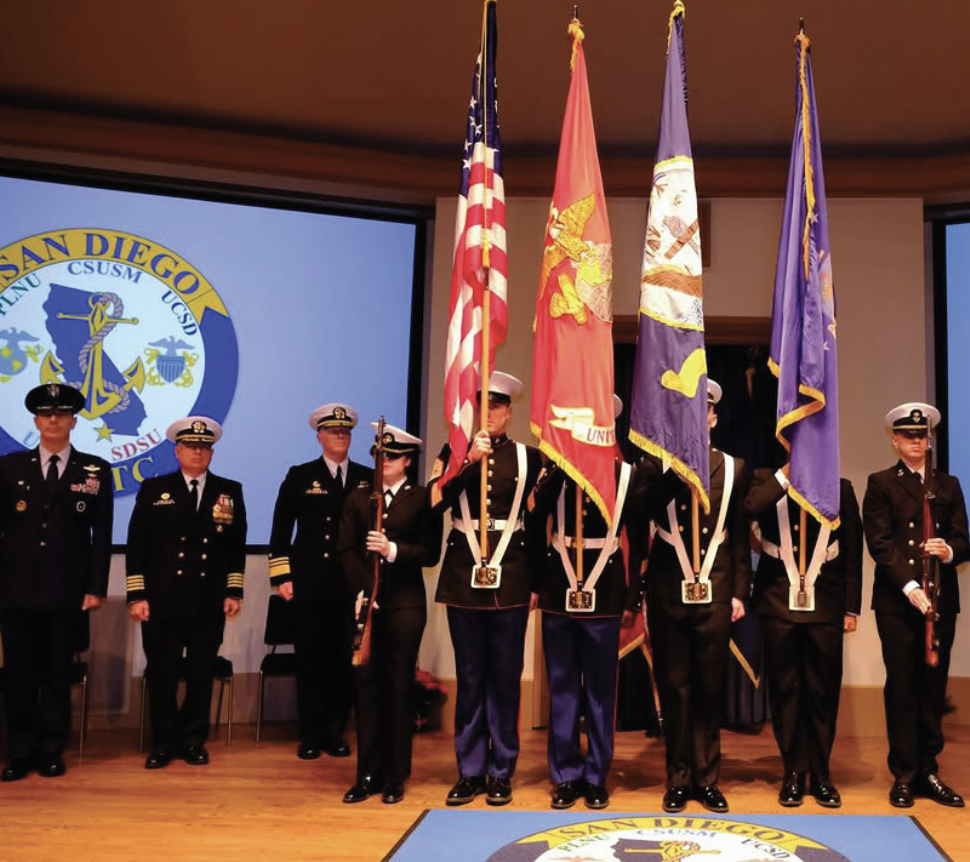
NROTC San Diego commissioned new lieutenants on campus at the end of the Fall Semester. Photo courtesy of @nrotcsd/Instagram
 The USD Vista
Leave a comment