DAVID COOK / OPINION EDITOR
“Welcome to the University of San Diego! Enjoy the next four years, because before you know it, you’ll be graduating!”
Everyone has heard this proclamation at some point during their first year at USD. It’s easy to hear that as a young first-year student and ignore it. Four years feels like a lifetime when you’re just figuring out where your classes are, meeting people for the first time or coming to terms with having to pay for your laundry at Mata’yuum Crossroads.
Then suddenly, you’re a senior. You’re sitting in your room, two months away from graduation, realizing that the thing everyone warned you about is actually happening. The years passed in what feels like a blink. And with that realization comes something else: a quiet, persistent anxiety about what comes next.
At first glance, it’s easy to blame that anxiety on the job market. Entry-level positions are competitive, internships can be difficult to secure and the path into many industries feels increasingly narrow. Students spend years building resumes, stacking internships and networking in hopes of standing out in competitive fields. From this perspective, the anxiety surrounding graduation appears purely economic. If the job market were easier, the thinking goes, seniors would feel far less pressure about leaving college.
But that explanation doesn’t fully capture exactly what’s going on. Even students who already have jobs lined up admit that what comes after graduation is nerve-wracking. USD senior Zack Kleinfeld has his post-graduation plans lined up with a job as Customer Success Manager at Adobe in San Francisco, noted that his biggest source of anxiety is uncertainty, showing that post-graduation anxieties aren’t just for those still on the job hunt.
“It’s a specific kind of uncertainty that feels like every major pillar of your life is about to change at once,” Kleinfeld explained. “Where are you living? What are you doing? Are you going to grad school? What happens to your relationship? What happens to your friendships? You go from a life that had structure baked into one where you have to build the structure yourself, and the gap between those two things is where most of the anxiety lives.”
The anxiety doesn’t disappear simply because employment is secured, suggesting the problem runs deeper than the labor market alone. The biggest challenges of graduation for seniors run deeper than financial and professional challenges. They are personal and structural. It’s the sudden disappearance of a clear path and the loss of an identity that has defined us for years and the pressure of navigating an uncertain future without a roadmap.
For many seniors, the emotions surrounding graduation are complicated. Audrey Hill, a senior art major at USD, described the feeling as a mixture of optimism and uncertainty as she searches for graphic design and marketing work.
“I’m hopeful, I’m excited to work, and I love the field that I’m going into,” Hill said. “But it’s been a lot of hunting and not a lot of closure with that.”
Part of what makes the transition so unsettling is the loss of structure. For the four years of college, life follows a clear rhythm. You always know what the next step is supposed to be. Graduation itself sits at the end of that timeline as a clear, defined milestone.
After graduation, that structure largely disappears. There is no syllabus for early adulthood. For many graduates, the shift is less about finding a job and more about losing the identity that organized their lives for years. Being a student is a defined role with expectations and milestones. Being a recent graduate figuring things out is far less clear. Hill noted the biggest adjustment may simply be the disappearance of a clear path forward.
“Everybody’s doing everything differently,” Hill said. “I know some of my roommates are going to grad school for five years, and other roommates are deciding to switch their whole career right now. There’s just no clear straight path after college.”
There is no debate that the structure of college life is vanishing, but what fuels the flame of anxiety is how this is truly the first time where the next step is not clear. Our education system is structured so you always know what comes next — elementary to middle school, then high school and then four years of college. There are clear stepping stones, and you always know where your next foot will land.
That is, until you finish college. Now, there is no stepping stone, no guard rails, and yet you still must take a leap and hope you are able to grab on before you fall too far.
This uncertainty might be manageable on its own, but it is intensified by something unique to our generation: constant comparison through social media. Every day, we see people our age who appear to be thriving. LinkedIn posts highlighting other students’ successes and latest internship offers fly across your feed while you have clicked the same blue “Apply” button 20 different times in the last week. Some people are launching companies, others are traveling the world and many influencers seem to have turned their personalities into full-time careers before turning twenty-five. Their lives look exciting, financially stable and fully figured out.
Of course, these examples represent a small minority. Social media platforms amplify the most visible success stories rather than the far more common experience of slowly building a career. The early years of most professions are quiet and gradual, and that process rarely goes viral. Still, it is difficult not to compare. When success stories are constantly placed in front of us, the normal beginning of a career can feel like falling behind. We end up measuring our progress not just against our peers, but against highly visible outliers whose experiences are anything but typical.
Arguably, the most daunting part of graduation is no longer being able to spend your years with some of the strongest friendships you have made. We have spent four years with the same familiar faces, especially at a relatively small campus like USD. Seemingly lifelong relationships are formed through taking similar courses, joining clubs or spending late nights at their favorite bar in Pacific Beach. After four years of the same old routine, there is a hard deadline. And when this deadline passes, what is now just life magically becomes a memory.
Graduation forces students to confront questions that college allowed them to postpone. What direction should I take? What does success actually look like? How long is it supposed to take to build a career? Can I even build a career?
Once the structure of university life disappears, those questions become unavoidable. The anxiety many seniors feel as they approach graduation is often framed as a purely economic problem, but the reality is that it is much more complicated. The labor market matters, but so does the sudden loss of structure, identity and clear milestones. In many ways, graduating is less about entering the workforce and more about learning how to navigate uncertainty for the first time. Maybe that is the real adjustment after college, maybe that is what college has been preparing us for all along.
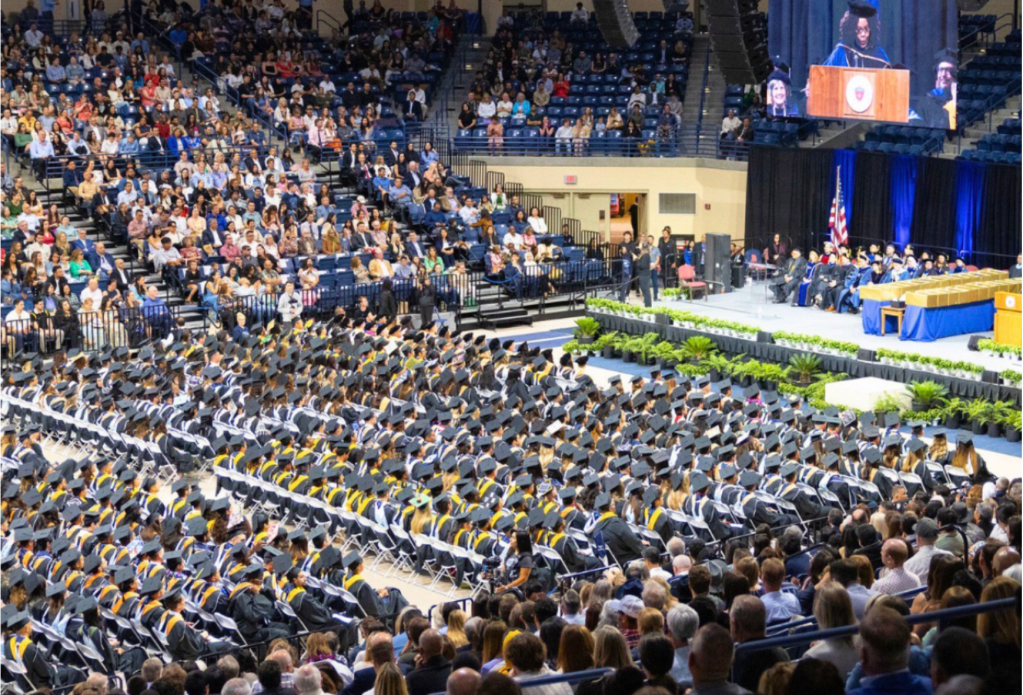
In Spring 2025, students gathered in the Jenny Craig Pavilion for their graduation ceremony. Photo courtesy of @uofsandiego/Instagram




 The USD Vista
Leave a comment