
CADEN HAYNOR / OPINION EDITOR
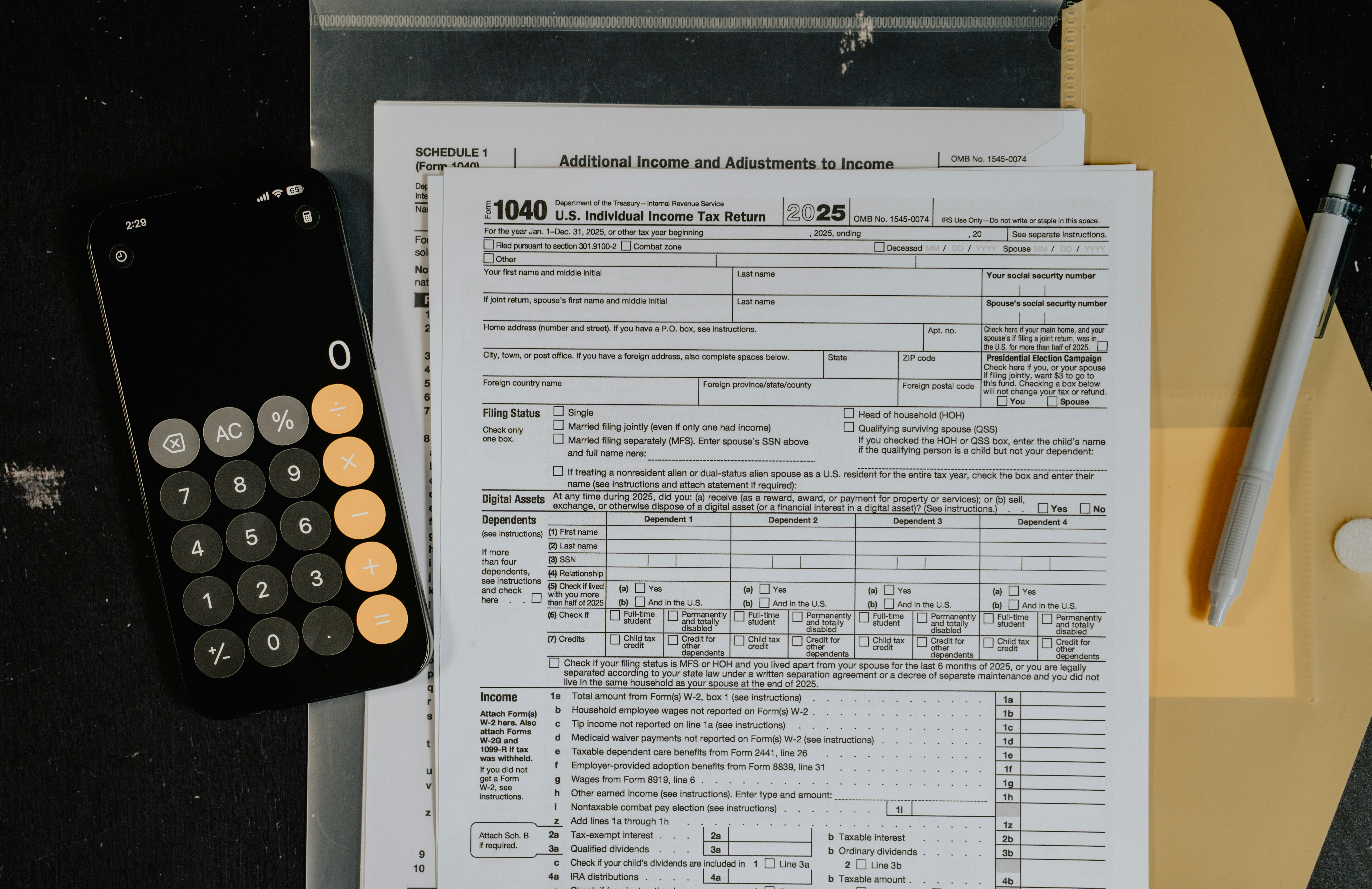
Tax forms and a calculator sit on a desk in preparation to file taxes. Photo courtesy of Kelly Sikkema/Unsplash
Nothing is certain in life except death and taxes, and sometimes it feels like they happen simultaneously on April 15 every year. The portending “Tax Day” is a consistent reminder to many of us college students that we are adults and our parents are not in the other room waiting to help us with our inevitable needs.
Many of us sat in front of our computers waiting for all the financial jargon to sort itself out into English. When it never did, I asked myself why I was never taught how to do this, since taxes apply to every working person.
Sitting in a geometry or calculus class has consistently begged the question “will this ever be useful?” from all of us at some point. As soon as April 15 rolled around, I wished my high school or university taught me how to navigate the ins and outs of withholding, expenses, W-2s, 1099s and everything else that popped up on my screen and made me furrow my brow.
Many of my friends, who did not decide to go through the struggle of doing their own taxes, were frustrated at paying upwards of $200 for someone else to file their taxes for them. Following this irksome taxation process, I decided to conduct some research on how students might gain access to helpful information on filing their taxes so that they do not have to pay a large sum of money or spend hours staring aimlessly at their computer screen.
USD Clinical Professor of Finance Dan Roccato teaches financial management and personal finance. Roccato explained how the United States is progressing in financial literacy and one of the negative effects of not teaching students about it.
“There’s something like 36 states or so that now require high schoolers to graduate with some sort of financial literacy course,” Roccato said. “So that’s clearly a step in the right direction. Ideally, we’d have all 50 states do it, but there is this movement afoot… But, we can see what happens, right? We have 43 million student loan borrowers, about a third of which are behind on their payments. And we can probably connect the dots and say because a lot of those people should have known about student loans.”
Financial literacy deserves more attention in schools, especially in the form of applied economics. There are multiple Wall Street Journal articles that say that schools need to teach their students the deep eccentricities of American capitalism in a formal economic theory course. I disagree on that front. I think that those courses would bore students and they would end up copying down terms mindlessly.
If there was a course that taught students how to file their taxes, build credit, manage a 401k, invest in a Roth IRA, mail a check, balance a checkbook and learn what a mortgage is, college students would be much better off. I, for one, felt like some of my high school classes were utterly useless when I could rattle off the quadratic formula, but I struggled to do my taxes.
Some may argue that students’ tax situations vary too much for a one-size-fits-all class. Realistically, when it comes to filing taxes, most students will only need to know the basics of a W-2 versus a 1099 income, and possibly what dependents are and how scholarships and donations apply.
All of those eccentricities can easily be fitted into a regular high school curriculum, especially considering that many people have free periods as upperclassmen. Furthermore, one class can definitely walk students through the tax forms and describe what each page means without going through how they might apply to every individual case.
There are resources that explain these topics to people who are unaware as well. Roccato gave a good resource for students who need information to increase their financial literacy and explain economic concepts.
“There’s a fantastic government website called FDIC.gov, it’s the Federal Deposit Insurance Corporation, and they’ve got just a whole abundance of really good information out there without selling you,” Roccato explained. “It’s very easy to read, it’s very understandable and it’s reliable. It’s good, basic, unbiased information that I would recommend over a lot of others.”
Another good government website that students can use when looking to file their taxes is using IRS Free File, which can be visited with the QR code below. This website helps you find a trusted partner to help you file your taxes, many of which do so completely free of charge. This is how you can file your taxes for free and hopefully access the correct information to do so correctly.

Thankfully, states are steadily increasing their financial literacy class requirements. As of 2025, 29 states passed bipartisan financial literacy graduation requirements, which means they require a standalone personal finance course for high school students to graduate.
If all states required high schools to teach students about these resources and how to navigate them, then the struggle to do taxes every year would lessen by a significant figure. At the very least, I would spend two less hours doing my taxes and might even spend my extra time learning the pythagorean theorem. That is, if my high school algebra class did not spend a semester on it.
As tax season returns, many young adults are left stressed while trying to navigate their taxes with little formal education in personal finance. Photo courtesy of Elisa Ventur/Unsplash


 The USD Vista
Leave a comment