PRATINYA BODANAPU / OPINION EDITOR
It is said that the first casualty of war is truth. For women, freedom is often not far behind.
Today, approximately 676 million women and girls live within 31 miles of an armed conflict — the highest number recorded since the 1990s. In 2024, the United Nations documented more than 4,600 cases of conflict-related sexual violence, an 87% increase from 2022. More than 60 million forcibly displaced women and girls also face heightened risks of gender-based violence.
However, while conflict can have distinct and disproportionate consequences for women, their experiences remain relatively absent from much of the reporting on war. Research has found that women account for only 12% of subjects and sources in news coverage of war and state-based violence.
The experiences of women in war-torn states like Sudan, Gaza and Ukraine illustrate how conflict can erode rights and protections in different ways. From access to health care and personal safety to economic independence, war can undermine the systems that turn rights on paper into protections in practice — especially for women.
According to U.N. Women, Sudan’s civil war between the Sudanese Armed Forces and the Rapid Support Forces began April 15, 2023 and since then, the number of people, primarily women and girls, requiring services related to sexual and gender-based violence has quadrupled from prewar levels. The U.N. Women Regional Director Anna Mutavati has described the prevalence of sexual violence throughout the conflict.
“Sexual violence is embedded in the blueprint of Sudan’s war,” Muvati said.
Individual accounts collected by U.N. Women illustrate the conditions behind those figures. One Sudanese woman, identified under the pseudonym Fatima for her safety, described fleeing her home with her family as fighting surrounded them.
“I expected the worst to happen to us on the way,” Fatima told U.N. Women.
Another woman, identified as Amna Salih, was 18 when soldiers raped her during the war. She later learned she was pregnant. With Sudan’s healthcare system severely disrupted, Salih struggled to obtain medical care, adequate nutrition and an income while also facing stigma associated with having a child conceived through rape. Months after giving birth, Salih described the uncertainty she faced about her life and her child’s future.
“The future is completely dark for me,” Salih stated.
These experiences reflect the broader systems of institutional collapse in war torn regions. The International Committee of the Red Cross has documented how sexual violence in armed conflict can be used to create fear, punish communities and disrupt social structures.
In Sudan, the erosion of women’s security has therefore occurred not primarily through changes in law, but through widespread violence and weakened systems of protection.
Gaza is also a prominent example of a state in which violence has led to a lack of rights for women. As of July 2026, 94% of Gaza’s hospitals were destroyed or only partially functional. Fewer than half of health facilities were operating at any level, and only 15% were capable of providing emergency obstetric care. An estimated 55,000 pregnant women were struggling to access safe delivery services.
Yasmeen, a midwife in Gaza City, was among them. When she went into labor at 4 a.m. her husband was unable to find an ambulance or transportation to a hospital. Yasmeen shared her story with the United Nations Population Fund (UNFPA), the United Nations sexual and reproductive health agency. Its mission is “to deliver a world where every pregnancy is wanted, every childbirth is safe, and every young person’s potential is fulfilled.”
Yasmeen told UNFPA. “But I had no choice but to deliver my own baby.”
Yasmeen’s experience demonstrates how the destruction of civilian infrastructure can have gender-specific consequences. Access to health care may remain a recognized right, but damaged hospitals, shortages of medication and unsafe transportation can prevent women from accessing them
Ukraine, on the other hand, presents a more complicated example because Ukrainian women continue to serve in the military, operate businesses, work in humanitarian organizations and participate in rebuilding communities. In some sectors, women’s economic participation has expanded as men have entered military service.
At the same time, U.N. Women reported significant setbacks in women’s safety and economic security. In 2025, nearly 1.9 million women and girls were internally displaced worldwide and approximately 6.7 million women required humanitarian assistance.
U.N. Women has described Russia’s full-scale invasion, specifically, as reversing progress in women’s safety, rights and economic opportunity. Some of those effects are indirect. Russian attacks on energy infrastructure, for example, have disrupted businesses across Ukraine. For women running small businesses, repeated power outages can reduce working hours and income.
“For my business, winter with blackouts is a disastrous time,” Ukrainian bakery owner Iryna Fishchuk told U.N. Women.
Describing the erosion of women’s rights during conflict requires an important distinction: war does not affect only women, nor is every consequence women experience necessarily a gender-specific loss of rights. Men and boys face their own gendered risks, including military conscription, forced recruitment, detention, torture and execution. The difference often lies in the inequalities that exist before conflict begins. Globally, women continue to perform more unpaid care work, possess less wealth and political power and face higher rates of certain forms of gender-based violence. When public institutions deteriorate, those existing disparities can shape how the consequences of war are distributed.
In fact, these disparities even continue after fighting subsides. In formal peace processes worldwide in 2024, women represented 7% of negotiators and 14% of mediators. Some negotiations excluded women entirely. That underrepresentation
has implications for postwar reconstruction. Decisions about health systems, education, justice, economic recovery and security determine how rights function after conflict, yet women remain a minority among the people formally negotiating those systems.
While Sudan, Ukraine and Gaza are completely different conflicts, they all reveal how systems already unequal for women can become even more restrictive when war breaks out.
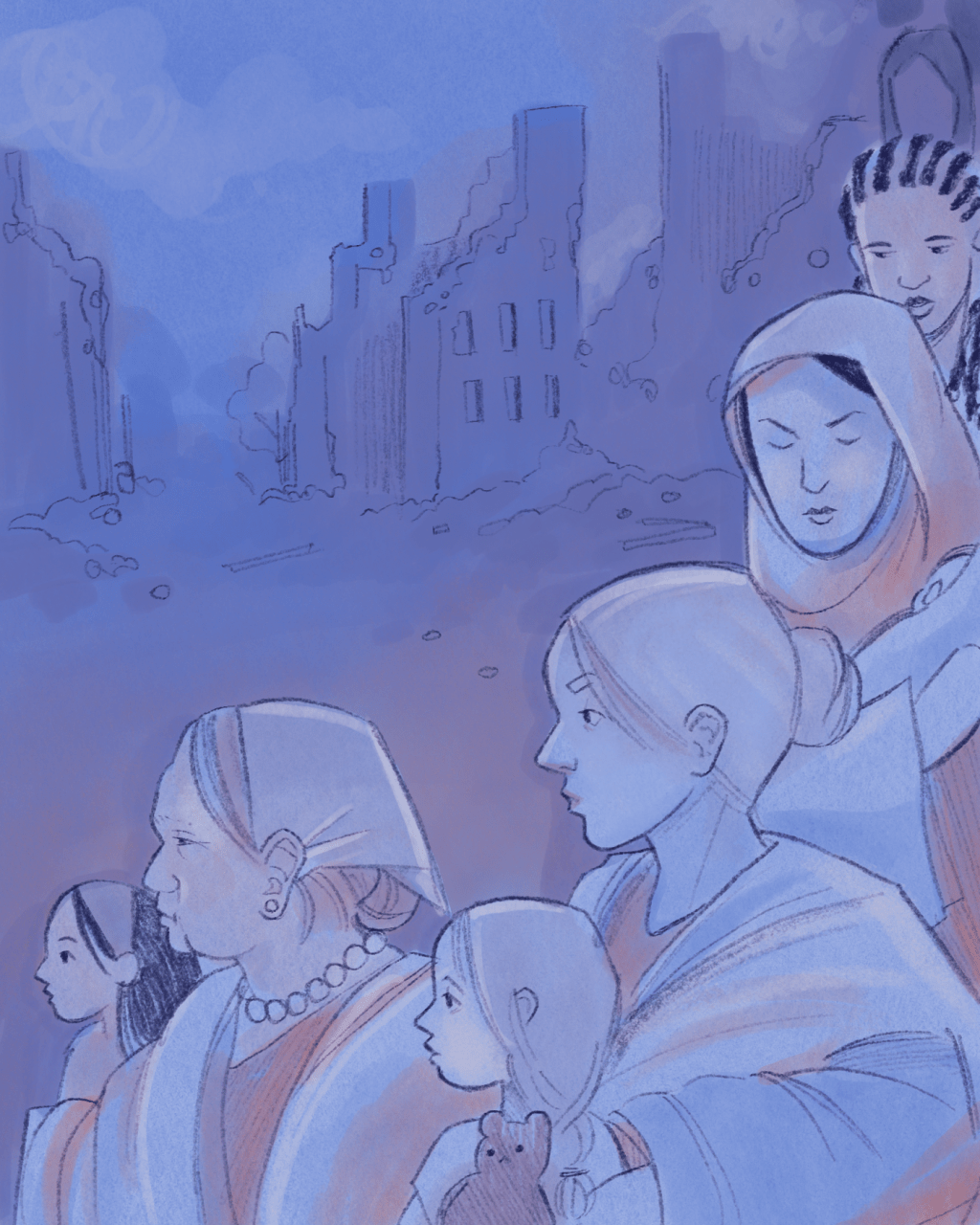
Women in the wake of war Art by Kyra Lefebvre



 The USD Vista
Leave a comment