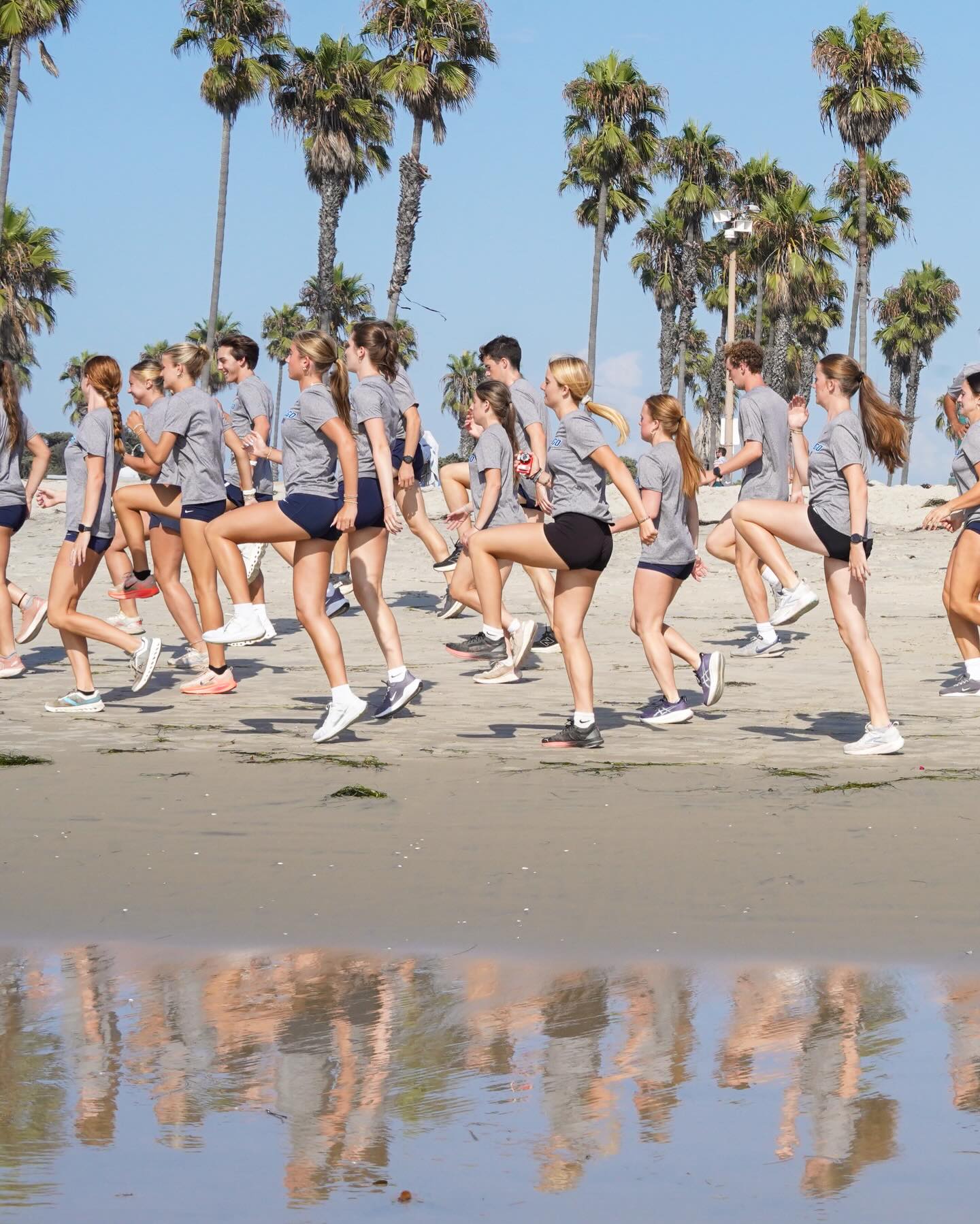
While many start their morning by making the long trek across campus to their 8 a.m. class, several student-athletes are already on their way back from an off-campus morning run, diving session or rowing practice in Mission Bay.
For many USD student-athletes, their practices take place just a short scooter ride from their dorm, but not all facilities are created equal.
Beyond the Jenny Craig Pavilion, Fowler Park and Torero Stadium, several sports on campus do not have a space of their own dedicated to their specific practice needs. Track and cross country, for example, conduct all their training and practice runs off campus. There has not been a running track on campus at USD since before the construction of the Joan B. Kroc Institute for Peace and Justice in 2001. Even that track was an informal dirt trail open to students.
Will Guarino, head coach of track and cross country, ran on that very track when he attended USD from 1984 to 1988. As a longtime fan of the San Diego area, Guarino views the team’s local adventures as an advantage to their craft.
“Even though it seems like a hindrance, I think it’s a growth opportunity that other teams don’t have,” Guarino said. “If their nature is nature, why can’t we actually provide them with what their calling is? Their calling happens to be people of the outdoors, and there’s no greater place [than San Diego].”
The track and cross country teams travel five days a week at local tracks and trails across San Diego County. From Del Mar to Mission Bay to Snapdragon Stadium to Bonita, the runners take turns carpooling and taking the university vans to complete their weekly training.
Rowing also takes advantage of the local resources with its competitions and practices in Mission Bay. Head coach of the women’s team Katie Thurstin admires her players’ ability to organize themselves by commuting back and forth throughout their weekly training schedule, and specifically the captains’ initiative in planning and regulating the system. At other colleges, such as Syracuse University or Dartmouth University, their rowing programs are supported by indoor rowing tanks, artificial pools with flowing water to simulate a real rowing session. Here at USD, any in-the-boat training must be done at Mission Bay.
“I think the athletes that stand out the most are the ones who support their teammates the most,” Thurstin said. “We’re a sport where there’s nine people that have to cross the finish line, so you cannot be the best person in the boat. You need to be the best person for the boat.”
Through the recently established rowing alumni board and meetings with USD architects, the team hopes to expand their on-campus facilities to maximize their time. As of now, the team practices six days a week and splits their time between commutes to Mission Bay and simulated training in the Sports Center. In their specialized rowing room, the team uses ergometer machines, which simulate the rowing motion done in the real boats. They are also available in the Wellness Center, and allow for the athletes to execute dryland training without leaving campus.

While rowing is able to commute as a team throughout the week, the swim and dive program is forced to split up. The diving team takes an early morning trip to the Poway Community Center about 30 minutes off campus every Tuesday and Thursday.
First-year diver Reese Taylor, sophomore diver Ava Valadez and junior diver Brooke Blaylock, all compete in both the 1-meter and 3-meter categories for the USD team. The Sports Center pool on campus only allows for them to train using the 1-meter boards with a pool depth of 11 feet. The 3-meter boards at the Poway pool comply with the NCAA minimum depth requirement of 12 feet, 6 inches.
“This year, since we all have 10:45 a.m. classes, it’s been a struggle,” Valadez said. “But I think we have a good system going on where we leave Poway as quickly as possible, and then we all change here before class.”
Each diving athlete is required to complete a driving certification process in order to be permitted to drive the team vans to and from morning practices. That way, all players take turns driving the school vehicles and split the responsibility evenly.
The athletes explained that the process has been one of trial and error. This season, they worked to find the most practical schedule for ensuring every athlete is back in time for classes.
As the divers balance their hour-long commute, changing and potential traffic, they learned to communicate with their professors beforehand to be transparent about their potential tardiness.
“I think [early morning practices] did make me more resilient because I still pushed myself to go there and get there and still make progress,” Taylor said. “Even if I didn’t have the best practice, I still showed up for myself and for my team.”
Many coaches have met with architects hired by the athletic administration to discuss feasible plans for athletic facilities. Within the next three to five years, the administration hopes to execute concrete plans and allow for student-athletes to prioritize their time on campus.


Join the conversation