RILEY RAINS / ARTS & CULTURE EDITOR
On the afternoon of April 10, USD students flocked to the beach, but not for the usual sun and surf. Artemis II landed right outside San Diego’s coast, and many wanted a chance to see — or hear — the “Integrity” crew’s splash back to Earth. The landing was not visible by the naked eye, however, the improbability didn’t discourage some Toreros from trying to see this once-in-a-lifetime landing. Many students tuned in through NASA’s live stream instead.
USD sophomore Ava Pres went to Garbage Beach to watch the Artemis II splash.
“It was hard to tell where to look as no one really knew where it was going to land,” Pres explained. “But we heard a loud boom just at the time of the landing, a lot like a firework exploding in the distance. Everyone was watching the live stream on their phones at the same time. It was pretty fun to see all these people invested in this.”
Artemis II is the first crewed mission of the Artemis program — a series of five planned endeavors. The Orion spacecraft, the Artemis II ship, left Earth on April 1 and returned on April 11, marking the first humans to orbit the moon since 1968.
The first cosmic expedition of the Artemis project was a test launch of the capsule with no humans inside it. This first preliminary launch had some issues in 2022, Artemis I was delayed due to hydrogen leaks and valve problems. There were also multiple power interruptions in the communication module and an unexpected protective outside layer loss during atmospheric reentry. These technical problems caused some anxiety leading up to Artemis II. The mission ran smoothly, omitting a small toilet malfunction that Mission Specialist Christina Koch quickly fixed, coining the nickname “space plumber.”
Artemis III will be an orbital test of the docking system between the space capsule and what NASA will use to land on the moon, set to occur in 2028.The finale’s precursor, Artemis IV, is sending humans back to the moon, boots-on-the-ground and all. The last step of the Artemis mission is a tentative base on the moon. The end goal is to use the moon as a stepping stone to Mars.
The ongoing mission could cost up to $105 billion dollars by 2028 in its entirety. While these figures were presented by various news sources such as The Washington Post and The New York Times, the total cost is not solidified as engineering projects tend to be fluid in their magnitude and direction. Some USD students are less than enthusiastic about this expenditure.
Some USD students are less than enthusiastic about this expenditure.
USD first-year Maxwell Gibbons shared his mixed feelings.
“I like spending money on cool stuff, like maybe going to Mars,” Gibbons explained. “But I also think that the money could be better spent. Not everything has to be cool.”
The Artemis II mission cost around $4.1 billion dollars to launch four astronauts, Commander Reid Wiseman, Pilot Victor Glover and two mission specialists: Christina Koch and Jeremy Hanson out of Earth’s orbit. They slingshotted around the moon before returning safely to Earth within 10 days. The Orion spacecraft utilizes a free-return trajectory, using both Earth’s and the moon’s gravitational pull to their advantage.
The crew was tasked with taking photos and documenting observations of the moon’s surface during their revolution. NASA is collecting high-resolution images so scientists on Earth can investigate fundamental scientific questions about mankind’s understanding of the moon’s evolution.
While these photos offer an objective view of the moon, human eyes can detect details that cameras cannot. For example, the crew spotted rays of different colors that the cameras missed — a discovery that alludes to various materials and elements on the moon’s surface.
USD professor and quantum physicist Sean Mossman, PhD, has been keeping up with every step of the Artemis journey. He explained the significance of keeping human eyes on the moon at all times.
“During the entire pass around the backside of the moon, the astronauts had very rigorous shifts of who was going to be at the window looking at the moon,” Mossman explained. “They had two people at the windows at all times. And they were explicitly told to make observations of the moon with your eyes and describe it qualitatively. NASA even asked them to record how they felt about it. They also live streamed it. Both the science team and the media outreach team were working together to bring us all along on the ride.”
The Orion spacecraft had to cut communication with Houston for 40 minutes on April 6 as they traveled toward the dark side of the moon. The radio transmission was not able to pierce through the moon’s body. Before communication paused, Glover sent Houston a heartfelt message.
“As we get close to the nearest point to the moon and farthest point from earth, as we continue to unlock the mysteries of the cosmos, I would like to remind you of one of the most important mysteries there on earth, and that is love,” Glover beamed. “We will see you on the other side.”
Scientists who have had the privilege to spacewalk often experience the overview effect. Coined by space philosopher Frank White, the term explains the cognitive shift characterized by an intense sense of awe and awareness of Earth’s unity and fragility.
Integrity had the opportunity to name two craters while they floated among the stars. One crater they coined after their team — Integrity. The second crater, one of the brightest on the moon, was named after Mission Commander Wiseman’s late wife, Carroll.
“It was a really heartfelt moment,” Mossman choked. “I was losing it a little bit. I think it was really impactful for a lot of people.”
Wiseman wept as he put in the request to Houston. After Artemis II was grounded, the crater name proposals were submitted to the International Astronomical Union — the body that governs naming celestial bodies and their respective features.
While the media outreach team has been touching some Torero’s hearts, others are less convinced.
USD first-year Lauren Suttie enrolled in a physics class that includes science news as a precursor to their lesson.
“I watched the highlight video in class,” Suttie said. “If you’ve ever been at a science fair in elementary school, that’s the vibes that it kind of gave me. It’s meant to make you think that it’s cool. It’s meant to be like an outreach thing so people who aren’t that invested in space can see it and be like ‘oh, this is so cool.’ I thought it was a tad corny.”
As the science community looks forward to seeing how the future Artemis missions turn out, Toreros are looking toward their own alumni. Matt Dominick and Jonny Kim were both selected for NASA’s Artemis mission, which makes them eligible for a possible moonwalk during Artemis IV.
USD sophomore Kiera Sheehan is a USD tour guide and she explained how these Torero alumni will soon be included in their script.
“It’s not fully in our guidebook quite yet, but our boss encouraged us to tell the prospective students,” Sheehan said. “The whole reason that it came about is that we had two alumni go on the 2017 mission. It is just USD continuing being a part of space, it’s actually really fascinating.”
As the Integrity crew returns to their families and the science talk on campus dies down, all eyes will be on NASA to see if Toreros will venture to Mars.
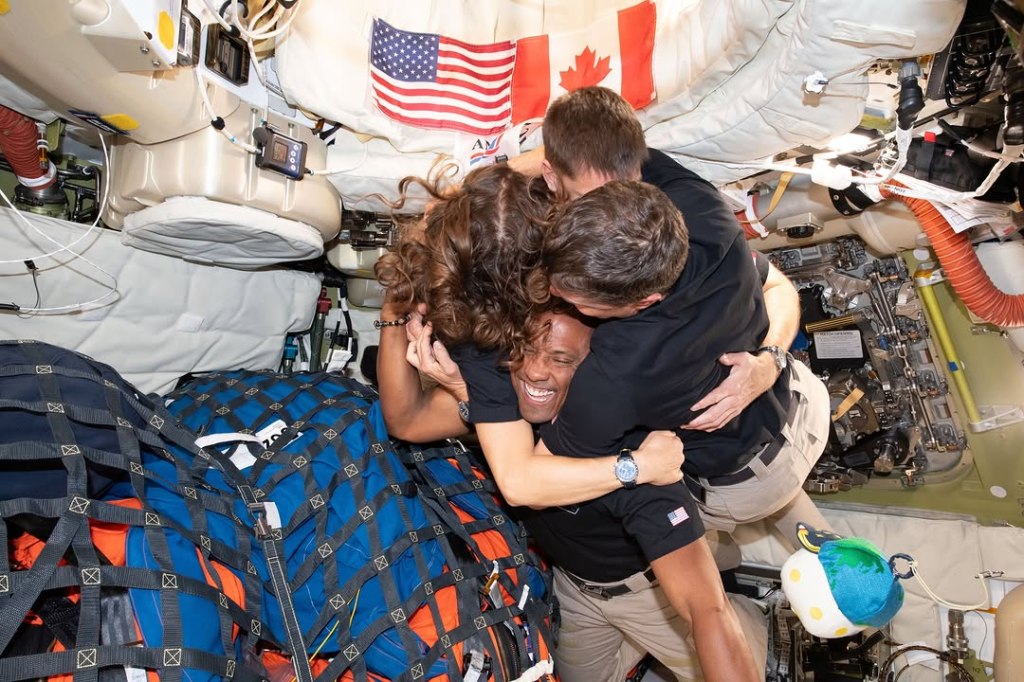
The Artemis II crew share a group hug on their way home after a lunar flyby where they captured updated moon photos. Photo courtesy of @scientific_american/Instagram




 The USD Vista
Leave a comment