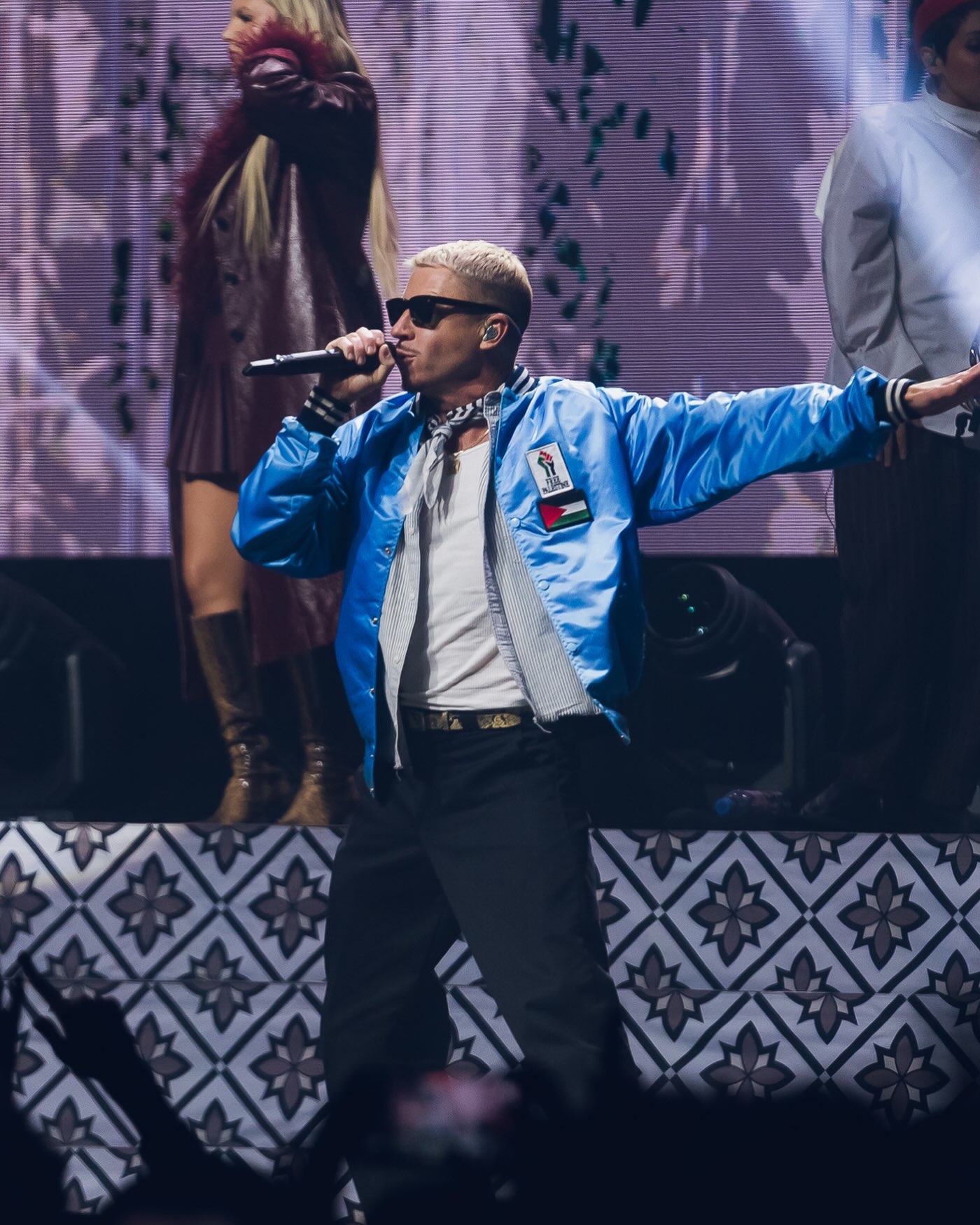
Excited fans packed into MetLife Stadium in East Rutherford, New Jersey on Sept. 4, eager to watch the artists they knew were about to take the stage. The U.S. leg of Ed Sheeran’s Loop tour was nearing its end, but not before American rapper Macklemore could join as his opener to close out the last stretch of shows. The Seattle-born artist took to the stage to perform his hit songs such as “Thrift Shop” and “Can’t Hold Us,” and to deliver a message to the fans in the audience.
Before wrapping up his set, the artist called for an end to the war in Gaza, expressing his support for the Palestinians in the West Bank.

“A big part of the reason why I wanted to do this tour in the first place is so that I could stand up in stadiums like this and say two words that are very, very dear to my heart: Free Palestine,” Macklemore said.
The artist then played “Hind’s Hail,” a song named for a young Palestinian girl killed by Israeli troops in Gaza in 2024, while video footage from the war played on the big screen. Divided opinions circled the rapper, some praising him for his advocacy, others calling for his removal from the tour. Twelve days later, concert venue owners for the remaining tour dates, led by Gillette Stadium owner Robert Kraft, gave Sheeran’s team an ultimatum — cut Macklemore from the lineup, or cancel the shows.
On Sept. 14, Messina Tour Group released a statement to Rolling Stone.
“As the concert promoter for Ed Sheeran’s U.S. Loop Tour, we have been notified by venues on the upcoming U.S. tour dates that they will not allow a concert to take place with Macklemore on the lineup, which would result in the cancellation of the tour and impact hundreds of thousands of fans,” Messina Tour Group wrote. “After discussions with stakeholders, Macklemore will not be performing on the remaining support dates.”
USD senior Rowan Daugherty has been a fan of both artists for many years. She shared her thoughts on activism among celebrities.
“I do think that celebrities have some sort of duty in a way [to be activists] … especially because a lot of people look up to them,” Daugherty shared.
About two weeks after being kicked off of the Loop Tour, Macklemore took to Instagram to announce his own Free Palestine Tour, a 3-stop tour hitting Dublin, Paris and London, whose proceeds would go to 12 organizations that support the movement, including Gaza Soup Kitchen, HEAL Palestine, Jewish Voice for Peace and Palestine Children’s Relief Fund, among others.
“What happened to me is bigger than one artist or one stage,” Macklemore wrote in his statement. “So, as you all know, my schedule freed up a bit. I’ve spent the last week reaching out to artists who have shown up and used their stages to stand in solidarity with the Palestinian people, regardless of the consequences. Artists who understand that our platforms mean very little if we’re only willing to use them when it’s safe.”
The tour kicked off with a sold out show in Dublin at the 3Arena on Monday, Oct. 26. Actors Mark Ruffalo and Cynthia Nixon, as well as The Strokes frontman Julian Casablancas and Irish singer Hozier joined Macklemore onstage for cameo appearances.
“I’m so proud of my country and the way they’re showing up and collectively witnessing Palestinian humanity and showing solidarity from here,” Hozier shared on stage.
“I’m so proud to say that we have a wonderful history of global solidarity when it comes to issues of emancipation and justice.”
The Free Palestine Tour’s second stop in Paris was also sold out, with the final show set for London’s Ovo Arena Wembley.
Despite the tour’s commercial success, it has continued to be clouded by controversy. In the lead-up to the London stop, over 50 members of the British House of Lords called for Macklemore to be barred from the country over his remark, arguing that his presence was harmful to public good.
Internet personality Dave Portnoy also took to social media backing Robert Kraft in his push to ban the rapper from the remaining U.S. tour dates. Social media commentary on the artist’s actions continue to grow increasingly divided, raising the question of the role of celebrities in speaking up for social issues.
USD sophomore Isabella Fonseca spoke about celebrities using their platform for advocacy.
“The people that agree with what they’re saying are going to like them even more, but people who don’t agree with what they’re saying might stop being their fans,” Fonseca said. “You have to approach it really carefully. I also don’t think that anyone should be slandered for not expressing or vocalizing their opinions.”
The success of the Free Palestine Tour follows a larger trend of increasing celebrity activism with action behind it. This past August, singer Olivia Rodrigo’s Daisy Chain Fields Music Festival raised $20 million for various charities and allowed fans to engage with the nonprofits directly, giving attendees the ability to learn more about the work they’re doing. This new form of celebrity activism moves beyond merely posting on social media, and it has opened up new conversations about whether art and politics should be linked.
Daugherty shared her thoughts on the intersection between activism and art.
“In a way, I wouldn’t even say there is a fine line between advocacy and art because advocacy can be art,” Daugherty shared. “Going back to Macklemore, most of his music is advocacy … he has a song called ‘Wings’ … I like that the song is about Nike [shoes], but it’s not [just] about the shoes, it’s about socioeconomic status and growing up in a materialistic world. That is art, but it is [also] advocacy.”
USD senior and history major Ivy Méndez discussed how art and politics are linked.
“No art is apolitical,” Méndez stated. “No matter whether you intended to make a political statement or not, you do have [a stance].”
The Free Palestine Tour made its final stop in London’s OVO Arena Wembley Friday, Oct. 30. The show featured artists such as Aja Monet and Nemahsis, as well Swedish activist Greta Thumberg who made an appearance as one of the show’s guest speakers.
While the official amount of money raised has not been disclosed yet, the tour ended with three sold-out arena shows. Macklemore also pledged his $1 million earnings from the Loop Tour to support six relief organizations, a vow he challenged Robert Kraft to match. Kraft acknowledged the request in a on X.
“Earlier today, before Macklemore challenged me to match his donation, Ed called me and asked me to commit $2 million to match his donation to aid in the region to fight this humanitarian crisis,” Kraft wrote on Sept. 16.
Kraft has not confirmed if he will match either donation.
Despite the controversy, fans from all over filled the venue in Europe, packing the arenas with thousands of excited music lovers for a night of community, joy and art from performers they loved.


Join the conversation