Last month, USD senior Evelyn Yandle received a phone call from the National Marrow Donor Program (NMDP), informing her that she matched with a 78-year-old patient with leukemia in need of stem cells. After going through health screenings and blood tests, Yandle’s results were sent to the patient’s healthcare team. She is currently waiting on final testing to determine if she is a match.
“It was pretty cool,” Yandle explained. “I joined and a few months later I was a match for someone.”
Before becoming co-president, USD senior Sam Azelby was giving blood when she spotted an NMDP table on campus.
“I tried to give blood that day, and NMDP was tabling, I thought it was such an amazing cause just because cancer is very prevalent in my family history,” Azelby shared.
“It has affected me personally. At the time my cousin had just gotten diagnosed with leukemia and that’s when I wanted to start the club.”
After seeing the table, Azelby decided to start the club with help from Yandle.
“I saw Sam tabling for the Alcalá Bazaar and I got really inspired because I want to go into the health field,” Azelby said. “I am applying to medical school. I feel like that aligns directly with helping save lives and just expanding outreach too.”
This fall, Yandle and Azelby worked together to establish a chapter of NMDP on campus.
NMDP is a nonprofit organization that matches donors with patients in need of bone marrow or blood stem cell transplants. NMDP uses a donor registry to pair patients with donors who are genetic matches. Once matched, donors either donate blood stem cells or bone marrow to patients in need.
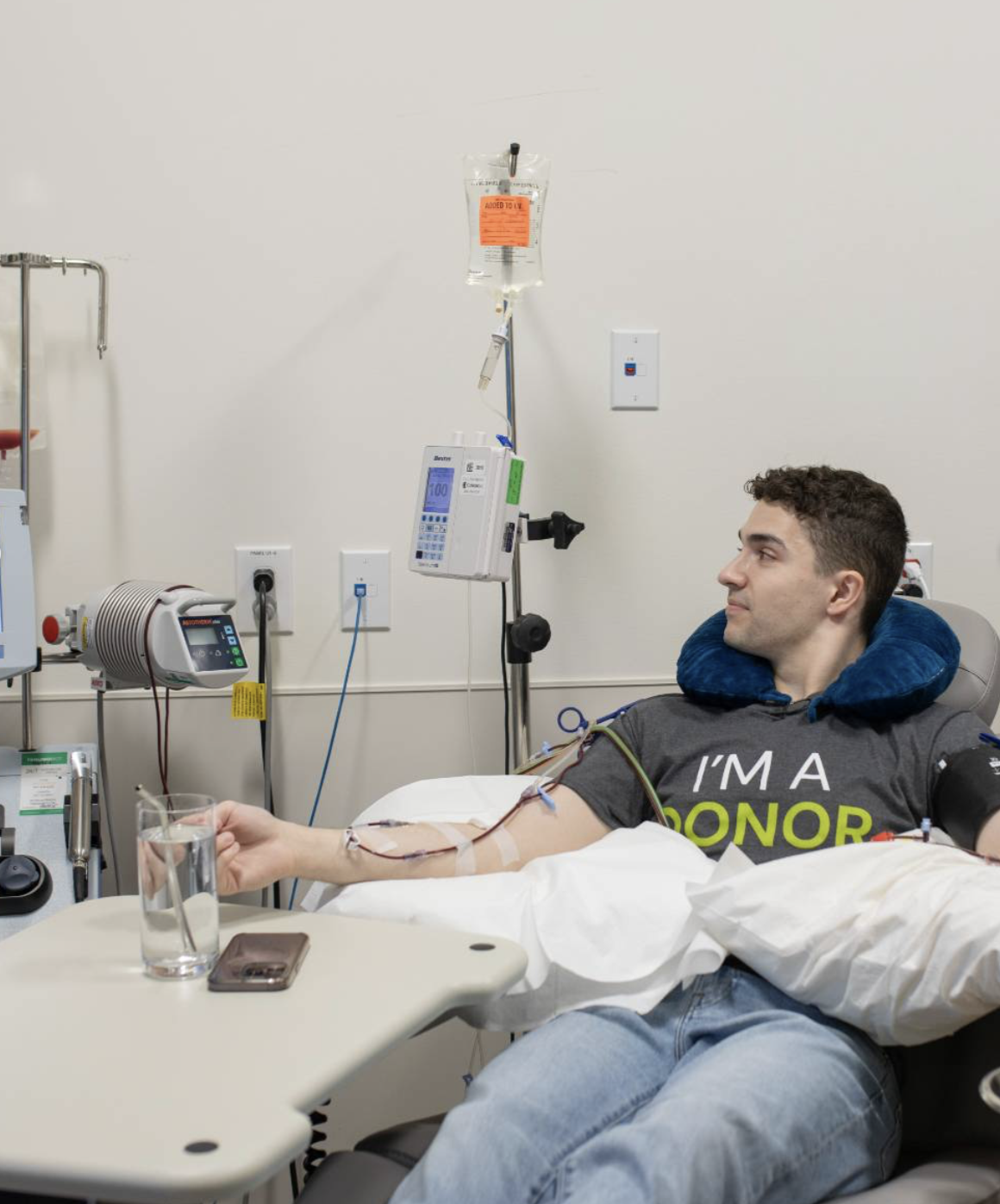
Blood stem cell donations, which are done through a process similar to donating plasma or blood through an IV, make up 90% of donations completed through NMPD.
The other 10% of donations are bone marrow donations, which require a surgical procedure under anesthesia and are paid for by NMDP.
On Nov. 3, the pair hosted the first-ever NMDP meeting on campus. The meeting explained how NMDP finds genetic matches for patients and the importance of the nonprofit itself. At the end of the meeting, students were given the option to join the NMDP registry by doing a cheek swab. The swabs were sent to NMDP for processing at a laboratory.
Over the summer, the American Red Cross declared its second-ever national blood crisis due to low donation numbers across the country, with the national blood supply falling nearly 25% in June.
While this shortage continues to affect hospitals nationwide, NMDP faces a different issue.
Rather than focusing on blood types, NMDP uses human leukocyte antigens (HLA) matching that pairs specific proteins found on the cells of patients with donors who share the same HLA markers. During HLA matching, doctors look at up to 12 different markers on a patient’s DNA, making a match difficult to find because there are millions of possible combinations. In order to find a match, doctors want patients and donors to share at least eight to ten of the same HLA markers.
Joyce Valdez oversees college chapters of NMDP, including USD’s. NMDP currently uses a registry consisting of 44 million worldwide potential donors. Out of those donors, finding a match for certain patients remains difficult.
“That’s where we have such a shortage,” Valdez noted.
According to Yandle and Azelby, over the past year, 300 students have joined the NMDP registry. USD first-year Kylie Anderson explained why she joined the club at USD.
“At the HOSA International Leadership Conference, I witnessed a donor meet their recipient for the very first time. Seeing that real, life-saving impact made a huge impression on me,” Anderson said.
USD sophomore and neuroscience major Kiki Mellos shared her opinion on the club’s mission.
“I think a club like this is really important,” Mellos commented. “It helps connect people who need potentially life-saving treatments with donors, while also giving people more resources and information about the donation process.” The recently established USD chapter of NMDP pairs donors with patients who need blood stem cell or bone marrow transplants. The worldwide registry can match patients in need with donors from anywhere, including the USD campus.


Join the conversation