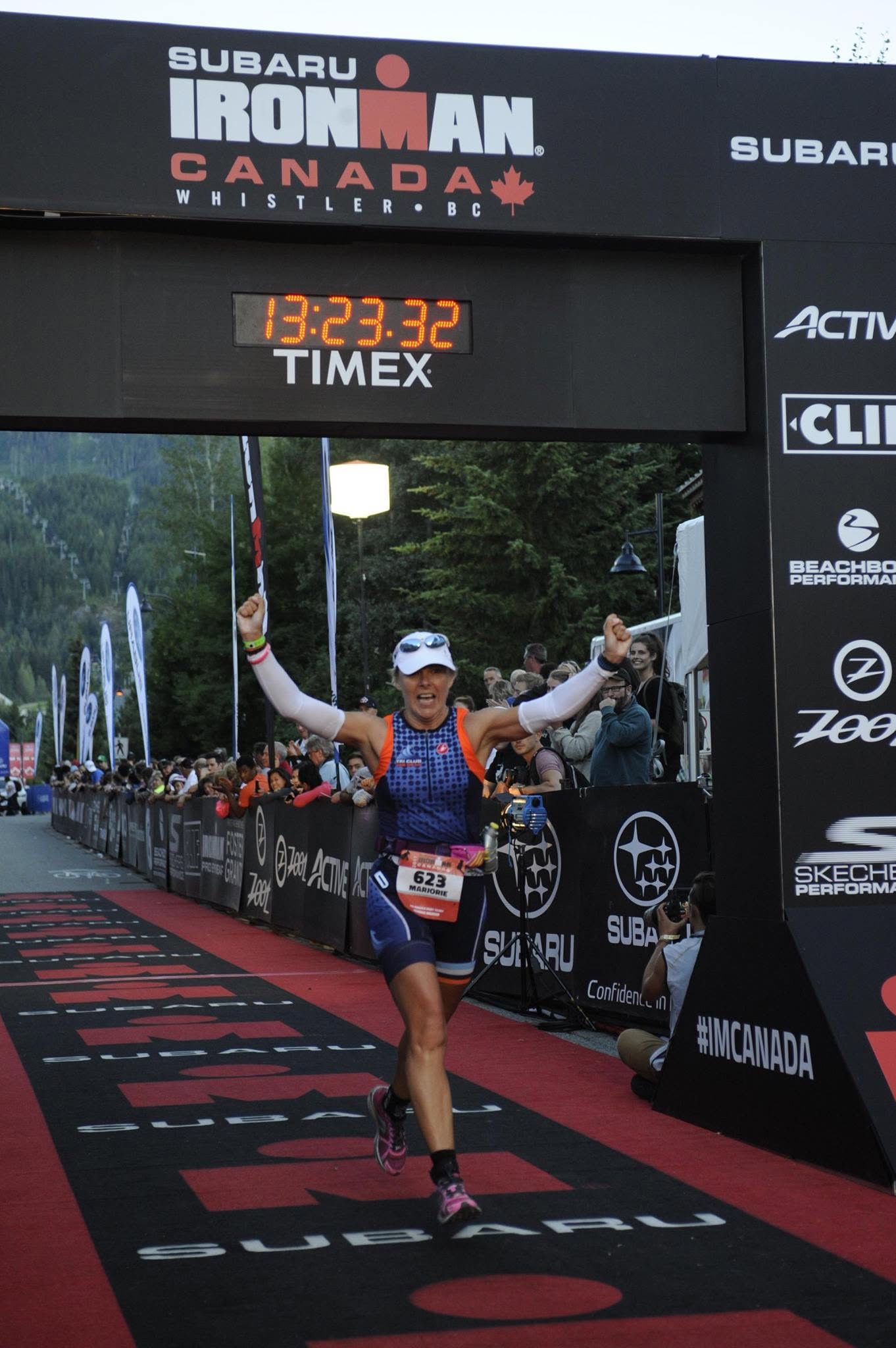
As a professor in the biology department at USD, Marjorie Patrick balances her long workdays teaching lectures with weekends that lead her down mile-long trails of running, biking and swimming throughout San Diego.
She has a doctorate in biological sciences and is teaching two courses this semester, a lower-division bioenergetics and systems class and an upper-division sports physiology class.
Alongside that, she has her own research lab in comparative animal physiology. Outside of the Torero community, she races in triathlons and marathons, traveling across the world and qualifying for a multitude of competitions.
Patrick, who ran cross-country in high school, relaunched her running career almost two decades ago.
“Maybe it was my midlife crisis,” Patrick said. “I had just gotten tenure at USD as a professor, and I had a five-year-old son, and I was like, ‘What else can I do?’”
Marathons were her answer.
For the past 17 years, Patrick has been training and competing in global races and has finished 23 marathons, some of the most competitive and sought-after races in the running community, including the Boston Marathon.
First-year Ellie Whittmann has been running for the past five years, including on her high school cross-country team and through the run club on campus.
“It’s really impressive, running marathons,” Whittmann commented. “As a runner myself, I could never imagine running for that long.”
The Boston Marathon — the oldest consecutively held marathon in the world — has strict qualifying standards based a the runner’s age, gender and race time.
According to RUN, only about 13% of experienced runners expect to qualify in their career. Patrick has qualified for the race five times.
“It’s paid off,” Patrick said. “I’ve been on the podium one time and got to world champs. It’s just something I enjoy.”
Patrick still experiences nerves and uncertainty during races.
“I always tell people I have a chicken in my head,” Patrick described. “‘Slow down, you can stop if you want. So it’s fighting that chicken. There’s been races where I beat that chicken, but there’s been races when the chicken has won.”
After her 23-marathon-long streak, Patrick found herself signing up for triathlons, including the well-known Ironman. Ironmans come in half and full distances, with Ironmans 70.3 (or a half-triathlon) consisting of a 1.2-mile swim, 56-mile bike ride and 13.1-mile run. Full Ironmans double each of those distances.
The full Ironman championships take place in Kona, Hawaii, and the Ironman 70.3 championship location changes annually. It was held in St. George, Utah, the year Patrick qualified.

First-year Anna Brice has been running since the third grade.
“I do distance running,” Brice said. “I ran a half-marathon over the summer. It’s definitely a goal of mine to run a marathon some time.”
Patrick created her own upper division class in the biology department. In her class, students choose a sport and spend the semester learning how different physiological systems integrate. Enrollment consists of a variety of students, from student-athletes to engineers to pre-med students.
Mark Chapman, a professor in integrated engineering with a doctorate in bioengineering, collaborated with Patrick to bring the class abroad. In summer 2024, the Karolinska Institute in Stockholm, Sweden, housed the class for the summer, where integrated sports physiology was taught to the study abroad students.
“To be able to teach a class that’s based in your passion, the students sense the enthusiasm that you have for it,” Patrick said. “That gets the students enthusiastic about it too. So, it’s a fantastic class to teach.”
Patrick and Chapman plan to bring the course to Sweden once more in summer 2028. Patrick has no plans to halt her triathlon and marathon endeavors.
“You got to find something that gets you outside doing something . . . what’s really important is the community,” Patrick commented. “A lot of my close friends now, I’ve known because of marathoning or doing triathlons.”
On Nov. 15, at Fiesta Island — the birthplace of the triathlon in 1974 — Patrick got back onto her bike and raced the San Diego Bicycle Club time trial, representing the San Diego Triathlon Club. She hoped to beat her past time of 1:14:34.2, a second place finish earlier this fall.


Join the conversation