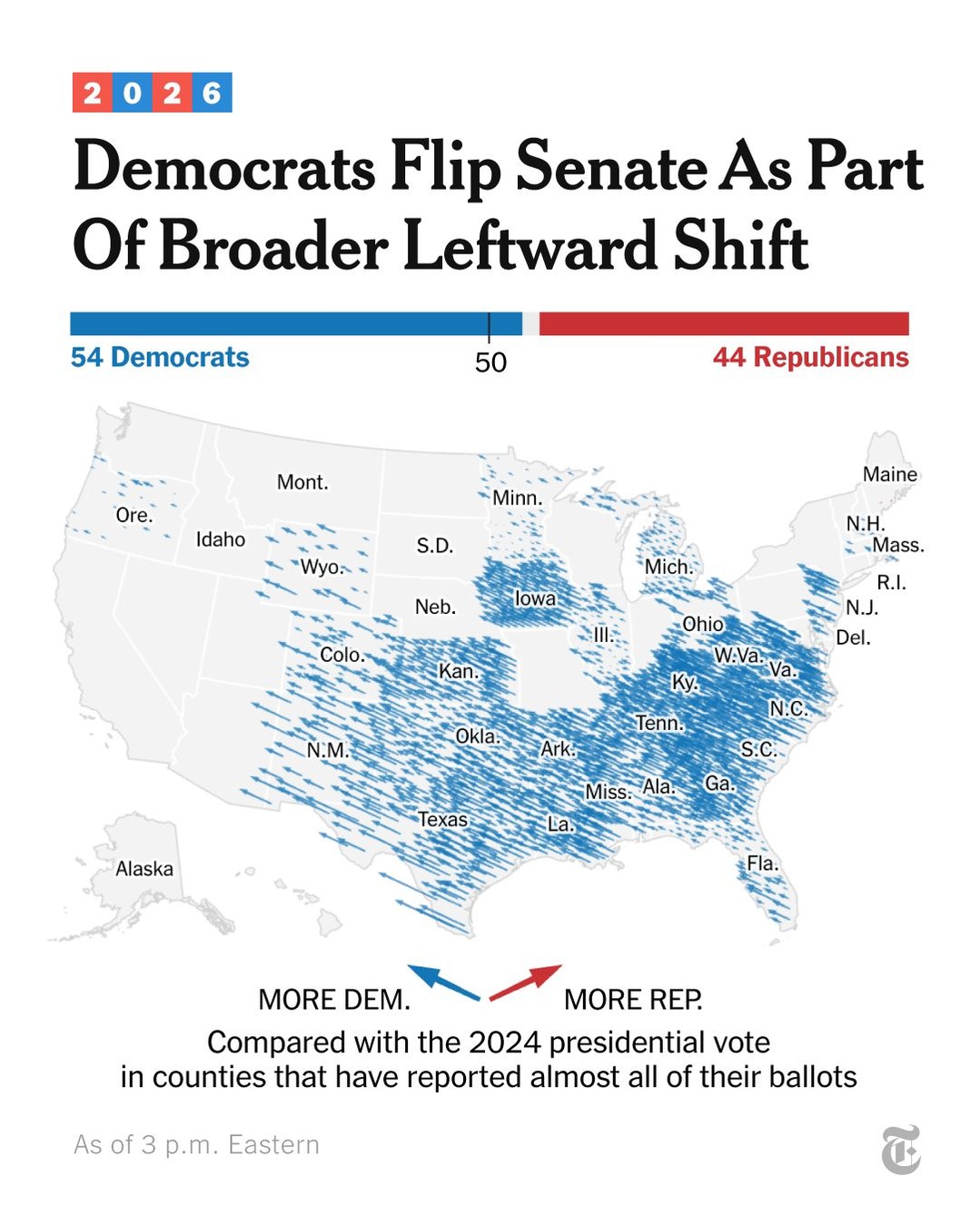
On Nov. 3, Americans witnessed what many have called a “blue wave” or even a “blue tsunami” in the midterm elections. Across multiple races, Democrats made sweeping, and to some extent, unexpected gains.
Many traditionally Republican states, including Iowa, Kansas and Texas saw previously Republican held congressional seats flip to Democratic candidates.
This is a common phenomenon in midterm elections, and is often indicative of Americans’ views toward the current presidential administration. But it does not necessarily mean that the country is headed in a more progressive direction.
USD professor Evan Crawford, has a doctorate in political science and teaches upper and lower division classes on American politics. Crawford explained that it is typical for the president’s party to loose seats during midterms, often due to general dissatisfaction with the administration’s policies.
“We would expect [Republicans] to lose seats,” Crawford said. “The expectation was that Democrats would win the House, and win the Senate, but what was maybe unexpected was the magnitude.”
The scale of the Democratic party’s gains in the midterms goes further than a response to poor economic conditions — which historically, have contributed to major losses in a president’s party — or the simple fact that the Trump administration is deeply unpopular. Ultimately, the blue wave was a combination of factors that political scientists cannot yet fully explain.
However, these substantial gains made by the Democratic Party do not mean that there has been an ideological shift among voters. In fact, a somewhat contrary trend emerged in the decisions made on ballot measures.
Voters in newly flipped or traditionally Democratic states seem to have favored Democratic candidates for political representation. However, their decisions on certain ballot measures reflected more conservative positions, particularly in terms of social issues.
Crawford explained that historically, results like these aren’t that surprising.
“If you look at prior elections, we have a long history, state by state, where blue states will simultaneously vote for Democratic candidates and then either vote down what would be considered a liberal measure or vote in what would be considered a conservative measure,” Crawford said. “Voters are fickle this way, but it’s normal actually.”
One of the most glaring contradictions was demonstrated in several states where voters were presented with ballot measures concerning transgender participation in school sports. Arizona flipped blue in the midterms, but its Proposition 318, entitled “Require All Schools and Athletic Associations to Restrict Sports Participation and Access to Private Spaces Based on Sex” was approved by voters. Similarly, in Washington, a traditionally democratic state, Initiative 638 entitled “Sex Verification Requirements for Female School Sports” was voted in. Both of these measures define athletic eligibility based on biological sex rather than gender identity.
Lucia Laniecki, a USD junior majoring in political science, explained some of the factors she thinks might have played a role in more conservative measures being voted in.
“I think it’s maybe a result of two things,” Laniecki said. “It’s largely a result of the majority of the population still being pretty moderate … Secondly, an indication of this rhetoric that this administration has been pushing. There’s been so much fearmongering surrounding trans athletes in sports, when the numbers of actual trans-athletes is minuscule, this is not an issue that, in reality, is as detrimental as the administration is pushing.”
Beyond historical trends, the current administration’s rhetoric is perhaps the reason we see contradicting behavior from voters, and why this behavior seems antithetical to the “blue wave” label this election has been given. “I think it does go to show that even though there was this pushback from the general population, the rhetoric and the words that this administration is putting out there, they do really have an impact,” Laniecki said. “It also means a lot coming from the highest office in the country, so it’s disappointing and somewhat scary to know that it has such an impact.”
These trends comment on the longevity of democratic gains. If voters supported Democratic candidates primarily to express opposition toward the current administration — rather than out of a broader ideological shift — it becomes more difficult to say whether this support will carry over into the 2028 presidential election, especially if voters remain influenced by the rhetoric employed by the administration and Republican party more broadly.
Angela Gomez, a USD junior majoring in international relations, believes these trends might impact the kind of movement we see in the legislative branch over the next two years.
“I don’t think we’re going to see as much progress as people think,” Gomez said. “But I hope that for the presidential election, people stay consistent in their votes. Progress can only be made through consistency.”
Ultimately, the results from the midterm election have demonstrated that party affiliation and voter turnout alone are not enough to indicate a shift toward more progressive ideology among voters.
As the country moves forward and into the 2028 election cycle, it’s important that voters keep this in mind as we wait to see whether the blue wave may indicate a temporary reaction to the current administration or a broader shift in terms of progressive ideology.


Join the conversation